Part 1: System cardDel 1: Systemkort
1. Core Function
High-capacity anchor handling and towing winches—rated up to 600 tonnes first-layer pull and 950 tonnes static brake holding on heavy Anchor Handling Tug Supply (AHTS) vessels—deploy, recover, and tension offshore rig mooring chains, wire pennants, deep-water synthetic lines, and towlines1. Working in concert with aft-deck stern rollers, hydraulic shark jaws, and towing pins, multi-drum main winches, shaft-mounted cable lifters, and storage reels manage extreme dynamic sea loads through stepless torque control, dynamic payout braking, active tension limiting, and fail-safe emergency release1.
2. Primary Operational Tasks
- Anchor Breakout and Heavy Heaving: Generate up to 500–600 tonnes of first-layer pull to break free dragged or fouled rig anchors and recover mooring spreads alongside hydraulic shark jaws and towing pins1.
- Deep-Water Wire and Rope Spooling: Deploy and retrieve multi-thousand-meter steel work wires and high-modulus synthetic ropes onto main, secondary, and below-deck storage drums under active level-wind spooling and back-tension1.
- Long-Distance Rig and Vessel Towing: Sustain continuous towing loads on upper or declutchable drums under automated constant-tension/auto-towing control and dynamic braking1.
- Rig Chain Handling and Locker Transfer: Engage shaft-mounted cable lifters (gypsies) and below-deck chain-pulling wheels to haul, pay out, and stow 70–162 mm offshore rig chain into vessel lockers1.
- Emergency Load Release: Execute rapid, controlled full-load line release under normal power or dead-ship blackout to prevent capsizing, girting, or structural overload5.
3. System Interconnections
Inputs: Dedicated hydraulic power units (HPUs) or AC variable frequency drive (VFD) inverters supply prime motive power14 (explicit main switchboard feeder breaker schematics are not detailed in available technical manuals). Water-cooling circuits dissipate heat from dynamic disc drag brakes and heavy electric winch motors19, though specific seawater-versus-freshwater heat-exchanger loop designs and hydraulic oil-cooler flow ratings are absent from reviewed equipment specifications. Dedicated hydraulic accumulators or backup electrical reserves supply dead-ship emergency release energy12. Aft-bridge hold-to-run control levers, hard-wired emergency release switches, strain-gauge load pins, and line-speed/length sensors provide operator commands and feedback (exact shaft-encoder hardware specs are omitted from reviewed manuals)1.
Outputs: Controlled mechanical torque produces variable-speed hoisting, high-capacity dynamic payout braking, or low-drag free-wheel release at drums and gypsies1. Real-time line tension, speed, and paid-out length readouts stream to the aft-bridge main control station and integrated vessel towing systems such as TOWCON RT1 (explicit Dynamic Positioning thruster feed-forward telemetry protocols are not documented in available sources). Automated recorders log load time-series—capturing all events above 200 kg on instrumented winches26—while bridge panels raise audible and visual alarms for programmable overload limits, chain-stopper actuation, electrical busbar faults, and emergency-release hydraulic/pneumatic pressure drops5 (dedicated brake or oil thermal alarm setpoints are not specified in reviewed manuals).
4. Redundancy and Criticality
Under SOLAS Regulation II-1/3-8 and IMO MSC.1/Circ.1175/Rev.1 (December 2020), shipboard towing and mooring arrangement plans and supporting hull foundations are regulated against design towing loads29, while class rules and industry practice link winch sizing to bollard pull and rope Minimum Breaking Load (MBL)—with operational guides recommending brake slip settings near 60% of wire MBL to render safely under shock surges12, whereas Lloyd's Register rules set minimum brake slipping at 80% of nominal line breaking strength when chain stoppers are fitted33. Effective 1 January 2026, SOLAS Regulation II-1/3-13 (Resolution MSC.532(107)) and mandatory IMO MSC.1/Circ.1662 require new anchor handling winches—and existing winches by their first renewal survey on or after that date—to incorporate tension limiting, continuous load monitoring, remote spooling, and dead-ship emergency release on both winches and chain stoppers, backed by commissioning overload tests (110% of Maximum Line Pull and Brake Holding Capacity under updated Lloyd's Register rules)5. Although IACS UR M79 (Rev.1) formally governs close-quarters port and terminal towing winches rather than open-ocean AHTS-only duties13, its benchmarks—release within 3 seconds at 100% design load, controlled anti-spin drag, and blackout energy for at least three release cycles or 5 minutes of continuous release—inform dual-role towing drum engineering12. Machinery redundancy relies on dual drive motors with pressure-equalizing valves, single-drive half-speed fallback, cross-feed from tugger pump units to retain full pull at reduced speed, and fail-safe Spring-Applied Hydraulically-Released (SAHR) brakes that lock automatically upon power loss14.
Part 2: Technical deep diveDel 2: Teknisk dybdeanalyse
1. Multi-Drum Waterfall vs. Side-by-Side Winch Architecture
Heavy AHTS winches are built in waterfall or side-by-side (in-line) multi-drum configurations spanning 100–600 tonnes of first-layer pull across single, double, or triple drums6, alongside rarer four-drum reverse-waterfall designs noted in maritime operational commentary10. In a standard double-drum waterfall arrangement, one drum is mounted vertically above and slightly aft of the other4. The elevated upper drum typically handles long-distance towing, benefiting from clearer aft-bridge sightlines and straighter leads over the lower drum4, while the lower drum acts as the primary anchor-handling work drum aligned closer to the stern roller1. Large deep-water vessels combine multiple dedicated drums, exemplified by the Rolls-Royce Brattvaag 2BSL600W/SL500W package aboard AHTS Aurora Sandefjord, which pairs two 600-tonne main waterfall drums with a 500-tonne declutchable special handling/towing drum holding 14,800 m of 76 mm wire1.
Architectural Subsystem | Typical Role on AHTS | Representative Dimensions and Capacities | Spooling and Mechanical Constraints |
|---|---|---|---|
Main Waterfall Winch (2 Drums) | Upper drum: ocean towing / work; Lower drum: anchor breakout and chain work4 | Pull: 150–600 t; Brake: up to 950 t (1st layer); Drum ø 2.0 m × 4.6 m flange × 2.5 m length; 6,200 m of 76 mm wire1 | Minimizes deck footprint4; raises local equipment VCG41; improved upper-drum fleet angle4 |
Special Handling / Towing Drum | Declutchable deep-water towage or primary mooring deployment1 | Pull: 500 t; Brake: 600 t; Drum ø 3.5 m × 5.4 m flange × 6.5 m length; 14,800 m of 76 mm wire or 2,180 m of 203 mm fibre rope1 | 1,100 mm socket compartment isolates termination; spooling gear rated to 23 t side load1 |
Side-by-Side (In-Line) Winch | Dual independent anchor handling / towing on lower vertical profile24 | Double or triple drums; 100–500 t pull, up to 670 t brake24 | Lower VCG than waterfall; wider athwartships width increases lateral offset from centerline4 |
Secondary Winches | Deep-water pennant storage, wire deployment, auxiliary hoisting1 | 2 × 170 t pull (210 t band brake); 28,600 m of 48 mm wire or 1,600 m of 203 mm fibre rope1 | 1,100 mm port socket compartment; active spooling gear rated to 60 t side load1 |
Below-Deck Storage Reels | Protected storage of spare tow wire and synthetic deep-water lines1 | Spare wire reel: 1,800 m of 90 mm wire; ODIM fibre reels: 1,000–2,500 m of 151–245 mm rope at 225 kN inner pull1 | Twin 900 mm socket compartments per fibre reel; frees main deck and shields synthetics from deck abrasion1 |
Shaft-Mounted Cable Lifters (Gypsies) | Direct hauling and payout of offshore rig mooring chain1 | Main winch pockets: 76 mm fitted with 84 mm and 120 mm spares; dedicated chain-pulling wheels adjustable 70–162 mm1 | Coupled directly to work-drum shaft—work drum cannot handle work wire while gypsy handles chain3 |
Selecting waterfall versus side-by-side geometry trades deck footprint against vessel Vertical Center of Gravity (VCG) and fleet angle. Stacking drums vertically preserves main working deck space on AHTS vessels that carry large aft deck cargos (e.g., 810 m² cargo decks42)4. However, parametric weight modeling in SAWE Paper 3562 (spanning 66–110 m AHTS hulls) shows how sensitive stability is to raised deck machinery: on a 3,500-tonne lightship vessel at 8.5 m VCG, a 30 cm miscalculation in local winch VCG shifts total ship VCG by 5 cm, contributing to a 10 cm cumulative VCG error when combined with mass estimation uncertainty41. Side-by-side drums keep mass lower to the main deck but occupy greater beamwise space and sit farther off the stern centerline.
Drum width and lead distance govern the fleet angle ( ) between the departing wire and a line perpendicular to the drum axis at the lead sheave or stern fairlead8:
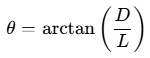
where  is lateral offset from the lead centerline and
 is the horizontal distance to the lead point8. Wire-rope supplier guidelines citing Wire Rope Technical Board and ASME B30 limits restrict fleet angle to 1.5°–2° (0.5°–2° in crane-rope guides) on smooth drums and 4°–6° on Lebus-grooved drums8. Any nonzero angle generates a lateral crushing component against the drum flange or adjacent rope wraps8:

Even at 5°, sin(5°) ≈ 0.087, converting nearly 9% of working line tension into lateral side-crushing force8. Because AHTS drums sit close to stern centering guides, IMO MSC.1/Circ.1662 (Section 3.1.6) mandates remotely operated active spooling (level-wind) gears on anchor handling winches5. Driven by low-pressure hydraulic motors via proportional control valves (such as the E2B spooling valve noted in Rolls-Royce installation manuals)45, traversing guides maintain near-zero effective fleet angle8 while withstanding side loads up to 62 tonnes on main drums and 60 tonnes on secondary drums1. Mechanical comparisons between diamond-screw carriages and closed-loop electronic servo-synchronized level-winds are not detailed in the reviewed OEM documentation.
For mooring chain operations, cable lifters (gypsies) are mounted outboard on the main work-drum shaft—such as 76 mm pockets fitted alongside interchangeable 84 mm and 120 mm spare assemblies swapped via cable-lifter changers1. Because gypsies couple directly to the work-drum shaft via jaw/claw clutches, the work drum cannot independently handle work wire while running chain on the gypsy3. Dedicated below-deck chain-pulling winches (e.g., RRM Brattvaag AKMX4185, adjustable from 70–162 mm, covering the 76–152 mm offshore rig chain range) transfer chain through detachable chutes into four to six below-deck lockers totaling 940–1,000 m³1. Aft deck handling relies on hydraulically retractable shark jaws (300–800 t working load with 50–166 mm inserts), centering devices (±1,000 mm lateral sweep), towing pins with wirelock top plates (60 t pull-down), and pop-up stop pins (200 t SWL)1.
2. Drive Systems (Low-Pressure Hydraulic, High-Pressure Hydraulic & Electric VFD)
AHTS main winches employ Low-Pressure Hydraulic (LPH), High-Pressure Hydraulic (HPH), or Electric Variable Frequency Drive (VFD) powertrains7. Historically, heavy Norwegian AHTS tonnage has favored LPH systems—typified by Rauma/Ulstein Brattvaag (now Kongsberg Maritime) plants—feeding large-displacement multi-chamber hydraulic motors (e.g., MC 22 SBR / MG22SBR) from centralized HPU pump banks14. HPH systems operate at 220–250 bar using compact axial-piston (Rexroth A2FE/A6VE) or radial-piston (Hägglunds, Staffa, Bauer, Poclain) motors coupled to planetary or open spur-pinion reduction gearing27. Electric VFD winches pair AC motors with active inverters (such as NOV Loadlim™ anchor-handling packages, MacGregor VFD winches, and Tuf Marine anchor winches)6. Nominal LPH bar pressures and independent, peer-reviewed lifecycle efficiency or reliability benchmarks comparing LPH, HPH, and VFD plants on comparable hulls are not available in the reviewed documentation.
Engineering Metric | Low-Pressure Hydraulic (LPH) | High-Pressure Hydraulic (HPH) | Electric VFD |
|---|---|---|---|
Operating Pressure / Supply | Large-flow centralized HPU pump ring (exact bar rating not published in reviewed manuals)14 | 220–250 bar hydraulic circuit; variable/fixed piston motors27 | Vessel AC bus via bi-directional/regenerative VFD inverter15 |
Zero-RPM & Torque Stepping | High starting torque at 0 RPM; stepped chamber engagement (e.g., 600 t / 376 t / 154 t) plus stepless flow speed control1 | High starting torque at 0 RPM; variable displacement (e.g., 25–60 ccm) and proportional valve modulation4 | Electronic soft start/stop eliminates gear-step shock18; active PLC load limiting (Loadlim™)6 (0-RPM thermal holding curves not quantified) |
Deep-Water Payout (2,000+ m) | Non-regenerative: payout energy dissipates entirely as heat in oil and dynamic brakes1 | Non-regenerative: hydraulic throttling and water-cooled drag brakes shed energy as heat19 | Regenerative: Motors generate AC power back into ship consumers or propulsion if power plant is configured16 |
Cooling & Thermal Rejection | Requires hydraulic cooling and dynamic brake cooling sized for multi-megawatt payout22 | Lower fluid volume demands effective cooling capacity during continuous payout19 | Heavy marine motors (e.g., Kongsberg BRE XT140 trawl series) use water-cooled/heated jackets21; smaller tow units may be air-cooled57 |
Redundancy & Environmental Risk | Dual drives with equalizing valves; single-drive half-speed mode; tugger-pump cross-feed preserves pull at low speed14; large fluid inventory57 | Modular multi-motor drives on bull gear; pressurized hose/pipe burst and oil-spill exposure37 | Eliminates hydraulic fluid and oil-leak fire/spill hazards on deck57; quieter operation21; depends on inverter and cooling supply |
During deep-water anchor handling payouts (2,000+ m), hydraulic and electric winches behave fundamentally differently. Vendor engineering literature notes that hydraulic motors excel at high starting torque and sustained low-speed load holding without electric motor overheating37, and multi-unit LPH designs provide remarkable hydraulic fault tolerance: in the Brattvaag SL350W/BSL350W manual, isolating one drive unit retains single-drive operation at roughly half speed, while failure of four main pump units allows tugger winch pumps to sustain full rated pull across all drive modes at reduced line speed14. However, offshore engineering commentary confirms that regenerative braking is not feasible in conventional hydraulic winches54. Paying out heavy catenaries converts gravitational potential energy continuously into mechanical power ( ) that must be rejected as heat19:

Within representative mid-range payout envelopes of the Aurora Sandefjord winch (whose dynamic brakes handle up to 625–816 t at 62–72 m/min on Layer 1 and 367–398 t at 102–127 m/min on full drum)1, paying out 150 tonnes at 60 m/min (1.00 m/s) dissipates 1,471 kW (1.47 MW); 250 tonnes at 60 m/min dissipates 2,452 kW (2.45 MW); and 400 tonnes at 50 m/min (0.83 m/s) dissipates 3,269 kW (3.27 MW) continuously as heat56. Hydraulic plants rely on oil cooling circuits and water-cooled dynamic drag brakes to prevent fluid overheating and brake fade19.
Electric VFD winches recover this descending energy. As documented in academic marine-cybernetics research and maritime technical reporting, bi-directional VFD inverters allow drive motors to operate as generators during payout, feeding regenerated electrical power back to the ship's consumers or propulsion thrusters when the vessel power system is engineered for reverse power flow16 (specific resistive dump-bank sizing is not detailed in available manuals). Active electric drives such as NOV's Loadlim™ also enforce PLC-selectable tension limits per rope size, decoupling drivetrain rotational inertia from wave-induced line spikes during continuous maximum-load dynamic braking6. Eliminating high-pressure deck hydraulics removes oil-spill risks57 and cuts acoustic noise21. While smaller subsea winches advertised by vendors can operate air-cooled57, heavy high-torque offshore motors—illustrated by Kongsberg's BRE XT140 water-cooled electric trawl winch motor—require closed water-cooling/heating jackets to manage continuous thermal loads21.
3. Brakes, Clutches & Holding Capacity Physics
IMO MSC.1/Circ.1662 distinguishes Maximum Line Pull (MLP) (sustained powered hauling capacity), Brake Holding Force (structural design load of the brake), and Brake Holding Capacity (BHC) (maximum static line pull held without slipping)5. Across commercial AHTS hardware, static first-layer BHC ranges from 1.20x to 2.00x rated first-layer winch pull—including 950 t BHC on a 600 t Brattvaag main drum (1.58x)1, 750 t on a 600 t MacGregor drum (1.25x)7, 670 t on a 500 t Palfinger drum (1.34x)38, 600 t on a 350 t catalog winch (1.71x)19, and 200 t on a 100 t Damen winch (2.00x)24. Relative to vessel propulsion and wire strength, industry anchor-handling guides specify towline MBL at least 2x static bollard pull, with brake slip calibrated near 60% of wire MBL so the brake renders before parting the line31—corresponding closely to a 1.5x–2.0x bollard-pull holding envelope. Statutory and class thresholds vary by application: DNV Pt.5 Ch.10 Sec. 3.8 specifies an 80% first-layer holding criterion for towing winches61, Lloyd's Register Pt.3 Ch.10 requires ≥80% of nominal line MBL where stoppers are fitted (or 150% of winch pull for passive mooring)33, and Norwegian Regulation No. 998 for mobile offshore units mandates dual independent brakes totaling 120% of anchor-line breaking strength22.
Because motors and brakes generate fixed maximum shaft torque ( ), both powered line pull and static brake holding capacity fall inversely with active spooling pitch diameter:
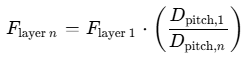
Evaluating the Aurora Sandefjord 2BSL600W/SL500W drum (2.000 m core, 4.600 m flange, 90 mm wire giving first-layer pitch diameter D1 = 2.090 m) demonstrates a 51.3% drop in static holding capacity from inner wrap to full drum1:
Drum Layer State | Implied Pitch Diameter | Step 1 Line Pull | Line Speed (Step 1) | Max Dynamic Braking | Implied Static Brake Holding Capacity | Capacity Loss vs. Layer 1 |
|---|---|---|---|---|---|---|
1st Layer (Inner) | 2.090 m56 | 600 t1 | 0–18.0 m/min1 | 816 t (@ 0–62 m/min)1 | 950.0 t1 | 0% (Baseline) |
Mid-Drum | 3.191 m56 | 393 t1 | 0–28.6 m/min1 | 535 t (@ 0–94.5 m/min)1 | 622.2 t (torque-scaled)56 | -34.5% |
Full Drum (Outer) | 4.295 m56 | 292 t1 | 0–38.4 m/min1 | 398 t (@ 0–127 m/min)1 | 462.3 t56 | -51.3%56 |
Because full-drum holding drops to 462.3 t (950 × 2.090 / 4.295)56, crews must pay out wire onto lower layers prior to locking brakes for maximum breakout or holding loads.
Primary static holding relies on Spring-Applied Hydraulically-Released (SAHR) band brakes clamping directly onto drum brake rings11. As peer-reviewed research in TransNav highlights, spring-loaded band cylinders automatically take up lining wear and linkage elongation, maintaining repeatable holding torque compared with manual screw-spindle brakes that lose capacity as linings thin60. Vendor friction data for marine grades illustrate typical material properties: DNV-GL approved brass-wire woven lining FTL095 achieves static μ = 0.60 and dynamic μ = 0.50 with water and oil resistance, while copper-wire woven towing grades FTL129 and FTL137 yield static μ = 0.45–0.52 and dynamic μ = 0.40–0.42 in dry or damp service64. Secondary SAHR wet multi-disc brakes are fitted for parking and emergency stopping; Damen winch manuals document 250–320 bar maximum casing ratings, 12–26 bar opening pressures, and strict lubrication using mineral hydraulic oil (≤VG 150, SAE 10, or ATF) free of friction-reducing Extreme Pressure (EP) additives62. For sustained high-speed declutched payouts, dedicated water-cooled dynamic disc drag brakes absorb continuous thermal energy7.
Drums and chain gypsies connect to bull gears via sliding dog (jaw) clutches or friction clutches11. Dog clutches lock mechanically via splined sliding sleeves lubricated through external grease nipples11, delivering positive, slip-free torque for heavy low-speed anchor pulls and gypsies37, though they require stationary alignment and firm brake engagement before shifting62. By contrast, pneumatic or hydraulic friction clutches—supplied via shaft-end rotorseals at up to 8 bar clean dry air in Damen configurations, resting disengaged while spring brakes remain set62—enable smooth engagement under motion and reliable emergency declutching under load. Operational safety manuals stress applying brakes before de-energizing motors and ensuring fail-safe automatic braking upon control release to prevent uncontrolled load drop37.
4. Emergency Quick-Release (EQR) Mechanisms & Statutory Standards
AHTS vessels face severe girting (transverse beam-on capsize) or stern flooding if a towed unit loses control, propulsion fails, or a seabed anchor snags under peak sea loads3. Mandatory requirements tightened significantly on 1 January 2026 with the entry into force of SOLAS Regulation II-1/3-13 (MSC.532(107)) and IMO MSC.1/Circ.1662 for anchor handling winches and associated gear34.
Standard / Rule | Scope and Effective Vintage | Release Time and Load Rating | Dead-Ship / Blackout Energy | Anti-Spinning and Control Rules |
|---|---|---|---|---|
SOLAS II-1/3-13 & IMO MSC.1/Circ.16625 | Anchor handling winches & loose gear; in force 1 Jan 2026 (existing ships by 1st SC renewal on/after 1 Jan 2026)34 | Safe, controlled release of wire and chain stoppers; must restrict pay-out speed for drum inertia5 | Mandatory release of both winches and chain stoppers under normal and dead-ship conditions5 | Guarded bridge + optional local release; ≥320 Lux lighting at instructions; post-EQR full inspection & residual brake test5 |
IACS UR M79 (Rev.1)12 | Close-quarters, port/terminal towing winches (contracts ≥1 Jan 2020 / Rev.1 ≥1 Jul 2021); excludes ocean-only AHTS duties12 | ≤3 seconds after activation at up to 100% maximum design load12 | Greater of ≥3 release attempts OR ≥5 min continuous hold-open (or full line run-off time)12 | Anti-spin drag limit: ≤5 t or 5% design load at 2 layers (≤15% if <25% downflooding force); weak link at drum end12 |
SOLAS II-1/3-8 & MSC.1/Circ.1175/Rev.129 | Shipboard towing & mooring equipment (Rev.1 issued Dec 2020)29 | Governs towing plans & hull fittings; CRS rules pair Rev.1 with truncated 80% bollard pull / design-load provisions29 | References flag/class emergency towing & release requirements29 | Requires verified towing/mooring arrangement plan & foundation strength29 |
LR Pt.4 Ch.4 Sec.10 / Class Rules35 | New anchor handling winches installed on/after 1 Jan 202635 | Commissioning overload tests: 110% MLP and 110% BHC (calculations allowed if testing impractical)35 | Verifies EQR & residual brake holding under dead-ship test5 | Annual functional tests & 5-yearly witnessed surveys; unsafe winches marked "not to be used"5 |
Bourbon Dolphin Report / NMA Reg. 99822 | Bourbon Dolphin inquiry (AHTS); NMA Reg. 998 (2009, mobile unit anchor winches)22 | ≤10 s (Bourbon Dolphin extract); ≤15 s controlled release (NMA MODU rules, ≥2.5 m/s @ 100 t)22 | Stored energy release; 50% automatic fail-safe residual brake upon power loss (NMA 998)22 | Spark prevention during high-speed EQR (NMA 998); Intact Stability Code MSC.415(97) stern load criteria2 |
EQR architecture must shed tension rapidly without inducing uncontrolled drum acceleration. IACS UR M79 (Section 3.1.4) prohibits free, uncontrolled drum spinning because slack backlash jams the wire on the drum and disables release13, while MSC.1/Circ.1662 (Section 3.1.7.4) mandates accounting for payout speed limits caused by rotational inertia5. Accordingly, winches use two primary approaches: declutched dynamic-braked payout, which disconnects motor/gearbox inertia and regulates drum rotation via water-cooled drag brakes or modulated residual band-brake resistance (kept below 5 t or 5% of design load under UR M79, or <2 t middle-layer resistance on PMH's fiber winch)7; or controlled torque-limited drive payout such as NOV's Loadlim™ system6. Dedicated mechanical centrifugal anti-runaway speed governor hardware is not detailed in the reviewed source material. At the bitter end, a calibrated weak link releases the line cleanly from the drum at low load12.
During a dead-ship blackout, stored energy from local winch-mounted hydraulic accumulators or backup batteries powers release12. Under UR M79, stored capacity must sustain the greater of three release cycles or 5 minutes of continuous brake-open pressure, backed by automatic bridge pressure and busbar alarms12. EQR controls must be hard-wired independently of programmable electronic systems wherever practicable, shielded against accidental tripping, override any winch Emergency Stop (E-stop) button, and allow bridge operators to cancel release and restore full normal braking immediately without deck intervention—while blocking automatic motor re-engagement12. Under MSC.1/Circ.1662 (Section 3.1.8.1), remote dead-ship emergency release and audible engagement alarms also apply to chain stoppers, requiring automatic disengagement of trapping pins and full post-release structural inspection5.
5. Operational Hazards, Deep-Water Weight & Maintenance
In ultra-deep water (2,000–3,000 m), steel wire rope self-weight consumes substantial winch hauling capacity before accounting for anchor holding or wave dynamics9. Modeling representative 6×36 IWRC wire unit masses (25.5, 30.6, and 36.0 kg/m for 76, 83, and 90 mm diameters) with a solid-steel seawater buoyancy factor of (7,850 − 1,025) / 7,850 = 0.8694 illustrates the magnitude of suspended cable weight56:
Modeled Steel Wire Diameter (Assumed IWRC Mass) | 2,000 m Air / Submerged Weight | 2,500 m Air / Submerged Weight | 3,000 m Air / Submerged Weight |
|---|---|---|---|
76 mm (25.5 kg/m)56 | 51.0 t / 44.3 t56 | 63.8 t / 55.4 t56 | 76.5 t / 66.5 t56 |
83 mm (30.6 kg/m)56 | 61.2 t / 53.2 t56 | 76.5 t / 66.5 t56 | 91.8 t / 79.8 t56 |
90 mm (36.0 kg/m)56 | 72.0 t / 62.6 t56 | 90.0 t / 78.2 t56 | 108.0 t / 93.9 t56 |
At 3,000 m depth, 90 mm steel wire adds 93.9 tonnes of submerged deadweight56. DNV operational guidance emphasizes that stern accelerations in rough seas generate severe shock loads when winches hold on the brake68, which combine with outer-layer drum capacity loss to risk parting lines. Deploying High-Modulus Polyethylene (HMPE) synthetic ropes (e.g., 12-strand HC12 at specific gravity 0.97, which floats in seawater) eliminates submerged catenary weight and corrosion9. However, HMPE introduces polymer creep, extreme thermal sensitivity near hot brake drums or friction points, cutting/abrasion across rough deck hardware, and hazardous snap-back recoil9. Consequently, HMPE lines are commonly stored below deck on dedicated reels (such as twin ODIM reels rated at 225 kN inner-layer pull with 900 mm socket compartments) to isolate them from deck hazards1.
On steel wire drums, spooling under inadequate back-tension or excessive fleet angle causes turns to gap or pile near drum flanges8. Subsequent high-tension outer wraps then crush and wedge ("knife") between loose lower wraps, inducing core deformation, crossover fatigue, kinking, bird-caging (irreversible strand unlaying), and uncontrolled slack-loop tangling ("bird-nesting") on payout8. Mitigation relies on disciplined back-tensioning during spooling, Lebus grooving, active level-wind tracking, dedicated socket compartments to keep end fittings off the working wrap bed, and targeted crossover inspection1.
Brake maintenance is equally critical. Operational guidelines warn that excessive payout speeds overheat linings and degrade holding power32, while moisture, oil ingress, and rust scale depress friction coefficients32 (exact polymer resin vitrification temperatures causing "glazing" are not quantified in reviewed friction datasheets). On wet multi-disc brakes, filling with EP-additive gear oil rather than specified pure hydraulic or ATF oils (≤VG 150) destroys disc friction62. Routine inspection under MSC.1/Circ.1662 (Section 3.5) and manufacturer bulletins includes measuring drum brake-ring thickness5, lining wear, and linkage hardware5.
Finally, accurate tension readouts depend on strain-gauge load pins fitted in drum bearing blocks or fairlead axles25. Marine stainless-steel shear pins (such as IP67-sealed Strainstall units) carry internal Wheatstone bridges outputting 1.3–2.0 mV/V at 10 V excitation, converted via external amplifiers to 0/4–20 mA or 10 Hz digital telemetry25. Industrial force pins are typically rated for 150% permissible overload (200% for hoist grades) and >300%–800% breaking load, achieving 0.1%–1.0% full-scale sensor accuracy (0.1%–0.2% multi-point bench calibration) and ≤3% overall system accuracy26. Maintaining calibration integrity requires rigid keeper plates to block pin rotation and side-loading82, preserving exact factory cable lengths, routing shielded cables clear of high-power VFD lines into receivers with ≥1 MΩ input impedance84, and—although some OEM commissioning manuals adjust zero/span only upon replacement25—conducting in-situ calibration against external reference load cells during dry-docking to remove structural bearing friction offsets82.
References
- Aurora Sandefjord, https://auroraoffshore.com/wp-content/uploads/2022/01/sandefjord.pdf
- Offshore Vessel Inspection Database (OVID) Programme ... - ocimf, https://www.ocimf.org/document-libary/1008-oviq4-7300-questionnaire/file
- Anchor Handling Tug Operations - I. C. Clark | PDF | Propeller - Scribd, https://www.scribd.com/document/508048773/Anchor-Handling-Tug-Operations-I-C-Clark
- High-Performance 45T Double Drum Waterfall Marine Winch, https://cpwinch.com/45t-double-drum-waterfall-marine-winch-the-ultimate-solution-for-offshore-operations/
- MSC.1/Circ.1662 - Guidelines for Anchor Handling Winches, https://www.iomshipregistry.com/media/saknhaa1/msc1-circ1662-guidelines-for-anchor-handling-winches.pdf
- Anchor Handling and Towing - NOV, https://www.nov.com/products/anchor-handling-and-towing
- Anchor handling / towing winches - MacGregor, https://www.macgregor.com/Product/products/offshore-deck-machinery-equipment/anchor-handling-winches/
- Fleet Angle in Winching: Wire Rope Spooling, Wear & Bird-Caging, https://www.herculeslifting.com/blogs/news/fleet-angle-analysis-winching-wire-rope-spooling
- HMPE Rope vs Wire Rope: Best Choice for Marine & Offshore Use, https://www.connect-knkt.com/hmpe-rope-vs-wire-rope-marine-offshore/
- Two Maersk Supply Vessels Sink En Route to Scrapyard - Page 6, https://forum.gcaptain.com/t/two-maersk-supply-vessels-sink-en-route-to-scrapyard/16948?page=6
- Anchor Handling and Towing Winches, https://www.dataimarine.com/products/winches/anchor-handling-and-towing-winches/
- M79 Towing winch emergency release systems, https://britishtug.com/new/wp-content/uploads/2021/01/ur_m79_new_oct_2018.pdf
- Towing Winch Emergency Release Standards | PDF | Tugboat - Scribd, https://www.scribd.com/document/414054652/Towing-Winch-Emergency-Release-Systems-cu-Aplicare-Din-2020
- A09774 - Aker Brattvaag 119 REV C | PDF | Pump | Gear - Scribd, https://www.scribd.com/document/782973115/A09774-Aker-Brattvaag-119-REV-C
- Featured equipments for sale - Worldoils, https://www.worldoils.com/index.php/equipments
- Marine Control Systems - NTNU, https://assor.folk.ntnu.no/publications/marcyb.pdf
- Rauma Brattvaag Deck Machinery | Winches & Towing Systems, https://gumatech.com/auxiliary-machines/winch/trawler-winch/rauma-brattvaag-deck-machinery/
- Electric Variable Frequency Anchor Winch, https://tufmarine.com/electric-variable-frequency-anchor-winch/
- Mooring Winch and Equipment Catalogue | PDF | Crane (Machine), https://www.scribd.com/document/422157295/Product-Catalog
- Jack-Up Drilling Rig Specifications | PDF | Crane (Machine) - Scribd, https://www.scribd.com/document/731103731/Jack-Up-Rig-Specification-for-Preparation-Inspection-Commisioning-and-Testing
- ELECTRIC TRAWL WINCHES - Kongsberg, https://www.kongsberg.com/contentassets/f5b574c34b5b46b89f934f5b3763af06/43.dm_2p-01.12.15.pdf
- Regulations of 10 July 2009 No. 998 on positioning and anchoring, https://www.sdir.no/siteassets/engelske-forskrifter-pdf/10-july-2009-no.-998-anchoring-regulations-09.pdf
- The Emergency Release —— Marine Towing Winch - KNOW-HOW, https://en.hiseamarine.com/know-how/the-emergency-release-marine-towing-winch.html
- Anchor handling winches - Damen Marine Components, https://www.damenmc.com/products/deck-equipment/anchor-handling-winches
- Strain-Gauge Load Pins for Winches | PDF | Electronics - Scribd, https://www.scribd.com/document/874371777/Original-Load-Cells
- Winch Monitoring for Winch Monitoring for Increased Safety - UNOLS |, https://www.unols.org/sites/default/files/201004rvoap34.pdf
- ANCHOR HANDLING AND TOWING WINCH DW60-D20-Lxx, https://pmh.no/wp-content/uploads/2015/12/pmh_anchor-handling-and-towing-winch_dw60-d20-lxx_2016-1.pdf
- Section 3 Emergency release system requirements - imorules, https://imorules.com/GUID-79E968A4-F5A5-486B-9006-B5661C8D738F.html
- Amendments To Rules For Ships EIF 1.1.2026 - Scribd, https://www.scribd.com/document/1015299426/Amendments-to-Rules-for-Ships-EIF-1-1-2026
- MSC.1/Circular.1175/Rev.1 – Revised Guidance on Shipboard, https://www.imorules.com/MSCCIRC_1175R1.html
- Mooring line strength: ship design MBL, LDBF and standards, https://brropes.com/rope-strength-standards/
- Anchor Handling and Towing Guidelines | PDF - Scribd, https://www.scribd.com/document/381691877/Anchor-Handling-Guide
- Section 11 Anchor winches and windlasses, https://www.imorules.com/GUID-E1C7C1C0-49DF-4871-B2F0-03D5C7C6E1F5.html
- Norwegian Maritime Directorate, https://www.sdir.no/contentassets/7136f20a42f0408fa337b9e9a11534fc/eng-rsr-18-2025---endringer-i-byggeforskriften.pdf
- 01/2026: New SOLAS requirements for anchor handling winches | LR, https://www.lr.org/en/knowledge/class-news/01-26/
- Section 2 Towing winch emergency release systems - imorules, https://imorules.com/GUID-134F2745-F2CE-439D-86AF-7C8A71E95607.html
- Anchor winch & Windlasses for commercial ships - AS SCAN, https://as-scan.com/products/maritime/all-maritime-products/anchor-winch-windlass
- Anchor Handling and Towing Winches - PALFINGER, https://www.palfinger.com/worldwide/en/our-products/deck-equipment/winches/anchor-handling-and-towing-winches.html
- Outline Specification RAmpage 6000-DE Offshore Terminal Tug, https://centreguyana.com/cw/cgc/media/RFI-28-2023-23-230-Exxon-Guyana-RAmpage-6000-DE-Outline-Spec-R4.pdf
- Maersk Training Anchor Handling Simulator Course - pdfcoffee.com, https://pdfcoffee.com/maersk-training-anchor-handling-simulator-course-pdf-free.html
- Paper 3562 Parametric Estimation of Anchor Handling/ Towing Winch, https://shipweight.com/wp-content/uploads/2024/04/SAWE%202012%20-%20Paper%203562%20Parametric%20Estimation%20of%20Anchor%20Handling%20Towing%20Winches.pdf
- Wärtsilä Encyclopedia of ship technology, https://www.wartsila.com/docs/default-source/marine-documents/encyclopedia/wartsila-o-marine-encyclopedia.pdf
- Fleet Angle Calculations - Ingersoll Rand Lifting & Material Handling, https://liftingsolutions.ingersollrand.com/en/resources/winch-selection-support/fleet-angle-calculations/
- Fleet Angles on Wire Rope - Crane Ropes Australia, https://www.craneropesaustralia.com.au/fleet-angles-on-wire-rope/
- Install - Manual RR - Winch - I | PDF | Pump | Valve - Scribd, https://www.scribd.com/document/782973020/Install-manual-RR-Winch-I
- Marine Products Systems Catalogue | PDF - Scribd, https://www.scribd.com/document/338930877/Marine-Products-Systems-Catalogue
- Oil, Gas and Offshore Equipments marketplace, Oil & gas equipments, https://www.worldoils.com/index.php/equipments?page=7
- 80 Ton Bollard Pull AHTS Specifications | PDF - Scribd, https://www.scribd.com/doc/98602442/80-Ton-AHTS-Specification-Rev-0
- Anchor Handling Vol.3 - Scribd, https://www.scribd.com/document/739365121/Anchor-Handling-Vol-3
- Larger tonnage may favour low pressure drives - News Content Hub, https://www.rivieramm.com/news-content-hub/news-content-hub/larger-tonnage-may-favour-low-pressure-drives-39907
- Winches - Fornaes.com, https://www.fornaes.com/various/winchesdrums/winches/
- ULSTEIN BRATTVAAG ANCHOR WINCH HYDRAULIC MOTOR MC, https://www.industrialmarinepower.com/ulstein-brattvaag-anchor-winch-hydraulic-motor-mc-22-sbr-hydraulic-marine-trade/
- MacGregor Deck Machinery Manual | PDF | Clutch - Scribd, https://www.scribd.com/document/491740436/CM-P4683-86-ISSUE-A
- Anchor winch | Offshoreteknikk, https://offshoreteknikk.wordpress.com/tag/anchor-winch/
- DRY CARGO - international, https://www.drycargomag.com/ThreeDmags/Magazine-Editions/September-2023-Issue/offline/download.pdf
- unknown_url
- 6 common problems associated with hydraulic winches and how to, https://www.str-subsea.com/2023/10/11/6-common-problems-associated-with-hydraulic-winches-and-how-to-overcome-them/
- Offshore Winch Market Size, Share & Forecast Report, 2035, https://www.marketgrowthreports.com/market-reports/offshore-winch-market-120988
- MARINE, https://media.salvex.com/auction/d/1829903/182990251_720657.pdf
- Spring-loaded Winch Band Brakes as Tools to Improve Safety, https://www.transnav.eu/files/Springloaded_Winch_Band_Brakes_as_Tools_to_Improve_Safety_During_Mooring_Operations_on_Ships,1055.pdf
- DNVGL-RU-SHIP Pt.5 Ch.10 Vessels for special operations, https://diving-rov-specialists.com/index-b-documents_htm_files/vd_48-dnv-rules-class-chap10-vessels-special-ops.pdf
- KRAAIJEVELD Winch User Manual | PDF | Clutch | Brake - Scribd, https://www.scribd.com/document/217194077/damen-511205-6-7
- SB 88-106 - MacGregor, https://www.macgregor.com/globalassets/tts/bulletins/sb-88/sb_88-106_measurement_of_brake_ring_thickness.pdf
- Marine brake linings: winches, windlasses, drawworks | FTL, https://frictiontechnology.co.uk/industries/marine-and-offshore/
- Ensuring Maritime Safety: A Deep Dive Into Anchor Windlass, https://muir.com.au/ensuring-maritime-safety/
- O-002-Windlass Mooring Winch | PDF | Safety | Electrician - Scribd, https://www.scribd.com/document/730513373/O-002-WINDLASS-MOORING-WINCH
- to the guidelines on technical supervision of ships in service, https://rs-class.org/upload/iblock/0f9/0f96e0fe9b49108352c357422aa473a4.pdf
- Anchor handling operations Rules & Standards – ongoing initiatives, https://riggflytt.com/wp-content/uploads/2025/05/07-DNV.pdf
- 1359 - Technical Information, https://www.classnk.or.jp/hp/pdf/tech_info/tech_img/T1359e.pdf
- Anchor Handling Winches – Incoming New Requirements, https://north-standard.com/insights-and-resources/resources/news/anchor-handling-winches-incoming-new-requirements
- Rules & Regulations for anchor-handling - Marine Safety Forum, https://www.marinesafetyforum.org/wp-content/uploads/2025/06/02-R5-Chain-Handling-Issues-DNV.pdf
- Towing Winch Emergency Release Systems - ClassNK, https://www.classnk.or.jp/hp/pdf/rules/amendments/e-Amendments/Outline/210630/21-2-32e_outline.pdf
- Towing Winch Emergency Release Systems for Tugs, https://www.krs.co.kr/download/TechnicalRules/%EC%A3%BC%EC%9A%94%20%EC%A0%9C_%EA%B0%9C%EC%A0%95%20%EC%82%AC%ED%95%AD/20_%EC%98%88%EC%9D%B8%EC%84%A0%20%EC%98%88%EC%9D%B8%20%EC%9C%88%EC%B9%98%EC%9D%98%20%EB%B9%84%EC%83%81%ED%92%80%EB%A6%BC%EC%9E%A5%EC%B9%98%20%EC%9A%94%EA%B1%B4%20%EA%B0%9C%EC%A0%95/Towing%20Winch%20Emergency%20Release%20Systems%20for%20Tugs.pdf
- Rules for the classification of ships, Part 1, https://www.crs.hr/Portals/0/adam/KlasifikacijskaPravila/uOaSvYFqSEGBde053b2rtA/Dokument/Rules%20for%20the%20classification%20of%20ships,%20Part%201,%20General%20requirements,%20Ch.%205,%2007_2024.pdf
- on towing and anchor handling winches - GoPublic, https://cdn2.gopublic.dk/soefartsstyrelsen/Media/637741160024385040/Technical%20regulation%20on%20towing%20and%20anchor%20handling%20winches%20and%20towing%20hooks%20in%20ships.pdf
- Bourbon Dolphin Accident Report 2007 | PDF | Prosecutor - Scribd, https://www.scribd.com/document/183212875/Bourbon-Dolphin-Capsizing
- Intact Stability 2008 (IMO 2020) | PDF - Scribd, https://www.scribd.com/document/751772864/Intact-Stability-2008-IMO-2020
- Rules Changes Notice for Hull 2021 | PDF | Ships - Scribd, https://www.scribd.com/document/932339447/Vol-II-2021-Amendment-Rules-for-Hull-May-2021
- HMPE Rope vs Wire Rope for Offshore Operations - Unique Group, https://www.uniquegroup.com/media-centre/blog-articles/hmpe-rope-vs-wire-rope-offshore-operations/
- Offshore and Subsea Deep Water Rope Application - English Braids, https://www.englishbraids.com/markets/commercial-marine/offshore-subsea/
- Hay Point Coal Terminal Brake Render Testing Guidelines - BHP, https://www.bhp.com/-/media/project/bhp1ip/bhp-com-en/documents/about/our-business/minerals-australia/hpct/2024-hpct-brake-render-testing-guidelines.pdf
- Designing, Calibrating, and Installing Custom Load Pins | Massload, https://www.massload.com/what-goes-into-designing-calibrating-and-installing-custom-load-pins/
- How does a load pin work - SENSY, https://www.sensy.com/en/load-pins/how-does-a-load-pin-work
- Installation Guide: Loadpins & Load Measuring Shafts - Pat Kruger, https://www.pat-kruger.com/installation-guide-loadpins-load-measuring-shafts/
- Calibration of load monitoring system with external load cell - Alatas, https://alatas.com/calibration-of-load-monitoring-system-with-external-load-cell/