1. Incident Overview and Key Facts
| Feature | Details |
|---|---|
| Date of Incident | July 25, 1956 |
| Time of Collision | ~23:10 (11:10 PM) Local Time |
| Vessels Involved | SS Andrea Doria (Italian Line) MS Stockholm (Swedish American Line) |
| Vessel Types | Luxury Passenger Liner / Motor Vessel (Ice-strengthened) |
| Flags of Registry | Italy / Sweden |
| Location | Off Nantucket Shoals, North Atlantic Ocean |
| Weather Conditions | Dense fog (visibility < 1 nautical mile), heavy swell |
| Casualties | Approximately 46-50 fatalities (confirmed) |
| Outcome | SS Andrea Doria sank on July 26, 1956 MS Stockholm remained afloat (heavily damaged) |
| Investigating Authority | No formal unified international inquiry (Settled out of court; USCG findings published separately) |
2. The Vessel and Crew Context
2.1 SS Andrea Doria: The Pinnacle of Italian Luxury
The SS Andrea Doria was more than just a ship; she was a floating ambassador of Italian culture, design, and post-war economic recovery. Launched in 1951 and entering service in 1952, she was the pride of the Italian Line (Italia di Navigazione).
2.1.1 Technical Specifications
- Classification: Luxury Ocean Liner
- Gross Tonnage: 29,083 GRT
- Length Overall (LOA): 214.5 meters (703 ft 8 in)
- Beam (Width): 27.5 meters (90 ft 2 in)
- Draft (Loaded): ~9.5 meters (31 ft)
- Propulsion System: Two-shaft steam turbine propulsion, powered by six large boilers. This system was designed for sustained high speeds (up to 23 knots) required for the prestigious transatlantic run.
- Passenger Capacity: Approximately 1,150 passengers in various classes, with a crew of around 500.
2.1.2 Structural Design and Stability Features
The Andrea Doria was designed with several advanced safety features for the era, including extensive watertight compartmentation. However, these features possessed inherent limitations that would prove fatal during the 1956 incident.
- Watertight Bulkheads: The vessel was divided into numerous watertight compartments. While robust, the bulkheads only extended to the top of the A-Deck. This design was common for the era but left the ship vulnerable to “progressive flooding” if the list exceeded the height of these bulkheads.
- Stability Profile: As a high-sided liner, the Andrea Doria had a significant center of gravity (G) relative to its center of buoyancy (B). Her stability was heavily dependent on the proper management of her fuel and ballast tanks to maintain an optimal metacentric height (GM).
- Internal Infrastructure: The ship featured complex internal layouts, including service tunnels and access corridors that connected various compartments, including the critical generator room.
2.2 MS Stockholm: The Resilient Ice-Breaker
The MS Stockholm was a Swedish-American Line motorship, specifically engineered for the rigors of the North Atlantic.
2.2.1 Technical Specifications
- Classification: Ice-Strengthened Motor Vessel
- Gross Tonnage: 12,165 GRT
- Length Overall (LOA): 160 meters (525 ft)
- Beam (Width): 22 meters (72 ft)
- Propulsion System: Two-shaft diesel engine propulsion, providing high torque and reliability for ice-strengthened operations.
- Cruising Speed: ~18.5 knots
2.2.2 Structural Design
The most defining feature of the Stockholm was her reinforced bow. Designed to navigate through light ice and heavy North Atlantic swells, the bow was constructed with thickened steel plating and a strengthened internal frame. This structural reinforcement, while making the ship highly resilient to frontal impacts, turned her bow into a formidable battering ram during the collision with the Andrea Doria.
3. Chronological Timeline of Events
The events leading to the collision were characterized by a series of navigational misinterpretations and a failure to utilize available communication tools.
July 25, 1956: The Approach
- 21:00: Both vessels are navigating through a dense, “pea-soup” fog bank off the coast of Massachusetts. Visibility is extremely poor, often dropping below 500 yards.
- 22:30: Andrea Doria is moving westbound at approximately 21.85 knots. The bridge team is utilizing radar to monitor the surrounding waters.
- 22:45: Stockholm is moving eastbound at approximately 18.5 knots. The Stockholm is sailing slightly north of the traditional eastbound shipping lane to save time, placing her in the path of the westbound lane.
- 22:50: First Radar Contact. Andrea Doria’s radar detects an echo at a range of 17 nautical miles, bearing 4 degrees to starboard. The bridge team begins to track the target, but due to the limitations of the era’s radar technology (lack of automated plotting), the relative motion is estimated manually.
- 22:55: Stockholm’s radar also detects Andrea Doria. The Stockholm’s officer, potentially due to a misinterpretation of the radar range setting (mistaking a 5-mile range for 15 miles), believes the vessels are at a much safer distance.
The Collision Course
- 23:00: Navigational Divergence. A critical error occurs here. Andrea Doria’s officers, intending to ensure a safe starboard-to-starboard passing, order a course change to port. Simultaneously, the Stockholm’s officers, intending to widen a port-to-port passing, order a turn to starboard. These two maneuvers—turning towards one another—put the vessels on a direct, head-on collision course.
- 23:05: Both ships are now closing the distance at a combined speed of over 40 knots. Neither ship has initiated radio contact to confirm their identity or intentions.
- 23:08: The vessels are within visual range, but the fog is so thick that the ships are only discernible as dark shadows in the final seconds.
Impact and Immediate Aftermath
- 23:10: Impact. The Stockholm’s reinforced bow strikes the Andrea Doria’s starboard side, just aft and below the bridge wing. The impact is a “T-bone” collision, occurring at nearly a 90-degree angle.
- 23:11: The Stockholm’s bow penetrates the Andrea Doria’s hull to a depth of nearly 40 feet (12 meters), reaching the keel. Five fuel tanks on the starboard side are instantly breached.
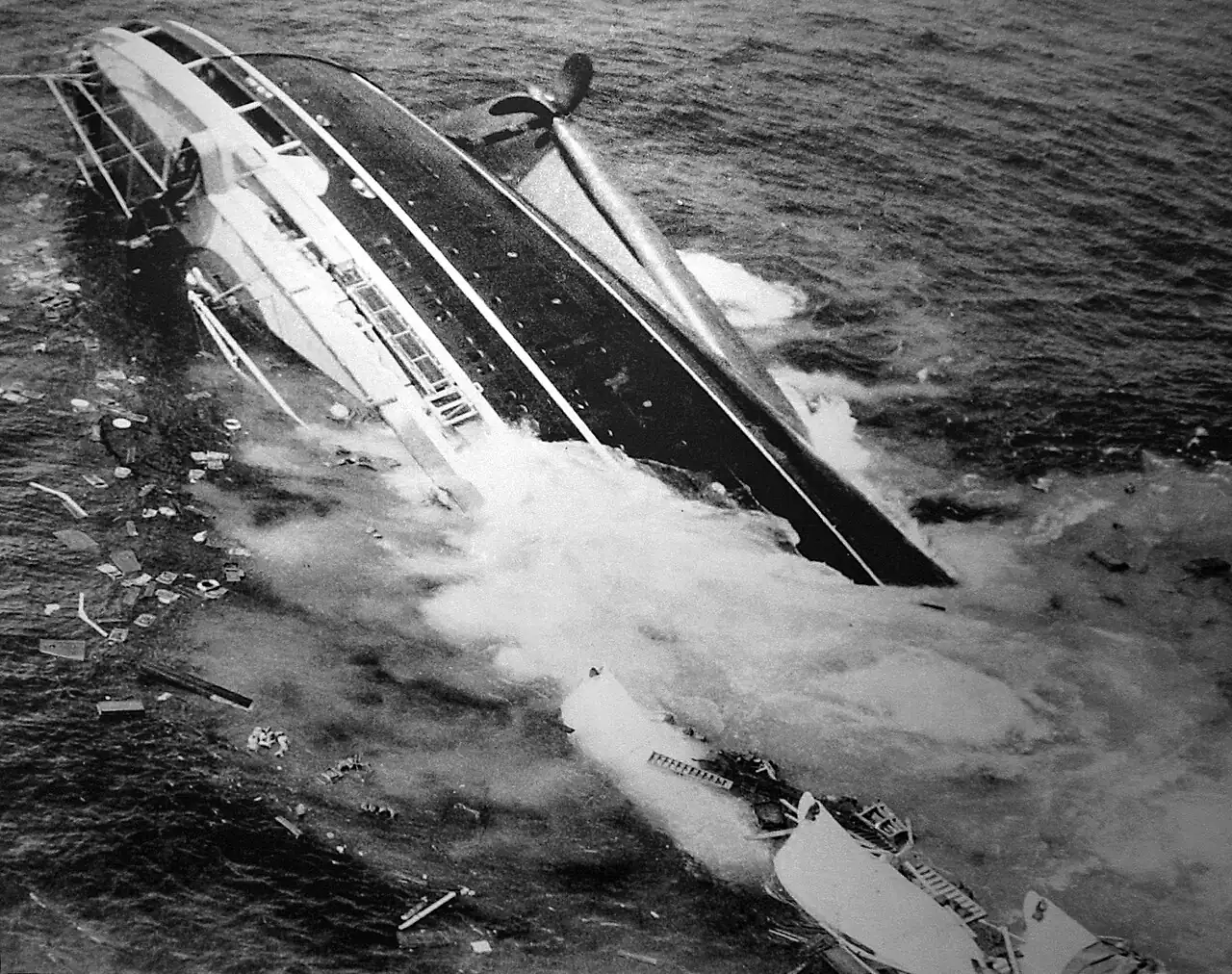
- 23:12: The List Begins. Water rushes into the breached tanks. Because the port-side fuel tanks were largely empty (containing only air), a massive asymmetric weight imbalance is created. The Andrea Doria begins a rapid and severe starboard list.
- 23:15: The list exceeds 20 degrees. On the port side, the lifeboats are now hanging at an angle so extreme that they cannot be lowered from their davits without striking the ship’s hull.
- 23:30: The generator room is flooded due to a failure in watertight integrity in an access tunnel, leading to a loss of primary electrical power and lighting.
The Sinking
- July 26, 01:00: The list increases as progressive flooding occurs. As the ship heels, the tops of the starboard watertight bulkheads dip below the waterline, allowing seawater to flow into adjacent compartments.
- 04:00: The Andrea Doria is in a state of extreme distress. The list is so severe that the ship is nearing its capsizing point.
- ~11:00: The SS Andrea Doria capsizes and sinks to the ocean floor.
4. Technical & Hydrodynamic Failure Analysis
A forensic examination of the incident reveals a chain of physical and mechanical failures that converted a survivable collision into a maritime catastrophe.
4.1 Collision Physics and Structural Integrity
The collision was an “energy-intensive” event. The kinetic energy () of the two massive vessels, combined with their closing speed, resulted in a massive force upon impact. The Stockholm’s bow, designed to cleave through ice, functioned as a high-pressure penetrator. The localized stress at the point of impact exceeded the yield strength of the Andrea Doria’s hull plating, resulting in the catastrophic breach of the fuel tank boundaries.
4.2 Hydrostatic Stability and the Asymmetric Flooding Phenomenon
The most critical factor in the sinking was the loss of transverse stability.
4.2.1 The Role of Asymmetric Loading
In a standard flooding scenario, a ship might maintain some degree of uprightness if the flooding is distributed. However, the Andrea Doria experienced asymmetric flooding.
- Starboard Side: Rapidly inundated with thousands of tons of seawater.
- Port Side: Remained largely buoyant due to the air-filled, empty fuel tanks.
This created a massive heeling moment (). The distance between the center of gravity of the added water and the centerline of the ship was substantial, creating a torque that forced the vessel to heel over to starboard.
4.2.2 Metacentric Height (GM) and the Loss of Stability
As the ship listed, its metacentric height (GM)—a measure of its initial stability—decreased. As the center of gravity () shifted due to the incoming water, it moved closer to the metacentre (). Once the moved above , the vessel would lose all ability to right itself and would capsize. The severe list also caused the “effective” watertight enclosure to fail as the bulkheads were submerged.
4.3 Progressive Flooding and Bulkhead Failure
The Andrea Doria’s design relied on the assumption that watertight compartments would remain isolated. This was invalidated by two factors:
- Submergence of Bulkhead Tops: As the list increased, the water level on the starboard side surpassed the height of the watertight bulkheads. This turned the ship’s internal structure into a series of interconnected “channels,” allowing water to flow from compartment to compartment via stairwells and corridors.
- The Access Tunnel Breach: The lack of a watertight door in the service tunnel between the generator room and the tank controls allowed for the bypass of the primary bulkhead. This was a critical failure in the ship’s redundant safety systems.
5. Human Factors, Bridge/Engine Management, and Organizational Issues
The accident was a “systemic failure” where individual errors were compounded by organizational and environmental stressors.
5.1 The “Radar-Assisted” Collision: A Breakdown in Mental Models
The most significant human error was the failure of both bridge teams to maintain an accurate “mental model” of the situation.
- Misinterpretation of Relative Motion: In radar navigation, an officer must distinguish between true motion (the ship’s actual course/speed) and relative motion (how the target appears to move on the radar screen). Both crews failed to correctly translate relative motion into the true course of the approaching vessel.
- The “Confirmation Bias” Trap: Each crew likely fell victim to confirmation bias—interpreting radar echoes in a way that supported their existing plan (e.g., “We are on a safe course for a starboard-to-starboard passing”).
5.2 Communication Breakdown
The absence of radio communication was a critical failure in bridge resource management. In an era where radio was standard, the failure to “call and confirm” intentions meant that both ships were operating on assumptions rather than facts. This prevented the early detection of the diverging courses.
5.3 Watchkeeping and Fatigue
While not definitively proven, the heavy fog and the high-stakes nature of the transatlantic crossing likely contributed to increased cognitive load and potential fatigue among the watch officers, reducing their ability to detect subtle changes in radar echoes.
6. Emergency Response, Evacuation, and Search & Rescue
6.1 The Lifeboat Dilemma: LSA Failure
The deployment of life-saving appliances was the most harrowing aspect of the disaster.
The Andrea Doria was equipped with sufficient lifeboats for all souls on board. However, the mechanical deployment of these boats was predicated on the ship being relatively upright.
- The Port-Side Failure: As the ship heeled to starboard, the gravity-fed davits on the port side could not swing the boats out over the water. Any attempt to lower them would have resulted in the boats smashing against the ship’s hull.
- The Starboard-Side Difficulty: While the starboard boats could be lowered, the extreme angle made the process incredibly dangerous for both the crew and the passengers, as the boats would swing wildly.
6.2 Search and Rescue (SAR) Excellence
Despite the failure of the ship’s own evacuation systems, the rescue operation was a triumph of maritime cooperation.
- The Ile de France: The French liner Ile de France played a pivotal role, maneuvering close to the listing Andrea Doria to facilitate the transfer of passengers.
- The Rescue Fleet: Numerous other vessels, including the Percival Gallois and the City of New York, arrived to assist, creating a massive, coordinated SAR operation in the middle of a fog bank.
7. Salvage, Wreck Removal, or Environmental Impact
The wreck of the Andrea Doria remains at its collision site, approximately 240 meters below the surface.
- Current Status: The wreck is a protected site of historical significance.
- Environmental Impact: While the initial collision released a significant amount of fuel, there was no long-term environmental catastrophe, as the fuel was largely dispersed or consumed during the sinking process.
- Archaeological Value: The wreck is a primary site for studying mid-20th-century maritime engineering and the realities of deep-sea shipwrecks.
8. Official Investigation Findings and Root Causes
The lack of a single, formal, unified investigation (due to the legal settlement) has left much of the “official” record to be reconstructed from USCG reports and subsequent academic analysis. However, the consensus on the root causes is well-established:
- Primary Root Cause: Navigational error characterized by the misinterpretation of radar data and a failure to properly plot relative motion.
- Secondary Root Cause: The failure to utilize radio communication to resolve navigational ambiguity.
- Technical Root Cause: Asymmetric flooding caused by the failure to ballast empty fuel tanks, leading to a catastrophic loss of transverse stability.
- Design Root Cause: Inadequate watertight integrity in service passages and the limited height of watertight bulkheads.
9. Regulatory and Industry Reforms Triggered
The Andrea Doria disaster was a watershed moment for maritime safety, leading to several critical reforms:
- COLREGs (International Regulations for Preventing Collisions at Sea): The disaster highlighted the need for clearer, more enforceable rules regarding radar-assisted maneuvering and the importance of unambiguous communication.
- Mandatory Shipping Lanes: The incident led to the implementation of much stricter “Traffic Separation Schemes” (TSS) to ensure that eastbound and westbound vessels remain well-separated, even in low visibility.
- Stability and Ballast Management: New regulations were introduced regarding the management of fuel and ballast, emphasizing the need for vessels to maintain a stable center of gravity at all times.
- Enhanced Radar Training: The maritime industry shifted toward more rigorous, standardized training for radar interpretation, moving away from manual plotting toward more advanced, automated systems.
10. Key Takeaways for Modern Mariners
- Redundancy in Navigation: Never rely on a single source of information. Cross-reference radar with visual sightings, AIS, and mathematical plotting.
- The Power of Communication: In ambiguous situations, “verbalize” your intent. A quick radio call can prevent a catastrophe.
- Stability is a Constant Responsibility: A ship’s stability is not a static property; it is a dynamic variable that must be actively managed through ballast and fuel control.
- Preparedness for Extremes: Always design and train for the “worst-case” scenario, such as a severe list that renders standard evacuation equipment unusable.
11. Sources and Official Reports
- United States Coast Guard (USCG): Investigation of the Collision between SS Andrea Doria and MS Stockholm.
- Swedish American Line: Operational Logs and Technical Specifications for MS Stockholm.
- IMarEST: Analysis of the Andrea Doria Disaster and its impact on Maritime Safety.
- USNI Proceedings: Navigational Analysis of the Andrea Doria-Stockholm Collision.
- The Disaster Archive: Historical Records and Technical Data on the SS Andrea Doria.
- Academic Study: Hydrostatic and Hydrodynamic Analysis of the Andrea Doria Sinking.