1. Incident Overview and Key Facts
| Detail | Information |
|---|---|
| Date of Incident | November 10, 1975 |
| Time of Sinking | Approximately 19:15 EST |
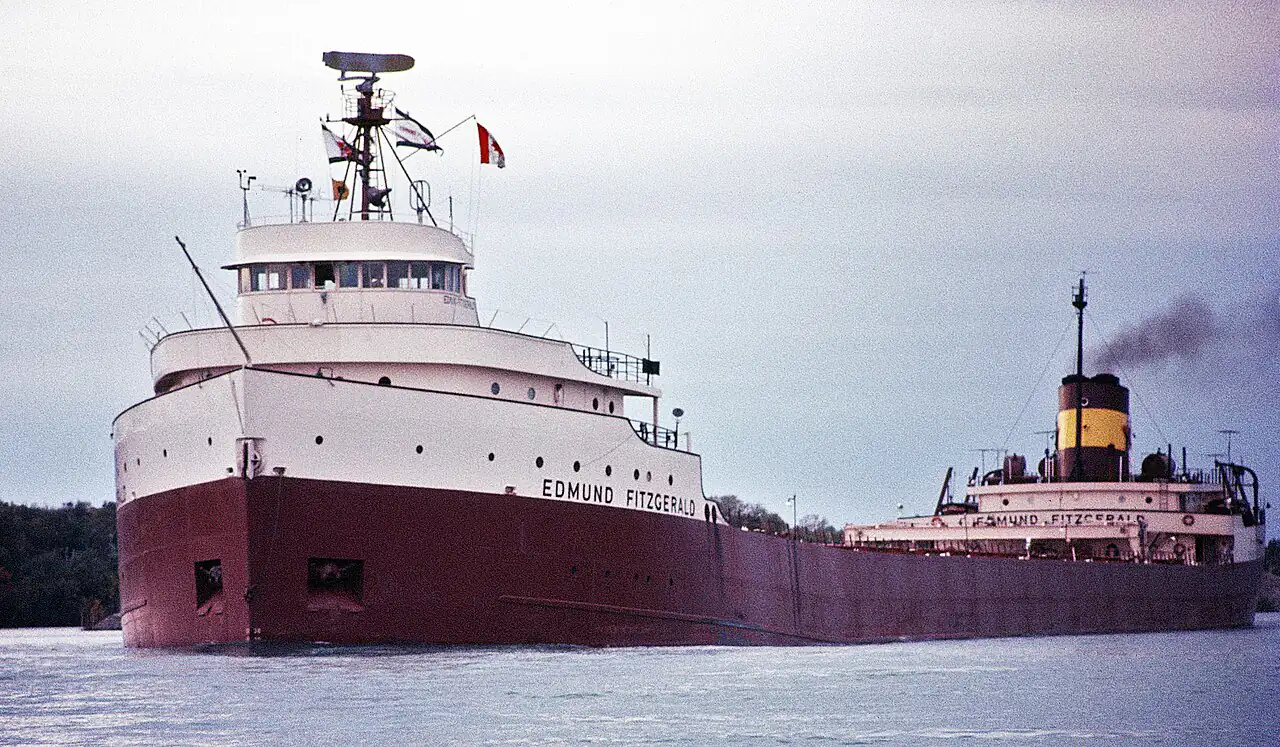
| Vessel Name | SS Edmund Fitzgerald |
| Vessel Type | Bulk Carrier (Taconite) |
| Flag | United States |
| Location | Lake Superior; 46°59.9’ N, 85°06.6’ W (approx. 17 miles from Whitefish Bay entrance) |
| Casualties | 29 (All crew members) |
| Outcome | Total Loss; Vessel sank in deep water |
| Investigating Authority | National Transportation Safety Board (NTSB) / U.S. Coast Guard (USCG) |
2. The Vessel and Crew Context
2.1 Vessel Specifications
The SS Edmund Fitzgerald was a premier bulk carrier of the mid-20th century, designed for the efficient transport of taconite iron ore pellets across the Great Lakes. At the time of her loss, she was one of the largest and most technologically advanced vessels on the lakes.
- Length Overall (LOA): ~729 feet (222.2 m)
- Beam: ~73 feet (22.3 m)
- Gross Tonnage: ~13,000 GRT
- Deadweight Tonnage (DWT): ~54,000 tons
- Propulsion: Triple-expansion steam engine, single screw
- Cargo: Taconite iron ore pellets (fully loaded)
The ship’s design focused on high-capacity cargo holds and efficient loading/unloading via specialized gear. However, the structural integrity of the vessel’s upper works, specifically the weathertight integrity of the hatch covers, became a critical point of failure in this incident. For more on the mechanics of cargo containment, see ../subsystems/roro-ramps-hatch-covers-and-cargo-gear.md.
2.2 Crew and Operational Profile
The vessel was manned by a professional crew of 29 officers and sailors. The command was led by Captain Ernest M. McSorley, a highly experienced mariner. On the night of the accident, the vessel was en route from Superior, Wisconsin, to Detroit, Michigan, following a routine transit schedule through heavy weather.
3. Chronological Timeline of Events
3.1 Pre-Storm and Weather Progression
- Early November 1975: A massive low-pressure system began moving across the Great Lakes, generating severe gale-force to hurricane-force winds and massive waves on Lake Superior.
- November 9, 1975: The Fitzgerald departed Superior, Wisconsin, heavily laden with taconite. Weather conditions began to deteriorate rapidly.
- November 10, 1975 (Daytime): The storm intensified. The vessel encountered heavy seas and sustained winds. The crew implemented standard storm procedures, including reducing speed to manage vessel strain and stability.
3.2 The Final Hours
- 15:00 - 18:00 EST: The storm reached its peak intensity. Wind speeds exceeded 50-60 knots, with wave heights estimated to be significantly higher than the vessel’s freeboard.
- 18:00 - 19:00 EST: The vessel reported encountering severe conditions. Radio communications with other vessels, including the Anderson, confirmed the severity of the weather in the area.
- ~19:00 EST: The Fitzgerald was last heard from. Reports from nearby vessels indicated the ship was struggling with massive waves.
- ~19:15 EST: The vessel disappeared from radar and radio contact. No distress signal (SOS/Mayday) was transmitted.
3.3 Post-Incident Discovery
- November 11, 1975: Search operations commenced, but the extreme weather hindered rescue efforts.
- Late 1975 - 1976: Salvage and diving expeditions, including the use of the CURV-III submersible, located the wreckage in deep water (approx. 530 feet).
4. Technical & Hydrodynamic Failure Analysis
The sinking of the SS Edmund Fitzgerald was not the result of a single catastrophic failure but rather a “succession of failures” that compromised the vessel’s stability and buoyancy.
4.1 Topside Damage and Ballast Flooding
Initial evidence suggests that the vessel suffered topside damage during the storm. Damage to ballast tank vents and hull plating allowed seawater to enter the vessel’s ballast tanks and the “tunnel” (the area between the ballast tanks and the cargo holds).
As water entered the ballast tanks, the vessel’s overall weight increased, and more critically, its center of gravity shifted. This flooding contributed to a reduction in the vessel’s effective freeboard—the distance from the waterline to the main deck.
4.2 Loss of Freeboard and Increased List
A critical contributing factor was the regulatory environment regarding load lines. Amendments to the Great Lakes Load Line Regulations (1969, 1971, and 1973) had allowed for a reduction in the minimum required freeboard for vessels like the Fitzgerald.
With the reduced freeboard, the massive boarding seas (waves washing over the deck) had a much easier path to reach the ship’s openings. The accumulation of water on the deck and the flooding of the ballast tanks created a “free surface effect” and a significant list (tilting to one side). For detailed physics on this phenomenon, see ../fundamentals/ship-stability-gm-and-free-surface-effect.md.
4.3 Hatch Cover Failure and Rapid Inundation
The most decisive failure occurred when the heavy boarding seas exerted immense hydrostatic and hydrodynamic pressure on the hatch covers.
- Seal Failure: The hatch covers, while designed to be weathertight, were not fully watertight against the massive, sustained forces of the storm once the freeboard was significantly reduced. Water began to seep through the seals and non-weathertight elements.
- Massive Flooding: Once water entered the cargo holds, the vessel’s buoyancy was rapidly compromised. The influx of water into the holds caused an immediate and catastrophic loss of stability.
- Structural Collapse: The NTSB concluded that the massive weight and force of the seas eventually caused one or more of the hatch covers to collapse entirely. This led to “sudden and massive flooding,” leaving the crew with no time to react or transmit a distress signal.
The interplay between the hull’s structural strength and the water’s pressure is a core principle of maritime safety. For further reading, see ../fundamentals/watertight-subdivision-double-hulls-and-structural-strength.md.
5. Human Factors and Management Issues
5.1 Watchkeeping and Decision-Making
While Captain McSorley was an experienced mariner, the extreme environmental conditions presented a “black swan” event that pushed the crew to their limits. The decision to maintain course and speed through the storm was influenced by the need to reach Detroit on schedule, though the vessel did reduce speed as conditions worsened.
5.2 Communication and Alarms
The absence of a distress call remains one of the most haunting aspects of the tragedy. The technical analysis suggests the sinking was so rapid—likely occurring in a matter of seconds once the hatch covers failed—that the bridge crew was unable to issue a Mayday or even recognize the imminent danger before the vessel foundered.
6. Emergency Response and Search & Rescue
The search and rescue (SAR) effort was severely hampered by the ongoing storm. The Fitzgerald disappeared in an area of Lake Superior characterized by deep water and extreme wave energy. By the time search operations could be effectively organized, the weather had not subsided, and the survival window for any crew members in the water was virtually zero.
7. Wreckage and Salvage Analysis
7.1 The CURV-III Survey
The 1976 deep-water survey conducted by the CURV-III submersible provided the first clear picture of the wreck. The vessel was found in two main sections:
- The Bow Section: Located upright on the lake floor.
- The Stern Section: Located approximately 170 feet away, found in an overturned position.
7.2 The “Shoaling” Hypothesis Debunked
Throughout the investigation, a theory persisted that the Fitzgerald had struck a shoal (the “Six Fathom Shoal”) north of Caribou Island, which would have caused hull breaches. However, the NTSB and USCG investigations found no evidence of grounding damage.
- No Gasthes/Scrapes: Dive surveys of the stern and bow sections showed no signs of the characteristic scraping or denting associated with hitting bedrock.
- Hydrographic Verification: Subsequent surveys indicated that the “Six Fathom Shoal” was not positioned where earlier charts suggested, and there was no evidence of the ship’s track intersecting with any dangerous shoals.
8. Official Investigation Findings and Root Causes
The National Transportation Safety Board (NTSB) determined the following:
Probable Cause: The sudden, massive flooding of the cargo hold due to the collapse of one or more hatch covers under the weight of giant boarding seas.
Contributing Factors:
- Topside damage to ballast tank vents and hull plating allowed water to enter the ballast tanks and tunnel.
- The reduction in freeboard (authorized by previous load line amendments) allowed larger amounts of water to wash over the deck.
- The increased water on deck and flooding in the ballast tanks increased the vessel’s list and further reduced freeboard, making the hatch covers more vulnerable to the hydrodynamic forces of the waves.
- The lack of transverse weathertight bulkheads within the cargo holds meant that once one area flooded, the entire hold was compromised.
9. Regulatory and Industry Reforms Triggered
The loss of the SS Edmund Fitzgerald served as a watershed moment for Great Lakes maritime safety, leading to several critical changes:
- Load Line Revisions: The controversial amendments that allowed for reduced freeboard were re-evaluated. New standards were implemented to ensure that vessels maintained adequate reserve buoyancy even in heavy seas.
- Hatch Cover Standards: Enhanced requirements for the structural strength and weathertight integrity of hatch covers were established to prevent the type of collapse seen on the Fitzgerald.
- Improved Weather Forecasting: The tragedy highlighted the need for more accurate and timely meteorological data for Great Lakes mariners, leading to better integration of weather forecasting into maritime navigation.
- Structural Requirements: New investigations into the longitudinal strength and watertight subdivision of bulk carriers were initiated to ensure better survivability in the event of localized flooding.
10. Key Takeaways for Modern Mariners
- The Danger of Reduced Freeboard: Maintaining adequate freeboard is the first line of defense against boarding seas and subsequent loss of stability.
- The Criticality of Weathertight Integrity: Hatch covers and vents are not merely “covers”; they are critical structural components that must withstand extreme hydrodynamic loads.
- Rapid Inundation Risk: Once watertight integrity is lost in a large cargo hold, the transition from “distressed” to “sunk” can be nearly instantaneous.
- Environmental Vigilance: Extreme weather on the Great Lakes can create conditions that exceed even the most robust design assumptions.
11. Sources and Official Reports
- National Transportation Safety Board (NTSB). Marine Accident Report: SS Edmund Fitzgerald, Lake Superior, November 10, 1975. https://www.ntsb.gov/investigations/AccidentReports/Reports/MAR7803.pdf
- U.S. Coast Guard (USCG). Formal Casualty Report: SS Edmund Fitzgerald.
- National Transportation Safety Board (NTSB). Safety Recommendation Letters regarding Great Lakes Load Line Regulations. https://www.ntsb.gov/safety/safety-recs/recletters/M78_31_32.pdf
- Wikipedia. SS Edmund Fitzgerald. https://en.wikipedia.org/wiki/SS_Edmund_Fitzgerald
- NTSB Investigation Summary. https://www.ntsb.gov/investigations/Pages/DCA76AM001.aspx