1. Incident Overview and Key Facts
The Costa Concordia disaster remains one of the most significant maritime casualties of the 21st century, serving as a watershed moment for cruise industry safety standards and bridge resource management (BRM) training. On the night of January 13, 2012, the vessel struck the “le Scole” rocks off the coast of Isola del Giglio, Italy, while performing an unauthorized coastal salute. The impact caused a massive breach in the hull, leading to the immediate flooding of five contiguous watertight compartments and a subsequent loss of propulsion and electrical power.
The ensuing chaos, characterized by delays in the general emergency alarm and the abandon-ship order, led to a chaotic evacuation process. While the majority of the 4,200+ people on board were rescued, the incident resulted in 32 deaths and exposed deep-seated issues in organizational safety culture and command authority.
| Fact | Detail |
|---|---|
| Date of Incident | January 13, 2012 |
| Vessel Name | Costa Concordia |
| IMO Number | 9444905 |
| Vessel Type | Cruise Ship (Concordia class) |
| Flag State | Italy |
| Location | Isola del Giglio, Italy |
| Casualties (Fatalities) | 32 (27 passengers, 5 crew) |
| Outcome | Total loss of vessel; major salvage operation |
| Investigating Authority | Italian Ministry of Infrastructure and Transport |
2. The Vessel and Crew Context
The Costa Concordia was a state-of-the-art cruise ship, part of the Costa Cruises fleet, designed for high-capacity passenger service and luxury amenities. At the time of the accident, she was carrying approximately 3,206 passengers and 1,023 crewmembers.
Vessel Specifications
- Length Overall (LOA): 290.2 meters
- Beam: 37.0 meters
- Gross Tonnage: ~114,000 GT
- Propulsion: Two low-speed diesel engines driving azimuth thrusters [see ../subsystems/azipods-azimuth-thrusters-and-waterjets.md].
- Hull Design: Advanced watertight subdivision designed to meet SOLAS requirements, featuring a double hull in critical areas [see ../fundamentals/watertight-subdivision-double-hulls-and-structural-strength.md].
Operational Profile
The vessel was operating on a standard Mediterranean circuit. The incident was precipitated by a decision to deviate from the planned route to perform a “salute” to the island of Giglio—a common, though increasingly regulated, practice where cruise ships sail close to shore to allow passengers a view of the coastline. This maneuver was not part of the official voyage plan and was executed without sufficient situational awareness or risk assessment.
The crew composition was highly international, reflecting the globalized nature of the modern cruise industry. However, post-incident investigations highlighted that variations in training, communication protocols, and safety culture among the diverse crew members contributed to the breakdown in emergency management.
3. Chronological Timeline of Events
The following timeline reconstructs the sequence of events based on official investigative findings and bridge voice recordings.
January 13, 2012
- 19:18 CET: The Costa Concordia departs the port of Civitavecchia, Italy, bound for Savona. The voyage plan includes a modified transit to allow for the coastal sail-by of Isola del Giglio.
- 21:00 CET: The vessel approaches the Giglio archipelago. The Master (Captain) is on the bridge, having decided to perform the sail-by maneuver.
- 21:34 CET: The Master arrives on the navigation bridge. He instructs the helmsman to switch the steering from autopilot to manual mode to facilitate closer maneuvering.
- 21:40 CET: The vessel is proceeding at a relatively high speed (approximately 15-16 knots) in close proximity to the coastline, despite the darkness and the complexity of the local hydrography.
- 21:44 CET: As the vessel approaches the “le Scole” rocks, the Master realizes the ship is too close to the shore. He begins issuing significant rudder orders to attempt to turn the vessel away from the rocks.
- 21:45 CET: An order for “hard port” rudder is given. However, the vessel’s momentum and the timing of the order are insufficient. The port quarter of the vessel strikes the rocks at “le Scole” with significant force.
- 21:46 CET: The impact causes a massive gash (estimated at 53 meters in length) in the hull, breaching five contiguous watertight compartments.
- 21:47 CET: Rapid ingress of seawater leads to an immediate loss of main electrical power and propulsion systems. The vessel suffers a total blackout.
- 21:50 - 22:20 CET: The bridge team struggles to assess the extent of the damage. Communication between the bridge, the engine room, and the passengers is minimal or non-existent.
- 22:25 CET: The bridge team finally reports to the Livorno Coast Guard that the hull has been breached and the vessel is in distress.
- 22:30 CET: Panic begins to spread among the passengers. Some passengers attempt to muster at lifeboats, but the official General Emergency Alarm has not yet been activated.
- 22:36 CET: The first emergency response vessels (including local fishing boats and Coast Guard assets) arrive at the scene.
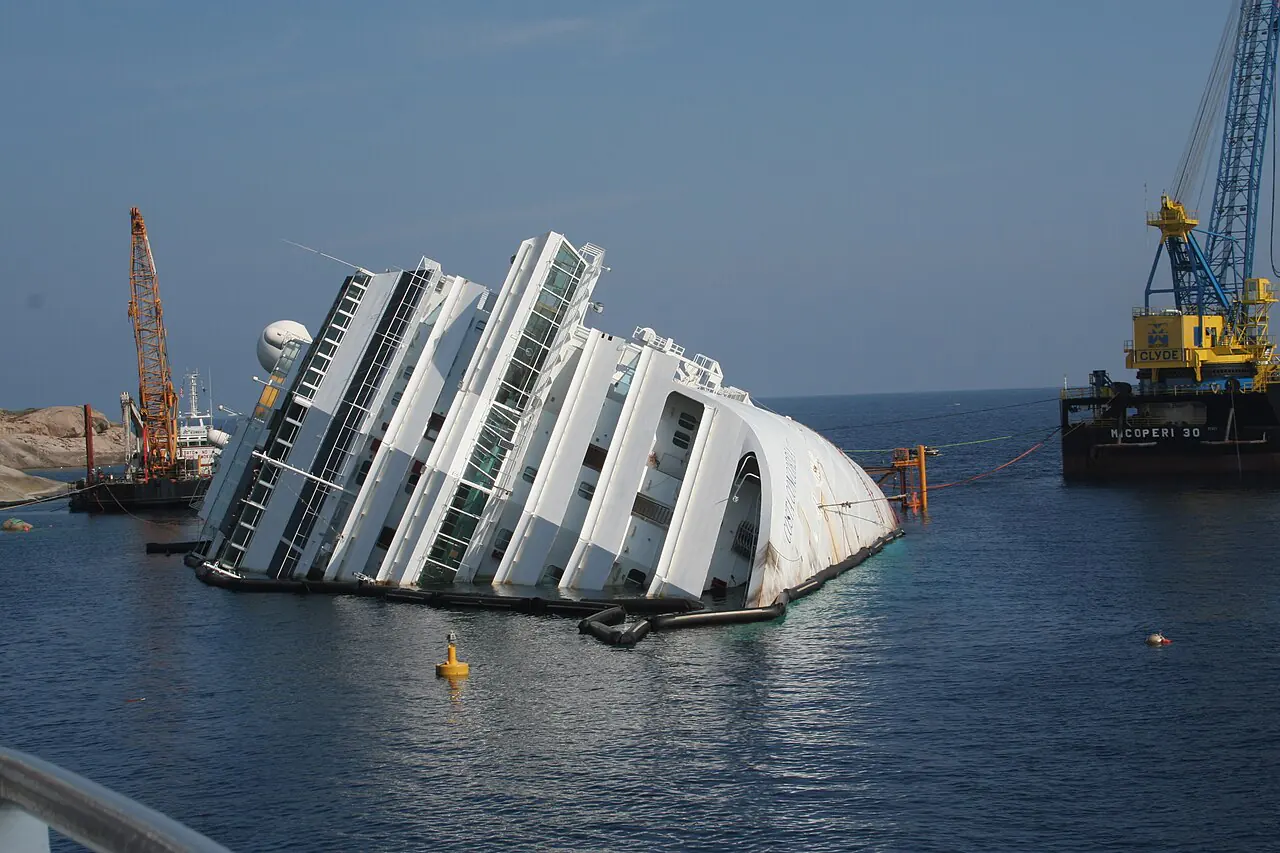
- 22:58 CET: The vessel, having lost much of its stability due to flooding, drifts and comes to rest on its starboard side on the underwater rocks.
- 23:00 - 00:00 CET: The list to starboard increases rapidly. The ship’s angle makes it increasingly difficult to launch lifeboats and Marine Evacuation Systems (MES).
January 14, 2012
- 00:00 CET: The vessel’s list becomes severe. The ship is now heavily inclined, significantly impacting the survivability of those in lower compartments.
- 02:00 - 06:00 CET: A massive Search and Rescue (SAR) operation is underway, involving helicopters, Coast Guard vessels, and civilian ships. The evacuation is described as “chaotic and disorganized.”
- 06:17 CET: The majority of the accessible passengers and crew have been evacuated. However, several individuals remain unaccounted for.
- Late Morning: The scale of the disaster becomes clear to the international community.
4. Technical & Hydrodynamic Failure Analysis
The Costa Concordia disaster was fundamentally a failure of hull integrity followed by a rapid collapse of stability and power.
Hull Breach and Compartment Flooding
The impact with the “le Scole” rocks was not a glancing blow but a high-energy collision. The rocks penetrated the hull, creating a 53-meter longitudinal gash. This breach opened five contiguous watertight compartments to the sea.
Under the vessel’s stability design, the flooding of five adjacent compartments exceeded the “one-compartment” or even “two-compartment” flooding standards typically required for such vessels [see ../fundamentals/watertight-subdivision-double-hulls-and-structural-strength.md]. The simultaneous flooding of these large volumes of water caused an immediate and catastrophic shift in the vessel’s center of gravity and buoyancy.
Loss of Power and Propulsion
The flooding was not localized to the hull skin; the ingress of water reached vital machinery spaces. The immediate consequence was:
- Electrical Blackout: The flooding of compartments containing main switchboards and power generation equipment led to a total loss of main electrical power within 50 seconds of impact.
- Propulsion Failure: The loss of power to the azimuth thrusters meant the vessel lost all ability to maneuver or hold position against the currents and wind.
- Emergency Power Limitations: While emergency generators are designed to kick in, the rapid flooding and the angle of the ship’s list prevented the effective operation of many emergency pumps and secondary power systems.
Stability and Capsize Mechanics
The Costa Concordia suffered from a rapid loss of transverse stability. As water filled the lower compartments, the vessel’s Center of Gravity (G) shifted, and the Center of Buoyancy (B) was compromised.
The “Free Surface Effect”—the movement of water within the partially filled compartments—further destabilized the ship. As the ship began to list, the water shifted to the low side, creating a massive destabilizing moment that accelerated the capsize. This process is detailed in the study of ship stability [see ../fundamentals/ship-stability-gm-and-free-surface-effect.md]. The vessel’s ability to resist the capsize was compromised by the fact that the flooding was not symmetric, leading to a massive initial heel.
5. Human Factors, Bridge/Engine Management, and Organizational Issues
The technical failure of the hull was the mechanism of the accident, but the cause was overwhelmingly attributed to human error and a breakdown in Bridge Resource Management (BRM).
The Master’s Decision-Making
The primary cause was the decision by the Master to perform an unauthorized and high-risk sail-by. This maneuver was performed:
- Too close to the coast: Reducing the margin for error to near zero.
- At excessive speed: 15-16 knots in night conditions near a rocky coastline is dangerously high for such proximity.
- With inadequate navigational tools: The bridge team was using charts of 1/100,000 scale, which lacked the fine detail necessary for such close-quarters maneuvering. Accurate navigation required 1/50,000 scale charts [see ../subsystems/ecdis-and-electronic-charts.md].
Bridge Resource Management (BRM) Failure
The bridge team failed to provide the necessary “challenge and response” required in modern maritime operations.
- Lack of Challenge: Despite the obvious risks of the maneuver, the officers on watch (OOW) did not challenge the Master’s decision or the high speed.
- Distraction: Investigations suggested that the bridge team was distracted during the critical minutes leading up to the impact, preventing them from identifying the looming danger of the rocks.
- Manual Steering Errors: The transition to manual steering and the subsequent delayed and inadequate rudder orders meant that by the time the Master attempted to correct the course, the vessel’s momentum made a collision inevitable.
Organizational and Command Failures
The failure extended beyond the bridge to the ship’s overall command structure:
- Emergency Management: There was a critical delay in activating the General Emergency Alarm and issuing the “Abandon Ship” order. This delay meant that many passengers were caught off guard in their cabins or in corridors when the ship began to list severely.
- Communication Breakdown: The lack of clear, calm, and timely communication between the bridge, the crew, and the passengers exacerbated the panic.
- Safety Culture: The decision to prioritize a “spectacle” (the sail-by) over strict adherence to the voyage plan indicated a compromise in the ship’s safety culture.
6. Emergency Response, Evacuation, and Search & Rescue
The evacuation of the Costa Concordia was one of the most complex and harrowing maritime rescue operations in history.
The Evacuation Process
The evacuation was characterized by extreme difficulty due to the ship’s rapid and severe list.
- Lifeboat Deployment: As the ship inclined, many lifeboats became unusable because they could not be lowered safely or were blocked by the angle of the hull.
- Marine Evacuation Systems (MES): The inflatable slides and chutes (MES) were also hampered by the ship’s position.
- Panic and Chaos: The delay in the official alarm led to a disorganized rush for the exits, which complicated the efforts of the crew to manage the evacuation.
Search and Rescue (SAR) Coordination
The response from the Italian Coast Guard and other agencies was massive and ultimately successful in saving the vast majority of lives.
- Multilateral Response: The operation involved helicopters, specialized rescue vessels, and civilian maritime assets.
- Challenges: The rugged coastline of Isola del Giglio and the deteriorating condition of the ship made the rescue operations extremely dangerous for first responders.
7. Salvage, Wreck Removal, or Environmental Impact
The recovery of the Costa Concordia was a feat of engineering that redefined maritime salvage capabilities.
The Parbuckling Operation
Because the ship was resting on its side in shallow water, traditional refloating was impossible. A massive, unprecedented operation known as “parbuckling” was executed.
- Stabilization: The wreck was first stabilized and the oil was removed to prevent environmental disaster.
- Cages and Tethers: Large steel structures (cages) were built around the hull, and massive cables were attached.
- The Rotation: Using a system of synchronized hydraulic jacks and heavy-lift salvage vessels, the ship was slowly rotated from its side back to an upright position.
- Refloating: Once upright, the wreck was flooded in a controlled manner to provide buoyancy, then pumped out to allow the ship to be refloated and towed to Genoa for dismantling.
Environmental Impact
A primary concern during the salvage was the release of approximately 2,000 cubic meters of fuel oil. Extensive containment measures, including booms and specialized recovery vessels, were deployed to protect the marine ecosystem around Isola del Giglio.
8. Official Investigation Findings and Root Causes
The Italian Ministry of Infrastructure and Transport, alongside international observers, concluded that the root cause of the Costa Concordia accident was the unconventional and unauthorized behavior of the Master, combined with a failure of the bridge team to provide effective oversight.
Key Findings:
- Primary Cause: Human error—specifically the Master’s decision to execute the sail-by maneuver.
- Contributory Cause: Poor Bridge Resource Management and a lack of effective communication.
- Technical Factor: The rapid flooding of multiple compartments due to the hull breach, which led to an immediate loss of stability.
- Management Factor: Inadequate emergency response and delays in passenger notification.
9. Regulatory and Industry Reforms Triggered
The disaster led to significant changes in international maritime regulations and industry practices:
- SOLAS Amendments: Stricter requirements for bridge resource management and passenger notification protocols.
- Enhanced Training: Increased emphasis on situational awareness and the “challenge and response” culture in officer training.
- Chart Accuracy: Greater scrutiny on the scale and accuracy of electronic charts (ECDIS) used during coastal transits.
- Safety Culture Audits: Increased focus on organizational safety culture within cruise lines, moving beyond mere technical compliance to behavioral oversight.
10. Key Takeaways for Modern Mariners
The Costa Concordia serves as a grim reminder of the following principles:
- The Danger of Complacency: Even the most modern and highly trained crews are susceptible to the “normalization of deviance” when unauthorized maneuvers become routine.
- The Criticality of BRM: A bridge is a team environment; the absence of active oversight by officers can turn a single mistake into a catastrophe.
- Stability is Fragile: Technical safeguards like watertight subdivision are designed for predictable failures; they can be overwhelmed by rapid, multi-compartment flooding.
- Command Responsibility: The Master’s authority is absolute, but it must be exercised with extreme caution and within the bounds of established safety protocols.
11. Sources and Official Reports
- Italian Ministry of Infrastructure and Transport: Official Investigative Report on the Costa Concordia Incident.
- NTSB (National Transportation Safety Board): Close-Out Memo - Accident Data - Costa Concordia. [https://data.ntsb.gov/Docket/Document/docBLOB?ID=40440021&FileExtension=.PDF&FileName=Close-Out%20Memo-Master.PDF]
- Protezione Civile (Italy): The Costa Concordia Shipwreck - Technical Overview. [https://www.protezionecivile.gov.it/static/76e14a9fc11674a61ca53d088e7ab1d2/Pubblicazione_Concordia_ENG_web.pdf]
- Seafarers Rights International: Costa probe blames the human element. [https://seafarersrights.org/costa-probe-blames-the-human-element/]
- GAO (Government Accountability Office): Cruise Vessel Safety and Security. [https://www.gao.gov/assets/gao-14-43.pdf]