The Panama Canal is more than a mere waterway; it is a cornerstone of global maritime commerce, a feat of engineering that reshaped the world’s trade routes, and a critical geographic chokepoint. Connecting the Atlantic and Pacific Oceans through the Isthmus of Panama, the canal provides a vital shortcut that saves thousands of miles for vessels traveling between the coasts of North America, Europe, and Asia.
This report explores the profound history of the canal, the intricate engineering of its lock systems, the fragile relationship between its operations and the tropical environment, and most importantly, how the canal’s physical dimensions have dictated the very architecture of the modern global merchant fleet through the creation of the Panamax and Neopanamax ship classes.
1. History and Engineering: From French Ambition to American Success
The dream of a canal through the Isthmus of Panama is centuries old, but the modern history of the waterway is defined by two distinct, and vastly different, eras of construction.
The French Attempt (1881–1889)
The first major attempt to conquer the Isthmus was led by Ferdinand de Lesseps, the celebrated engineer behind the Suez Canal. De Lesseps’ vision was a sea-level canal—a massive trench cut through the mountains without the use of locks. This proved to be a catastrophic miscalculation.
The French campaign was thwarted by three primary factors:
- Geography and Terrain: Unlike the flat, sandy terrain of the Suez, Panama presented dense jungles, mountainous terrain, and the volatile Chagres River.
- Disease: The most devastating blow was biological. Yellow fever and malaria, spread by mosquitoes, claimed the lives of an estimated 20,000 workers. The French, unaware of the mosquito-borne nature of these diseases, were unable to protect their workforce.
- Financial Collapse: The immense costs of excavation and the mounting death toll led to the bankruptcy of the Compagnie Universelle du Canal Interocéanique, causing a massive scandal in France.
The United States Era (1904–1914)
Following the Hay-Bunau-Varilla Treaty, the United States took control of the canal zone. Under the leadership of President Theodore Roosevelt, the project was reframed not as a sea-level endeavor, but as a lock-based system.
Two key breakthroughs ensured American success:
- Medical Breakthroughs: Colonel William Gorgas, a pioneer in tropical medicine, implemented aggressive mosquito-control measures—draining swamps, fumigating houses, and using oil to coat standing water. This effectively neutralized yellow fever and malaria as major threats to the workforce.
- Engineering Shift: Chief Engineer John Stevens (and later George Washington Goethals) realized that a sea-level canal was impossible. They designed a massive lock system that would lift ships over the continental divide into an artificial freshwater lake.
The canal officially opened on August 15, 1914, marking the completion of one of the greatest engineering projects in human history.
2. The Lock System: Engineering the Continental Divide
Because the Isthmus of Panama is not level, ships cannot simply sail through. Instead, they must be “lifted” over the mountains via a series of locks that act as water elevators.
The Three Major Lock Sets
The canal utilizes three primary sets of locks to move vessels through the varying elevations of the terrain:
- Gatun Locks (Atlantic Side): This is the largest set, consisting of three steps (or pairs of chambers) that raise vessels from sea level to the height of Gatun Lake.
- Pedro Miguel Locks (Pacific Side): A single-step set of locks that lowers vessels from Gatun Lake to the level of the Pacific entrance.
- Miraflores Locks (Pacific Side): A two-step set of locks that further lowers vessels to the Pacific Ocean.
Mechanics of the Lock Chambers
The operation of these locks is a masterpiece of hydraulic engineering.
- Gravity-Fed Water: Contrary to popular belief, the locks do not require massive pumps to move water. Instead, the system uses gravity to move water from higher Gatun Lake into the lock chambers.
- Lock Gates: Massive, watertight steel gates control the flow and seal the chambers.
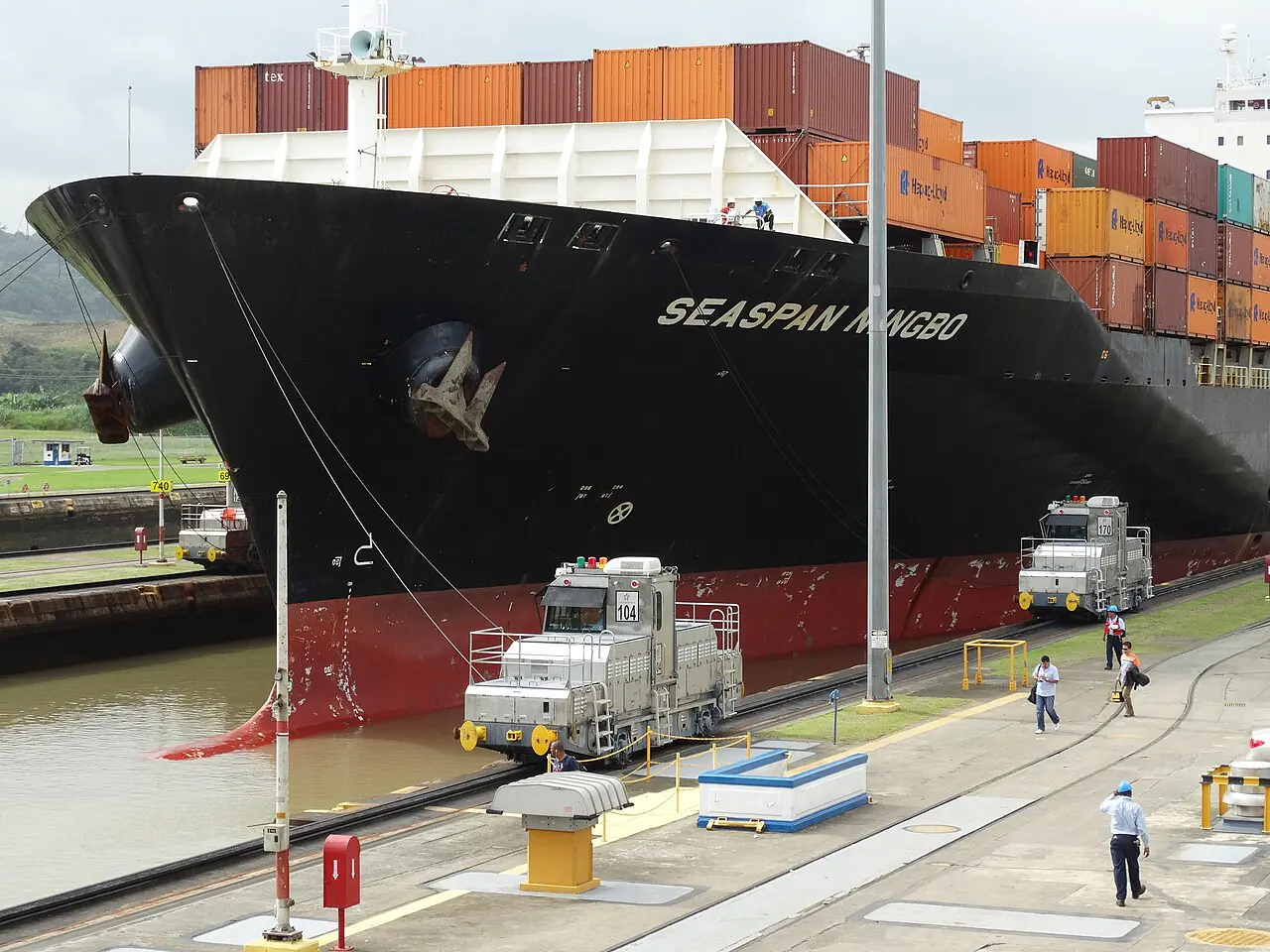
- Mules and Tugs: In the original lock sets, locomotives known as “mules” run on tracks alongside the chambers, using cables to keep vessels centered and prevent them from striking the walls. In the newer Neopanamax locks, large tugboats are used for maneuvering.
3. Water Management: The Gatun Lake Dependency
The Panama Canal is a freshwater waterway. Its ability to function is entirely dependent on the availability of water from the surrounding watershed, primarily stored in Gatun Lake.
Gatun Lake
Gatun Lake is a massive artificial freshwater reservoir created by damming the Chagres River. It serves two purposes:
- Navigation: It provides the high-altitude “highway” that ships traverse between the lock sets.
- Freshwater Reservoir: It provides the water necessary for each lockage.
The Hydrologic Cycle and Climate Risk
Every time a vessel transits a lock, millions of gallons of freshwater are discharged into the ocean. This makes the canal’s operation intrinsically tied to the tropical rainfall patterns of Panama.
In recent years, the canal has faced an existential threat from climate change and the El Niño phenomenon. During severe drought years, such as those seen in 2023 and 2024, water levels in Gatun Lake drop dangerously low. When the lake level falls below a critical threshold, the Panama Canal Authority (ACP) is forced to:
- Reduce Draft: Limit how deep ships can sit in the water to prevent them from hitting the bottom.
- Limit Transits: Reduce the number of ships allowed to pass through each day to conserve water.
These disruptions have massive repercussions for global supply chains, causing delays and forcing many large vessels to take the long route around Cape Horn or through the Suez Canal.
4. Ship Classes: The Evolution of Panamax Dimensions
The physical dimensions of the Panama Canal’s locks have acted as a “design constraint” for the entire global shipping industry. For over a century, naval architects have built ships specifically to fit through these locks, leading to the creation of distinct vessel classes.
The Original Panamax Class
From 1914 until 2016, the “Panamax” standard was defined by the dimensions of the original locks. A vessel designed as a “Panamax” was built to the maximum possible dimensions that could safely transit the Gatun, Pedro Miguel, and Miraflores chambers.
The Neopanamax (New Panamax) Revolution
In 2016, the Panama Canal Expansion Project was completed, adding a third lane of much larger locks. This created the Neopanamax (or New Panamax) classification. These larger locks allow for significantly greater beam (width), length, and draft, enabling the transit of massive container ships that were previously unable to use the canal.
Comparative Technical Specifications
The following table compares the technical constraints and typical dimensions of the primary ship classes.
| Specification | Original Panamax | Neopanamax (New Panamax) |
|---|---|---|
| Max Lock Length | ~965 ft (294.1 m) | ~1,201 ft (366 m) |
| Max Lock Beam | ~106 ft (32.3 m) | ~168 ft (51.2 m) |
| Max Tropical Fresh Water Draft | ~39.5 ft (12.0 m) | ~50.0 ft (15.2 m) |
| Typical Container Capacity (TEU) | ~5,000 TEU | ~13,000–14,500 TEU |
| Typical Tonnage (DWT) | 50,000 – 80,000 DWT | 120,000 – 150,000+ DWT |
| Primary Propulsion/Maneuver | Mules (Locomotives) | Tugboats |
The Tanker Scale: Panamax, Suezmax, and VLCC
While container ships are the primary users of the Neopanamax locks, the oil tanker industry follows a different set of size definitions. It is crucial to distinguish between the “Panamax” tanker and the much larger VLCC.
- Panamax Tanker: Typically 60,000–80,000 DWT. These were designed specifically for the original locks.
- Aframax: 80,000–120,000 DWT. Larger than a Panamax, these often require careful draft management for the canal.
- Suezmax: 120,000–200,000 DWT. These are sized to transit the Suez Canal and are generally too large for the original Panama locks.
- VLCC (Very Large Crude Carrier): 200,000–320,000 DWT. A VLCC is a titan of the seas, often over 300 meters long and drawing more than 20 meters of water. A VLCC cannot transit the original Panama locks. They are far too wide and deep. While some large tankers can utilize the Neopanamax locks, many VLCCs must still avoid the Panama Canal entirely, opting for the Suez Canal or the route around the Cape of Good Hope.
5. Navigation, Pilots, and the Role of the ACP
Operating a vessel through the Panama Canal is a high-stakes task that requires extreme precision.
The Panama Canal Authority (ACP)
Since the transfer of the canal from the United States to Panama in 1999, the waterway has been managed by the Autoridad del Canal de Panamá (ACP). The ACP is an autonomous agency responsible for the operation, maintenance, and regulation of the canal. It is one of Panama’s most significant economic drivers.
The Pilotage Process
Every vessel transiting the canal must be met by a highly trained Panama Canal Pilot. Unlike some ports where pilots are merely advisory, Panama Canal Pilots take active command of the vessel’s navigation. They work in close coordination with the ship’s master, the canal’s control tower, and the tugboats or locomotives to ensure the ship remains perfectly centered within the lock chambers.
6. Impact on Global Trade and Maritime Routes
The Panama Canal serves as a massive “force multiplier” for global trade. By providing a shortcut between the Atlantic and Pacific, it reduces:
- Fuel Consumption: Shorter distances mean less fuel used by vessels.
- Time at Sea: Faster transit times allow for higher frequency in shipping schedules.
- Operating Costs: Reduced time and fuel translate directly into lower costs for shippers and consumers.
The expansion to Neopanamax locks has fundamentally shifted the economics of containerization. It has enabled the use of “economies of scale,” where much larger ships carry more cargo per voyage, lowering the cost per TEU (Twenty-foot Equivalent Unit). This has reinforced the canal’s role as a critical artery in the “just-in-time” global supply chain.
7. Facts, Records, and Common Misconceptions
- Misconception: “The Panama Canal is a sea-level canal.”
- Fact: It is a lock-based canal. A sea-level canal would require excavating a massive trench through the mountains to the level of the oceans, a feat far more difficult and expensive than the current system.
- Misconception: “The canal uses massive pumps to move water into the locks.”
- Fact: The lockage process is almost entirely gravity-fed. Water flows from Gatun Lake into the chambers through large culverts located in the lock walls.
- Fact: The Panama Canal is a freshwater waterway. Even though it connects two oceans, the transit itself happens at a higher elevation in a freshwater lake.
8. Glossary
- ACP: Autoridad del Canal de Panamá (Panama Canal Authority).
- Beam: The width of a ship at its widest point.
- Draft (or Draught): The vertical distance between the waterline and the bottom of the ship’s hull (the keel).
- DWT (Deadweight Tonnage): A measure of how much weight a ship can safely carry, including cargo, fuel, and crew.
- El Niño: A climate pattern characterized by the warming of surface waters in the eastern Pacific Ocean, often leading to droughts in Panama.
- Lock: A chamber with gates at each end used to raise or lower vessels between different water levels.
- Neopanamax: A ship class designed to fit through the expanded Panama Canal locks.
- Panamax: A ship class designed to fit through the original Panama Canal locks.
- TEU (Twenty-foot Equivalent Unit): A standard unit of measurement used in shipping for the capacity of container ships.
- VLCC (Very Large Crude Carrier): A massive tanker designed for long-haul crude oil transport.