1. What Is This Ship?
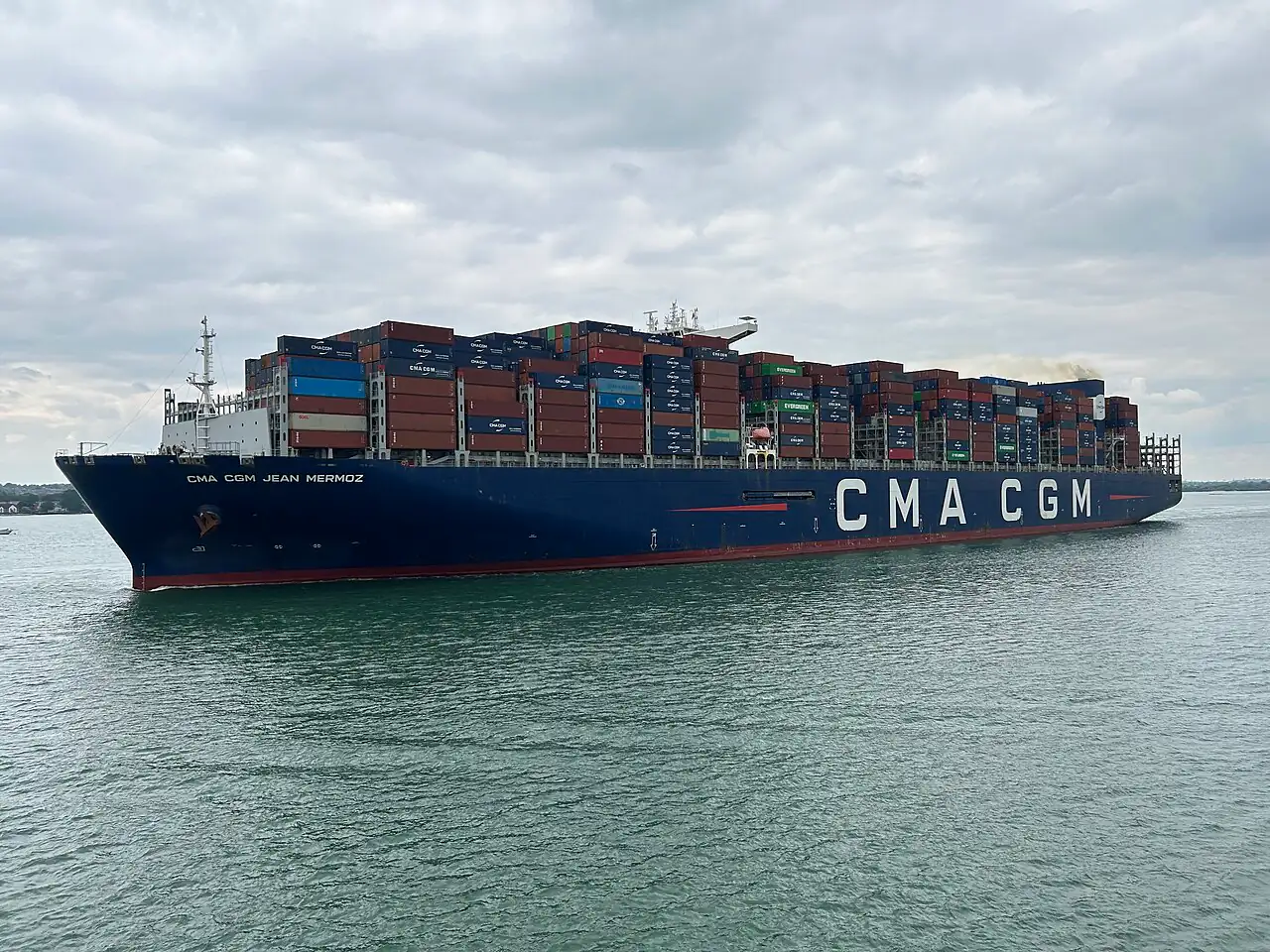
A container ship (also known as a boxship or containership) is a specialized type of cargo vessel designed specifically to transport goods in standardized intermodal containers. This method of transport, known as containerization, has revolutionized global commerce by allowing for the efficient, rapid, and secure movement of goods across multiple modes of transport—from ship to rail to truck—without the need to unpack and repack individual items.
The primary unit of measurement for a container ship’s capacity is the TEU (Twenty-foot Equivalent Unit). A standard 20-foot container is 1 TEU, while a standard 40-foot container is 2 TEU. Modern container ships are classified by their capacity, ranging from small “feeder” vessels carrying a few hundred TEUs to “Ultra Large Container Vessels” (ULCVs) that can carry well over 24,000 TEUs.
Unlike traditional break-bulk carriers, which require manual loading and unloading of individual crates, sacks, or barrels, container ships utilize standardized slots and specialized port equipment (like ship-to-shore cranes) to handle massive volumes of cargo with minimal human intervention. This efficiency is what allows the modern globalized economy to function, providing the scale necessary to move everything from high-end electronics and fashion to heavy machinery and consumer household goods across oceans in a predictable, cost-effective manner.
2. Mission and Operations
The mission of a container ship is to provide reliable, scheduled, and high-capacity transport for non-bulk seagoing cargo. Most container shipping operates on a liner service model, meaning ships follow fixed routes (strings) between major global ports on a strict schedule. This is analogous to a bus or train service for the ocean.
Hub-and-Spoke Model
To maximize efficiency, the container shipping industry utilizes a hub-and-spoke operational model. Large, ultra-efficient vessels (ULCVs) travel between major global maritime “hubs”—such as Singapore, Shanghai, Rotterdam, or Jebel Ali. These vessels carry massive quantities of cargo but are too large to enter many smaller ports.
Smaller vessels, known as feeder ships, then perform the “spoke” part of the operation. They pick up containers from the large hubs and distribute them to smaller regional ports. This allows shipping lines to serve a vast network of destinations while still benefiting from the economies of scale provided by the giant ocean-going vessels.
Intermodal Integration
A critical component of container ship operations is their integration with land-based logistics. The “intermodal” nature of the cargo means that a container loaded in a factory in inland China can be placed on a truck, moved to a rail terminal, loaded onto a container ship in Shanghai, and then transferred back to a truck or train in Los Angeles to reach a warehouse in the Midwest—all without the contents ever being touched. This seamlessness is the defining characteristic of modern maritime logistics.
3. Hull, Size, and Design
The design of a container ship is heavily dictated by the need for stability, capacity, and hydrodynamic efficiency. Because containers are stacked high on the deck and deep within the holds, the ship’s center of gravity and its response to waves are critical considerations.
Hull Geometry and Features
- Bulbous Bow: Almost all modern container ships feature a bulbous bow—a protruding structure at the front of the hull below the waterline. This bulb modifies the way water flows around the hull, reducing wave-making resistance and significantly improving fuel efficiency.
- Reduced Superstructure: To maximize the space available for container slots, the ship’s superstructure (the bridge and living quarters) is typically located toward the aft (rear) of the vessel and is kept as compact as possible.
- Cell Guides: Within the cargo holds, container ships use vertical steel rails known as cell guides. These guides ensure that containers are stacked precisely and safely, allowing them to be loaded and unloaded by cranes without shifting.
Classification by Size and Type
Container ships are categorized into several subclasses based on their dimensions and capacity:
| Class | Typical TEU Capacity | Description |
|---|---|---|
| Feeder | 500 – 3,000 | Small vessels used for regional routes and connecting smaller ports to hubs. |
| Panamax | 3,000 – 5,000 | Designed to fit through the original locks of the Panama Canal. |
| Post-Panamax | 5,000 – 10,000 | Larger than Panamax, typically exceeding the width of the old Panama locks. |
| New Panamax | 10,000 – 14,500 | Designed to fit through the expanded locks of the modern Panama Canal. |
| ULCV (Ultra Large) | 14,500 – 24,000+ | The giants of the sea, used for major transoceanic trade lanes. |
Ships are also classified by their loading capability:
- Geared: Equipped with their own deck cranes, allowing them to load and unload in ports that lack sophisticated shore-side infrastructure.
- Gearless: Most large container ships are gearless; they rely entirely on massive shore-based ship-to-shore (STS) cranes for cargo operations.
4. Propulsion and Engines
Propulsion is the most significant cost factor for container ships, primarily due to fuel consumption. Consequently, engine design focuses heavily on thermal efficiency and reliability.
The Slow-Speed Diesel Engine
The vast majority of container ships are powered by massive, two-stroke, low-speed diesel engines. These engines are designed to run at very low RPMs (often between 60 and 120 RPM), which allows them to be directly coupled to the propeller shaft without the need for a heavy and inefficient reduction gearbox.
Key characteristics include:
- High Torque: These engines produce enormous amounts of torque at low speeds, essential for moving a heavily laden vessel.
- Thermal Efficiency: Modern marine diesels are among the most efficient internal combustion engines in existence, converting a high percentage of fuel energy into mechanical work.
- Manufacturers: The market is dominated by a few key players, most notably MAN Energy Solutions (MAN B&W) and WinGD (formerly Wärtsilä).
Speed and Efficiency
While container ships are capable of speeds ranging from 16 to 25 knots, many operators employ “slow steaming”—reducing speed to significantly lower fuel consumption and reduce carbon emissions. Even a small reduction in speed can result in a disproportionately large saving in fuel.
Future Fuels and Dual-Fuel Technology
As the industry moves toward decarbonization, there is a massive shift toward dual-fuel engines. These engines can run on traditional heavy fuel oil (HFO) or very low sulfur fuel oil (VLSFO) but are also capable of using cleaner alternative fuels such as:
- Liquefied Natural Gas (LNG): Currently the most common alternative, significantly reducing sulfur and nitrogen oxide emissions.
- Methanol: Gaining rapid traction (e.g., Maersk’s recent investments) due to its easier handling compared to LNG.
- Ammonia and Hydrogen: Viewed as long-term “zero-carbon” candidates, though they present significant storage and safety challenges.
5. Electrical System and Power
A container ship is a floating power plant. Beyond propulsion, a massive amount of electrical energy is required to maintain the vessel’s systems and support its cargo.
Auxiliary Power Generation
While the main engine provides propulsion, a set of auxiliary engines (typically four-stroke diesel generators) provides electricity for the ship’s “hotel load” and cargo needs. These generators are arranged in a power management system that can automatically start or stop units based on the current demand.
Powering the Reefer Fleet
One of the most critical electrical requirements for modern container ships is the provision of power for reefer containers (refrigerated containers). These containers are used to transport perishable goods like fruit, meat, and pharmaceuticals. A large ULCV may have hundreds of reefer plugs distributed throughout the deck and holds, requiring a robust and highly redundant electrical distribution network to prevent cargo loss due to power failure.
Redundancy and Safety
Electrical systems are designed with multiple layers of redundancy. This includes:
- Emergency Generators: Located high up on the superstructure, these can automatically start and provide power to essential navigation, communication, and safety systems if the main generators fail.
- Uninterruptible Power Supplies (UPS): Used for critical bridge electronics to ensure no loss of data or control during brief power fluctuations.
6. Equipment and How It Is Used
The equipment on a container ship is specialized for the rapid movement of standardized boxes and the maintenance of vessel stability.
Cargo Securing Systems
Because container ships carry significant amounts of deck cargo, securing those containers against the forces of wind and heavy seas is paramount.
- Twistlocks: These are mechanical devices that lock the corners of containers together or to the ship’s structure.
- Lashing Rods and Turnbuckles: Used on deck to provide additional tension and prevent containers from shifting.
- Bridge Fittings: Used to secure containers in a continuous row.
Cell Guides
As mentioned in the design section, cell guides are the vertical steel structures within the cargo holds. They act like a guide rail, allowing containers to be lowered into place by a crane and ensuring they remain perfectly aligned as they are stacked. This prevents “stack collapse” and simplifies the loading process.
Stability and Ballast Management
A container ship’s stability is highly dynamic. As containers are removed or added, the ship’s center of gravity shifts. To counteract this, ships use ballast water tanks. By pumping seawater in or out of these tanks, the crew can control the ship’s trim (the longitudinal tilt) and list (the transverse tilt), ensuring the vessel remains stable and at an optimal draft for efficiency.
7. Navigation, Communications, and Safety
Operating a vessel that can be 400 meters long and carry tens of thousands of tons of cargo requires state-of-the-art technology.
Navigation Systems
- ECDIS (Electronic Chart Display and Information System): The modern standard for navigation, replacing paper charts. It integrates GPS, radar, and AIS data to provide a real-time digital map of the vessel’s surroundings.
- Radar (X-band and S-band): Used for detecting other vessels, landmasses, and weather patterns. X-band is better for fine detail, while S-band is better for detecting objects in heavy rain or fog.
- AIS (Automatic Identification System): A transponder system that broadcasts the ship’s position, speed, and identity to other ships and coastal authorities, significantly reducing collision risks.
Communications
Ships must remain in constant contact with shore-based authorities and other vessels. This is managed through the GMDSS (Global Maritime Distress and Safety System), which includes:
- VHF Radio: For short-range communication.
- Satellite Communications (Inmarsat): For long-range voice and data transmission.
- MF/HF Radio: For medium and high-frequency long-distance communication.
Safety Equipment
Safety is governed by the SOLAS (Safety of Life at Sea) convention. Essential equipment includes:
- Lifeboats and Liferafts: Specialized craft designed to be launched even in heavy seas.
- EPIRB (Emergency Position Indicating Radio Beacon): A device that automatically sends a distress signal with the ship’s location via satellite in the event of an emergency.
- Firefighting Systems: Including fixed CO2 or water-mist systems for engine rooms and cargo holds, as well as portable extinguishers and hydrants.
8. Crew and Organization
Despite high levels of automation, container ships require a professional, highly trained crew to manage operations, maintenance, and safety. The crew is organized into distinct departments.
Deck Department
Led by the Master (Captain), the deck department is responsible for navigation, cargo operations, and the overall safety of the vessel.
- Chief Mate: The second-in-command, responsible for cargo planning and stability.
- Officers (2nd/3rd Mates): Responsible for bridge watches and maintaining navigation equipment.
- Ratings (ABs and OSs): Able Seamen (AB) and Ordinary Seamen (OS) perform manual tasks, lookout duties, and maintenance.
Engine Department
Led by the Chief Engineer, this department is responsible for the operation and maintenance of the main engine, auxiliary engines, and all shipboard machinery.
- Engine Officers (2nd/3rd Engineers): Responsible for different sections of the engine room and technical maintenance.
- Electrician: A specialized officer responsible for the ship’s complex electrical systems.
- Ratings (Oilers and Wipers): Assist in the manual maintenance and lubrication of machinery.
Catering Department
The catering department ensures the well-being of the crew through food preparation and mess room maintenance. It typically includes a Cook and a Messman.
9. Certificates and Training Requirements
Maritime work is highly regulated to ensure that every person on board is capable of performing their duties safely.
STCW Convention
The primary international standard is the STCW (Standards of Training, Certification and Watchkeeping for Seafarers). This convention sets the minimum requirements for training, certification, and watchkeeping for all seafarers on ocean-going vessels. It ensures that a Mate or Engineer from one country meets the same competency standards as one from another.
Key Certifications
- Certificate of Competency (CoC): The primary professional license for officers.
- Endorsements: Recognition of a CoC by a different flag state.
- Medical Fitness Certificate: Required to ensure the crew is physically capable of working in a maritime environment.
- MLC (Maritime Labour Convention): Often referred to as the “Seafarers’ Bill of Rights,” this ensures decent working and living conditions for the crew.
10. Regulations, Class, and Inspections
The maritime industry is one of the most heavily regulated in the world, overseen by the IMO (International Maritime Organization).
Key IMO Conventions
- SOLAS (Safety of Life at Sea): Sets minimum standards for the construction, equipment, and operation of ships to ensure safety.
- MARPOL (Prevention of Pollution from Ships): The main international convention aimed at preventing pollution from ships, whether accidental or from routine operations (oil, sewage, garbage, air emissions).
- STCW: As mentioned, manages training and competency.
Classification Societies
While the IMO sets the rules, Classification Societies (such as DNV, ABS, Lloyd’s Register, and Bureau Veritas) are responsible for verifying that ships are built and maintained according to technical standards. They perform regular inspections and “surveys” to ensure the structural integrity and mechanical reliability of the vessel. A ship “in class” is one that meets the rigorous standards set by its chosen society.
Environmental Compliance (EEXI and CII)
In response to climate change, the IMO has introduced new regulations:
- EEXI (Energy Efficiency Existing Ship Index): A technical requirement for existing ships to improve their energy efficiency.
- CII (Carbon Intensity Indicator): An operational requirement that grades ships (from A to E) based on how efficiently they move cargo, incentivizing more sustainable operations.
11. Notable Shipyards, Operators, and Example Vessels
The container shipping industry is characterized by a few massive players and highly specialized manufacturing hubs.
Major Shipyards
The majority of the world’s largest container ships are built in East Asia, where massive industrial clusters provide the necessary scale and expertise.
- South Korea: HD Hyundai Heavy Industries, Samsung Heavy Industries.
- China: China State Shipbuilding Corporation (CSSC), Hudong-Zhonghua Shipbuilding.
Major Operators
A small number of global companies control the majority of the world’s container capacity.
- MSC (Mediterranean Shipping Company): Currently the world’s largest container line.
- Maersk: A pioneer of the industry and a leader in green technology.
- CMA CGM: A major French global carrier.
- COSCO: The dominant Chinese state-owned carrier.
- Hapag-Lloyd: A major German operator.
Example Vessels
- MSC Irina: One of the largest container ships in the world, part of the newest generation of ULCVs with a capacity exceeding 24,000 TEUs.
- Ever Given: A highly famous vessel that became a global news sensation when it became wedged in the Suez Canal in 2021, highlighting the vulnerability of global supply chains.
- Maersk Mc-Kinney Møller: A landmark vessel that pioneered the “Triple-E” class, focusing on extreme efficiency and low emissions.
- COSCO Guangzhou: A prime example of the “New Panamax” class, designed to maximize the capacity allowed by the expanded Panama Canal.
12. Environment and Future Outlook
The future of container shipping is defined by a single, massive challenge: Decarbonization. The industry is under intense pressure to reach net-zero greenhouse gas emissions by or around 2050.
The Path to Net-Zero
The transition away from fossil fuels is incredibly complex due to the energy density required for long ocean voyages. Several pathways are being explored:
- Alternative Fuels: As discussed, the industry is moving toward LNG, Methanol, and eventually Ammonia and Hydrogen.
- Wind-Assisted Propulsion: There is a resurgence of interest in using wind, not through traditional sails, but through modern technologies like rotor sails (Flettner rotors) or large, automated wing sails to supplement engine power.
- Operational Efficiency: Using AI and big data to optimize routes, speed, and trim to minimize fuel consumption.
Digitalization and Autonomy
The “Smart Ship” era is arriving. Digitalization is improving everything from cargo tracking to engine monitoring. We are also seeing the development of autonomous and semi-autonomous vessels, where AI-driven systems assist or, in the long term, replace human officers in certain navigation and engine room tasks, potentially increasing safety and reducing human error.
13. Facts, Records, and Common Misconceptions
- Misconception: Container ships are extremely fast. In reality, most container ships move at relatively modest speeds (16–25 knots). Speeding up significantly increases fuel consumption exponentially, making it economically unviable for most routes.
- Fact: Containerization changed the world. Before the 1950s, loading a ship was a slow, manual process. Containerization reduced the cost of shipping goods by orders of magnitude, enabling the mass production and global distribution we see today.
- Fact: The “Chokepoints” are vital. The global economy relies on a few narrow passages, like the Suez Canal and the Panama Canal. Any disruption in these areas (as seen with the Ever Given) can cause a massive ripple effect through the global supply chain.
14. Glossary
- AIS (Automatic Identification System): A tracking system used for identifying and locating vessels.
- Beam: The width of a ship at its widest point.
- Bulbous Bow: A protrusion at the bow that reduces wave resistance.
- CII (Carbon Intensity Indicator): An IMO rating for a ship’s operational carbon efficiency.
- ECDIS: Electronic Chart Display and Information System.
- Feeder Ship: A small container ship that services smaller ports.
- Gear / Gearless: Whether a ship has its own cranes or not.
- IMO (International Maritime Organization): The UN agency responsible for maritime safety and pollution prevention.
- Intermodal: Transporting goods using multiple modes of transport (ship, rail, truck) without unpacking.
- Knots: A unit of speed equal to one nautical mile per hour.
- Lashing: The process of securing containers to the ship.
- MARPOL: International convention for the prevention of pollution from ships.
- Panamax: Ships designed to fit the original Panama Canal locks.
- Reefer: A refrigerated container.
- SOLAS (Safety of Life at Sea): The primary international convention for ship safety.
- STCW: International standard for maritime training and certification.
- TEU (Twenty-foot Equivalent Unit): The standard unit of measurement for container capacity.
- ULCV (Ultra Large Container Vessel): The largest class of container ships.