1. What Is This Ship?
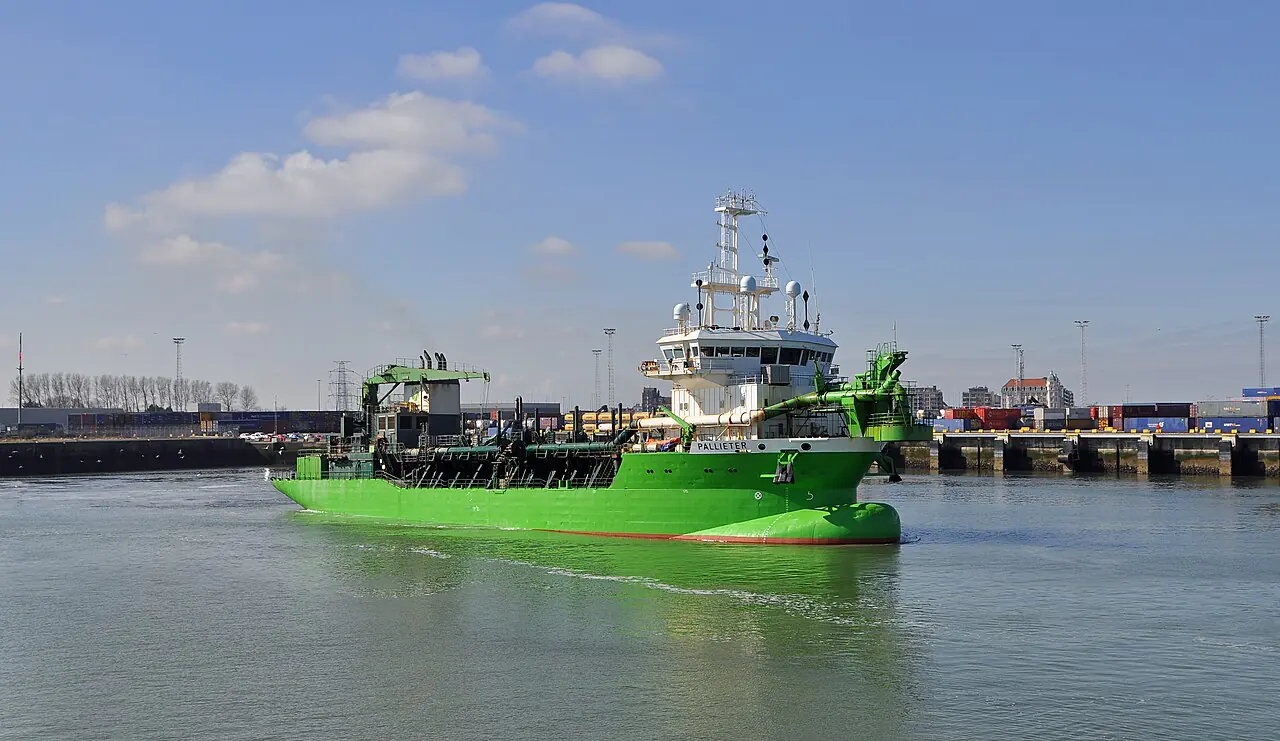
A dredger is a highly specialized vessel or floating plant designed to excavate material from a water environment—be it a seabed, riverbed, or lakebed. Unlike standard cargo or passenger vessels, the primary function of a dredger is not just transportation, but the active manipulation and relocation of the underwater terrain.
Dredging serves several critical functions in the modern world. It is essential for maintaining navigational channels and ports, ensuring that large commercial vessels can safely enter and exit harbors. It is also the cornerstone of land reclamation projects, where seabed material is “mined” and then used to create new land for urban development, airports, or industrial zones. Furthermore, dredging is used in mineral extraction (recovering sand, gravel, or precious metals) and for environmental remediation (removing contaminated sediments from water bodies).
Dredgers are broadly categorized into two primary technological families: Mechanical Dredgers and Hydraulic Dredgers. Mechanical dredgers use physical tools like buckets or clamshell grabs to lift material, making them ideal for hard-packed sediments or debris. Hydraulic dredgers, on the other hand, use water pressure and suction to move material in a slurry form, offering much higher efficiency for large-scale, continuous operations.
2. Mission and Operations
The fundamental operational cycle of a dredger follows a three-stage process: Excavation, Transport, and Disposal. The specific mechanics of these stages vary wildly depending on the vessel type.
Navigational Maintenance
Ports and shipping lanes are subject to constant sedimentation from river discharge and coastal erosion. Dredgers perform “maintenance dredging” to restore the design depth of these channels. This is often a routine, scheduled operation. In large ports like Singapore or Rotterdam, this is a continuous, non-stop endeavor.
Land Reclamation and Construction
In many parts of the world, land is scarce. Dredgers are used to “create” land by extracting seabed material and depositing it in a designated area. This material is often highly controlled; for instance, clean sand is used for construction, while finer silts might be used for creating wetlands or marshlands. This process is central to massive projects like the Palm Islands in Dubai or the expansion of Singapore’s landmass.
Operational Modalities
- Continuous Operation (Cutter Suction): A Cutter Suction Dredger (CSD) excavates material continuously and pumps it through a long pipeline directly to a discharge point. This is highly efficient for large-scale projects with a fixed destination, such as building a new coastline or deepening a canal.
- Batch Operation (Hopper Dredging): A Trailing Suction Hopper Dredger (TSHD) acts more like a traditional ship. It “vacuums” up a load of material, stores it in its internal hold (the hopper), sails to a disposal site, and unloads it. This is ideal for long-distance transport where a fixed pipeline is impractical.
- Mechanical Excavation: Using grabs or buckets, these vessels work in a “bite and lift” cycle. This is often used in tight spaces, such as inner harbors or near old piers, where precision is required but large-scale suction is impossible.
3. Hull, Size, and Design
Dredger hulls are engineered to balance two competing needs: the stability required for heavy excavation and the buoyancy/speed required for efficient transport.
Trailing Suction Hopper Dredger (TSHD) Design
TSHDs are characterized by a large internal “hopper” or hold. The hull is typically deep and wide to accommodate the massive weight of the dredged material. Because they must sail between job sites, TSHDs are designed with hydrodynamic efficiency in mind. They often feature reinforced hulls to withstand the impact of heavy sediment loads and the stresses of operating in varying sea states.
Cutter Suction Dredger (CSD) Design
CSDs are often stationary during operation. They rely on spuds—large, heavy steel poles that are lowered into the seabed to anchor the vessel and provide a pivot point. This allows the dredging ladder (the arm holding the cutterhead) to swing back and forth with extreme precision. The hulls of CSDs are often flatter to allow for stability while the heavy dredging arm is extended. Some CSDs are also designed as “self-propelled” units, allowing them to move between job sites, though they are generally slower than TSHDs.
Mechanical Dredger Design
These vessels (like grab or dipper dredgers) are often more compact and maneuverable. They may be purpose-built vessels or even modified barges equipped with crane-like structures. Their design focuses on maximizing the lifting capacity and reach of the mechanical arms.
| TSHD Class | Typical Dimensions (L x W x D) | Max Dredging Depth | Hopper Capacity |
|---|---|---|---|
| Small | 55 x 10 x 4 m | 10 – 35 m | < 4,000 m³ |
| Mid-size | 90 x 18 x 7 m | 25 – 55 m | < 8,000 m³ |
| Large | 130 x 23 x 9 m | 25 – 75 m | < 15,000 m³ |
| Jumbo | 180 x 32 x 13 m | 50 – 120 m | < 30,000 m³ |
| Mega | 225 x 38 x 12–15.5 m | 55 – 155 m | > 30,000 m³ |
4. Propulsion and Engines
Propulsion on a dredger must handle two distinct modes: high-power, low-speed maneuvering during dredging, and efficient, higher-speed transit during sailing.
Propulsion Technologies
- Azimuth Thrusters: Modern dredgers increasingly use azimuth thrusters (often in a Pod or Azipod configuration). These allow for 360° steering, providing the extreme maneuverability required to follow a precise dredging pattern or maintain position in heavy currents. They are essential for TSHDs that must navigate tight channels or maintain precise heading while trailing their suction pipes.
- Diesel-Electric Propulsion: This is the gold standard for large dredgers. Instead of a direct mechanical link between the engine and the propeller, diesel generators produce electricity, which then powers electric propulsion motors. This allows for much finer control over power distribution, especially when the vessel needs to divert massive amounts of energy from propulsion to the dredging pumps.
- Hybrid Systems: To reduce fuel consumption and emissions, many new vessels utilize hybrid setups, combining diesel generators with battery banks or using shore power during port stays. This is particularly useful for vessels operating in environmentally sensitive areas or near urban centers.
Engine Configurations
Most large-scale dredgers utilize medium-speed diesel generator sets. For example, the vessel Anchorage utilizes three Mitsubishi SU medium-speed diesel generators. These sets are often configured to run in parallel, allowing the crew to scale power up or down depending on whether the ship is simply sailing, dredging, or performing a heavy unloading operation. This modularity is a key component of modern energy management.
5. Electrical System and Power
The electrical system of a dredger is often more complex than its propulsion system. A dredger is essentially a floating power plant that must drive massive hydraulic and centrifugal pumps.
Power Management and Distribution
- Dynamic Power Management Systems (DPMS): Because dredging involves sudden, massive loads (e.g., when a cutterhead hits a hard rock or a suction pipe becomes clogged), a DPMS is critical. It monitors the load on all generators and automatically manages the distribution to prevent blackouts. This system is the “brain” of the vessel’s power grid.
- Variable Frequency Drives (VFDs): VFDs are used extensively to control the speed of the large electric motors driving the pumps and thrusters. This allows for much higher efficiency and more precise control over the dredging process, enabling the operator to adjust the suction flow rate in real-time.
- High-Voltage Distribution: Large dredgers operate on high-voltage systems (often several kilovolts) to minimize energy loss through the ship’s internal cabling while supplying the hundreds of megawatts required for heavy-duty dredging.
6. Equipment and How It Is Used
The “business end” of a dredger is its specialized dredging installation.
TSHD Components
- Dragheads: These are the “mouths” of the suction pipes. They are dragged along the seabed, often equipped with specialized nozzles to increase suction efficiency.
- Suction Pipes & Pumps: Large-diameter pipes transport the slurry (sand/water mix) from the seabed to the hopper. Centrifugal pumps, often driven by massive electric motors, provide the suction necessary to pull material up from the seabed.
- The Hopper: A massive internal hold that stores the dredged material. Its design must account for the immense weight and the abrasive nature of the sediment.
- Overflow System: When the hopper is nearly full, the water is separated from the sediment. The excess water is discharged through an overflow pipe, which helps concentrate the solid material in the hopper. This process is vital for maximizing the efficiency of each trip.
- Unloading Valves: Large doors or valves at the bottom of the hopper allow the vessel to dump its load at a disposal site. This can be done via bottom-dumping or, in some cases, by pumping the material out.
CSD Components
- Cutterhead: A rotating head with specialized teeth (made of hardened steel or tungsten carbide) that grinds and loosens hard seabed material. The cutterhead’s design is critical for the type of material being excavated.
- Dredging Ladder: The structural arm that carries the cutterhead and the suction pipe. It can be raised and lowered to control the depth of the cut.
- Discharge Pipeline: A floating or submerged pipe that carries the slurry from the ship to the reclamation area.
Mechanical Tools
- Clamshell/Grab: A heavy bucket suspended by cables, used for picking up large rocks, debris, or hard-packed mud.
- Dipper: A bucket attached to a mechanical arm, similar to an excavator, used for more controlled, localized excavation.
7. Navigation, Communications, and Safety
Precision is the hallmark of modern dredging. A few meters of error can mean a damaged pipeline or a failed navigational channel.
Precision Positioning
- RTK GPS (Real-Time Kinematics): Standard GPS is not precise enough for dredging. RTK GPS uses a local base station to provide “survey-grade” accuracy, often to within a few centimeters. This allows operators to know the exact position of a suction head or a grab bucket underwater.
- Acoustic Positioning: In deep waters where GPS signals cannot reach the seabed, acoustic transponders are used to track the position of underwater equipment. This is a vital fallback for deep-sea dredging operations.
Control Systems
- SCADA (Supervisory Control and Data Acquisition): Dredgers utilize advanced PLC-based (Programmable Logic Controller) control systems. These are monitored via HMI (Human-Machine Interface) workstations in the control room, allowing operators to manage everything from engine temperature to pump pressure and suction depth. This centralized control is essential for the coordination of the many complex sub-systems onboard.
Safety and Monitoring
Advanced alarm systems monitor engine health, hydraulic pressure, and environmental sensors. Onboard radar and AIS (Automatic Identification System) are standard for preventing collisions in busy shipping lanes.
8. Crew and Organization
A dredger requires a dual-specialized crew: traditional maritime officers for navigation and engineering, and specialized dredging personnel for the excavation operations.
Key Roles
- Dredge Master: The highest authority on the vessel, responsible for the overall safety and successful execution of the dredging plan.
- Dredging Engineer: A technical specialist who manages the dredging installation, ensuring that the pumps, cutterheads, and hydraulics are operating within design parameters.
- Dredge Operators/Drivers: Specialized personnel who operate the suction controls, the cutterhead, or the mechanical grabs.
- Deck/Engine Crew: Standard maritime personnel responsible for the vessel’s maintenance, propulsion, and general seamanship.
The organization often follows a hierarchical structure similar to cargo ships but with a much heavier emphasis on the “Dredging Department” which operates in tandem with the “Deck” and “Engine” departments.
9. Certificates and Training Requirements
Due to the complexity and danger of the machinery, dredging requires specific certifications that go beyond standard STCW (Standards of Training, Certification, and Watchkeeping) maritime requirements.
Specialized Dredging Certificates
Many national maritime authorities (such as those in India or the UK) issue specific grades of competency for dredging personnel. Common grades include:
- Dredge Driver (Grade I & II): Focused on the operation of the dredging machinery.
- Dredge Engineer (Grade I & II): Focused on the maintenance and operation of the complex hydraulic and electrical systems.
Training Pathways
These certifications typically require:
- Apprenticeship: Significant time spent as a fitter or apprentice on specialized dredging machinery.
- Sea Service: A documented number of days (often 240+ days) specifically performing dredging operations on a motor-driven vessel.
- Technical Exams: Rigorous testing on hydraulics, electrical systems, and dredging-specific mechanics.
10. Regulations, Class, and Inspections
Dredgers must comply with both international maritime law and specialized classification society rules.
International Standards
- IMO (International Maritime Organization): Governs general safety, pollution prevention (MARPOL), and navigation.
- Classification Societies: Organizations like DNV, Lloyd’s Register (LR), ABS, and Bureau Veritas (BV) establish technical standards for hull construction, machinery, and electrical systems. A dredger must be “in class” to be insured and to operate in major ports.
Inspections
Dredgers undergo regular, rigorous inspections. These include:
- Special Surveys: Deep inspections of the hull and structural integrity (crucial for TSHDs with heavy hoppers).
- Machinery Inspections: Checking the reliability of massive pumps and diesel-electric systems.
- Dredging Equipment Testing: Ensuring that dragheads, cutterheads, and emergency shut-off valves function correctly.
11. Notable Shipyards, Operators, and Example Vessels
The dredging industry is dominated by a handful of highly specialized global companies and world-class shipyards.
Major Dredging Companies
- Jan De Nul (Belgium): A global leader known for advanced TSHDs and cutter suction technology.
- DEME (Belgium): One of the largest dredging contractors in the world, specializing in complex marine engineering.
- Royal Boskalis (Netherlands): A powerhouse in both dredging and maritime infrastructure.
- Van Oord (Netherlands): Renowned for large-scale land reclamation and coastal protection.
- China Harbour Engineering (China): A major player in large-scale international infrastructure projects.
- Great Lakes Dredge & Dock (USA): The primary dredging specialist in North America.
Notable Shipyards
- Barkmeijer Shipyards (Netherlands): Highly respected for designing and building advanced, diesel-electric dredgers like the Anchorage.
Example Vessels
- Jan De Nul’s Cristobal Colon & Leiv Eriksson: Some of the largest and most capable TSHDs ever built.
- MV Tian Kun Hao (China): A massive 140-meter dredger capable of enormous throughput.
- The Anchorage: A prime example of modern diesel-electric, high-efficiency dredging design.
- Cassiopeia V: A notable large cutter suction dredger.
12. Environment and Future Outlook
Dredging is a double-edged sword: it is essential for human infrastructure but can be highly disruptive to marine ecosystems.
Environmental Impacts
- Turbidity and Sediment Plumes: The process of dredging disturbs the seabed, creating clouds of suspended sediment (plumes). This can block sunlight for seagrass, clog fish gills, and spread toxins through the water column.
- Noise Pollution: Dredgers generate significant, continuous broadband noise (typically below 1 kHz). This can interfere with the communication and navigation of marine mammals, such as whales and dolphins.
- Benthic Destruction: The physical removal of the seabed can destroy the habitats of organisms living on or in the sediment.
- Release of Contaminants: Dredging can “unearth” legacy pollutants (heavy metals, PCBs) that were buried in the sediment, making them bioavailable again.
The Future of Dredging
- Electrification and Hybridization: Reducing the carbon footprint through electric propulsion and shore power.
- Precision Dredging: Using AI and better sensor data to minimize the volume of material moved and the extent of sediment plumes.
- Circular Economy: Developing better ways to reuse dredged material (e.g., turning silt into construction bricks or artificial reefs) rather than just dumping it.
- Autonomous Dredging: The integration of unmanned surface vessels (USVs) and remote-controlled dredging systems could significantly reduce the human risk and operational costs of dredging in extreme or remote environments.
13. Facts, Records, and Common Misconceptions
- Misconception: “Dredging is just digging a hole.” In reality, it is a highly complex logistics and fluid-dynamics operation involving massive energy management.
- Fact: Dredging is a global necessity. Without it, almost no major modern port (Singapore, Rotterdam, New York) would be functional.
- Misconception: “All dredgers are the same.” A TSHD is a completely different beast from a CSD or a mechanical grab dredger; they are specialized for entirely different tasks.
- Fact: Dredging can be used for environmental protection. While it can be disruptive, it is also used to remove contaminated sediments and restore natural habitats.
14. Glossary
- Azimuth Thruster: A propulsion unit that can rotate 360 degrees for precise maneuvering.
- Cutterhead: The rotating grinding tool at the end of a CSD’s ladder.
- Draghead: The suction nozzle used by TSHDs to collect material.
- Hopper: The large internal hold in a TSHD used to store dredged material.
- Hybrid Propulsion: A system combining diesel and electric power for efficiency.
- RTK GPS: A high-precision positioning system used for sub-inch accuracy.
- Slurry: A mixture of water and suspended solids (sand/silt) transported through pipes.
- Spud: A heavy steel pole used to anchor a dredger to the seabed.
- Turbidity: The cloudiness or haziness of water caused by suspended sediment.
- VFD (Variable Frequency Drive): An electronic device used to control the speed of electric motors.