1. What Is This Ship?
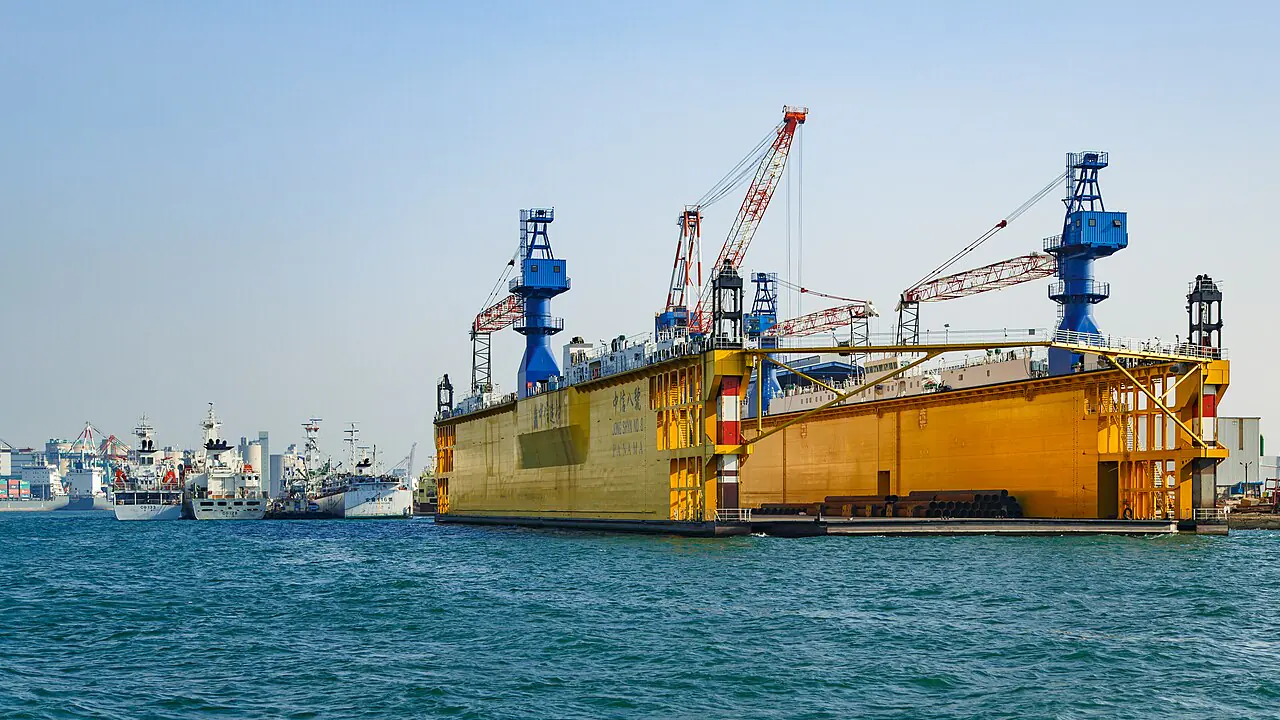
A floating dry dock (FDD) is not a ship in the traditional sense of a vessel designed for transit, but rather a specialized maritime facility designed to provide a stable, dry platform for the repair, maintenance, and construction of other vessels. It functions as a mobile extension of a shipyard’s land-based infrastructure, offering unparalleled flexibility in where and how ship repairs can be conducted.
At its core, a floating dry dock operates on the fundamental principle of buoyancy as defined by Archimedes’ principle. By controlling the amount of water within internal ballast tanks, the dock can change its draft—either submerging itself to allow a vessel to float over its platform or deballasting to lift the vessel completely out of the water. This capability makes it an indispensable tool in the global maritime industry, especially for repairing large vessels in locations where permanent graving docks (land-based dry docks) are unavailable or impractical.
2. Mission and Operations
The primary mission of a floating dry dock is to provide a controlled environment for hull-related operations. These operations are critical for the seaworthiness, efficiency, and longevity of any vessel.
Primary Functions:
- Hull Maintenance and Repair: Cleaning hulls (removal of biofouling), repairing structural damage, coating applications (anti-fouling paints), and inspecting the underwater hull.
- Propulsion and Steering Gear Maintenance: Facilitating access to propellers, shafts, rudders, and thrusters, which are otherwise submerged and inaccessible.
- Sea Valve and Sensor Inspection: Allowing for the opening and inspection of sea chests, valves, and other through-hull penetrations.
- Ship Launching: In some shipyard configurations, floating docks are used to launch newly constructed vessels by providing a controlled lifting mechanism.
- Ship Recycling: As highlighted by recent industry trends (e.g., the Conoship design), floating docks are increasingly being utilized in the ship recycling sector to provide a more environmentally controlled and safer alternative to traditional beaching methods.
The Docking Cycle:
The operation of a floating dry dock follows a highly choreographed sequence of events:
- Preparation: The dock is positioned at the repair site, often assisted by tugs. The docking blocks (keel and bilge blocks) are precisely aligned on the dock’s floor according to the dimensions and shape of the incoming vessel.
- Submergence (Ballasting): Water is pumped into the dock’s ballast tanks located in the pontoon and/or wing walls. As the weight increases, the dock’s buoyancy is overcome, and it sinks to a predetermined depth (the “submerged draft”).
- Vessel Entry: The vessel to be repaired enters the dock, carefully guided by tugs or the dock’s own propulsion if it is a self-propelled model.
- Securement: Once the vessel is positioned over the blocks, the deballasting process begins. As water is removed, the dock rises, and the vessel’s weight is progressively transferred from its own buoyancy to the docking blocks.
- Emergence (Deballasting): The dock continues to rise until the vessel’s keel is well clear of the water, providing full access to the hull.
- Repair Phase: Maintenance, repairs, and inspections are carried out.
- Re-floating: Once work is complete, the dock is ballasted to submerge, the vessel is released, and the dock is deballasted to lift the vessel back to its operating draft.
3. Hull, Size, and Design
The design of a floating dry dock is a complex exercise in naval architecture, balancing buoyancy, stability, and structural strength. A floating dock’s anatomy can be divided into three primary components: the pontoon, the wing walls, and the ballast system.
Component Breakdown:
| Component | Description | Function |
|---|---|---|
| Pontoon | The horizontal base or bottom of the dock. | Provides the primary buoyancy and serves as the floor for the docking blocks. |
| Wing Walls | Vertical side structures extending upward from the pontoon. | Provide additional buoyancy, house ballast tanks, and offer protection/stability. |
| Ballast Tanks | Compartments within the pontoon and wing walls. | Control the dock’s draft by varying the amount of water held within. |
| Docking Blocks | Specialized supports placed on the pontoon. | Transfer the weight of the vessel to the dock’s structure. |
Design Classifications:
- Non-Self-Propelled (Towed) Docks: These are the most common type. They lack independent propulsion and must be moved to and from the repair site using tugboats. They are generally more cost-effective and simpler to design.
- Self-Propelled (Self-Docking) Docks: These are equipped with their own engines and propulsion systems (such as thrusters), allowing them to maneuver independently. While more expensive, they offer greater operational flexibility and can respond more quickly to urgent repair needs.
Dimensions and Scale:
Floating dry docks vary enormously in size. Small docks might be used for tugs or fishing vessels, while massive industrial docks are designed to accommodate the largest vessels afloat.
- Small/Medium Docks: Typically 50–150 m in length, suitable for coastal vessels, tugs, and medium-sized cargo ships.
- Large Industrial Docks: Can exceed 300–400 m in length (e.g., the Zhonghai Emeishan at 410 m). These are capable of docking Ultra Large Container Vessels (ULCVs), Very Large Crude Carriers (VLCCs), and even large cruise ships.
The structural design must account for the extreme stresses encountered during the docking/undocking process, particularly the longitudinal forces and the concentrated loads from the vessel’s keel. For more on the fundamental principles of hull maintenance, see drydocking-hull-maintenance-and-corrosion-protection.md.
4. Propulsion and Engines
In the context of a floating dry dock, “propulsion and engines” refers to the two critical power-related systems: the pumping systems used for buoyancy control and the propulsion systems (if the dock is self-propelled).
Pumping and Manifold Systems:
The most critical “engine” of a floating dry dock is its pumping system. The ability to rapidly and precisely control the water level in the ballast tanks is what makes the docking process possible.
- High-Capacity Pumps: Large centrifugal or submersible pumps are used to move massive volumes of water. These must be highly reliable, as any failure during the deballasting phase could result in the vessel settling onto the blocks prematurely or unevenly.
- Pumping Manifolds: A complex network of pipes, valves, and manifolds connects the pumps to the various ballast compartments in the pontoon and wing walls. This manifold allows operators to distribute water (or air, in some pneumatic systems) to specific tanks to manage the dock’s trim and list.
- Redundancy: Due to the high stakes, pumping systems are designed with significant redundancy. This includes multiple pump units and independent manifold lines to ensure that the failure of a single component does not compromise the entire operation.
Self-Propulsion Systems (If Applicable):
For self-propelled docks, the propulsion system typically includes:
- Diesel Engines/Generators: Providing the mechanical power for propulsion and electrical power for the dock’s systems.
- Thrusters: Often azimuth thrusters or tunnel thrusters, which provide high maneuverability in tight shipyard environments.
5. Electrical System and Power
The electrical infrastructure of a floating dry dock is as critical as its pumping system. It must support both the dock’s own operational needs and the intensive power requirements of the vessel being repaired.
Onboard Power Generation
Most floating dry docks are equipped with their own power plant, typically consisting of multiple large diesel generators. This provides autonomy, especially for towed docks that may be operating in remote locations or far from a shipyard’s main grid. The electrical system must be robust enough to handle:
- Pumping Loads: Starting large electric motors for high-capacity pumps creates significant transient loads on the electrical grid.
- Lighting and Auxiliary Systems: Continuous power for navigation lights, internal lighting, and control systems.
- Control Systems: Powering the sophisticated electronic control units used to manage ballast, pumps, and docking alignments.
Shore-to-Dock Connection
In shipyard environments, floating docks are often connected to the shore power grid. This “shore connection” can reduce the reliance on onboard diesel generators, lowering fuel consumption and emissions. Large-scale cable connections or busbars are used to facilitate this transfer.
Powering the Docked Vessel
One of the most important roles of the floating dock is to act as a power provider for the vessel under repair. When a ship is docked, it often shuts down its own main engines and auxiliary generators to allow for maintenance. The floating dock must provide:
- Shore Power (Cold Ironing): Supplying high-voltage electricity to the vessel’s main switchboards, allowing it to maintain lighting, HVAC, and essential machinery.
- Auxiliary Power: Providing smaller-scale power for specific repair tasks, such as welding, grinding, or running specialized testing equipment.
6. Equipment and How It Is Used
Beyond the structural components and pumps, a floating dry dock is equipped with a variety of specialized tools and equipment essential for ship repair and maintenance.
Docking Blocks (Keel and Bilge Blocks)
The most critical equipment for the physical support of the vessel is the set of docking blocks.
- Keel Blocks: These are heavy, stable blocks placed directly under the vessel’s keel. They are designed to bear the primary longitudinal weight of the ship.
- Bilge Blocks: These are positioned against the vessel’s bilge (the curved part of the hull where the bottom meets the sides). They prevent the vessel from rolling or shifting laterally during the docking and emergence processes.
- Alignment: Accurate alignment is paramount. Modern docks utilize laser-guided systems or precision manual measurement to ensure the blocks are perfectly positioned relative to the vessel’s centerline and structural members.
Crane Systems
Access to various parts of the hull and internal machinery often requires heavy lifting capabilities.
- Onboard Cranes: Many floating docks are equipped with their own cranes (often mounted on the wing walls) to move equipment, materials, and small components around the dock floor.
- Shore-Based Cranes: In a shipyard setting, large shore-based gantry or jib cranes are often used in conjunction with the floating dock to move heavy items like engine parts, propeller shafts, or large sections of the hull.
Specialized Repair Tools
The dry dock environment also hosts a suite of specialized equipment:
- High-Pressure Water Jetting: For cleaning hulls and removing biofouling.
- Welding and Cutting Equipment: For structural repairs and modifications.
- Sandblasting/Abrasive Blasting Equipment: For preparing hull surfaces for new coatings.
- Scaffolding and Access Platforms: To provide safe working heights for technicians.
7. Navigation, Communications, and Safety
Navigation and Maneuvering
While many docks are towed, maneuvering them into position is a high-precision task.
- Tug Assistance: The primary method for moving non-self-propelled docks. Tugs must work in concert with the dock master to ensure a smooth and controlled approach.
- Self-Propulsion (for Self-Docking Docks): Utilizing onboard engines and thrusters for independent movement.
- Positioning Systems: Using GPS and other electronic aids to maintain precise positioning during the docking and undocking cycles.
Communication
Clear, uninterrupted communication is essential for the safety of the operation.
- Dock Master to Tugs: Coordinating the movement of the dock.
- Dock Master to Vessel: Communicating with the captain of the vessel entering the dock.
- Internal Communication: Ensuring coordination between pump operators, crane operators, and the deck crew.
Safety Protocols
The docking operation is inherently high-risk, involving massive weights, moving machinery, and the potential for sudden shifts in stability.
- Stability Monitoring: Continuous monitoring of the dock’s metacentric height (), trim, and list is mandatory.
- Emergency Deballasting: Systems must be in place to rapidly deballast the dock in the event of an emergency (e.g., a vessel shifting or a sudden structural failure).
- Firefighting and Life Safety: The dock must be equipped with appropriate firefighting equipment and provide safe egress routes for the crew and workers.
- Personnel Safety: Rigorous protocols for working at heights, in enclosed spaces, and around heavy lifting operations.
8. Crew and Organization
The successful operation of a floating dry dock requires a highly trained and coordinated team.
Key Roles:
- Dock Master: The commanding officer of the docking operation. They are responsible for the overall safety and success of the docking/undocking cycles and coordinate all personnel.
- Dock Engineers: Responsible for the mechanical and electrical integrity of the dock, including the pumping systems and power generation.
- Pump Operators: Specialized technicians who manage the ballast and pumping manifolds.
- Crane Operators: Responsible for the safe movement of loads using onboard or shore-based cranes.
- Divers: Often required for underwater inspections or to assist in the placement of docking blocks.
- Shipwrights and Technicians: The workforce performing the actual repair and maintenance tasks on the vessel.
9. Certificates and Training Requirements
Operating a floating dry dock is a specialized discipline that falls under both maritime and industrial safety regulations.
Training Requirements
Personnel working on or with a floating dry dock must undergo specific training, including:
- Stability and Ballast Management: Crucial for pump operators and dock engineers to prevent catastrophic instability.
- Heavy Lift Operations: For crane operators and deck crew to ensure safe movement of large components.
- Emergency Response: Training in firefighting, man-overboard, and emergency deballasting procedures.
- Confined Space Entry: For personnel performing inspections within ballast tanks or other enclosed compartments.
Certifications
While individual certifications vary by jurisdiction, key requirements include:
- Classification Society Certificates: The dock itself must be classed by an organization like ABS, DNV, or LR, verifying it meets structural and operational standards.
- Competency Certificates: Operators of specialized equipment (e.g., cranes, large-scale pumps) often require formal certification.
- Safety Management Certificates: Compliance with the International Safety Management (ISM) Code or equivalent national standards.
10. Regulations, Class, and Inspections
Floating dry docks are subject to rigorous regulatory oversight to ensure they remain safe and seaworthy throughout their operational lives.
Classification Societies
The most significant regulatory oversight comes from classification societies, such as the American Bureau of Shipping (ABS), DNV (Det Norske Veritas), and Lloyd’s Register (LR). These organizations develop and enforce the rules for the design, construction, and maintenance of floating docks.
- ABS Rules for Steel Floating Dry Docks: These rules provide the technical foundation for everything from hull thickness and compartmentation to the capacity of the pumping machinery. Adherence to these rules is what allows a dock to be “classed,” which is often a requirement for insurance and shipyard operations.
Inspections and Surveys
To maintain their class, floating dry docks must undergo regular, scheduled inspections:
- Annual Surveys: A general inspection of the dock’s condition, including its machinery and stability systems.
- Special Surveys: Typically occurring every 5 years, these are much more intensive and may involve underwater inspections (diver-led or ROV) of the pontoon and wing walls, as well as detailed testing of all ballast and pumping systems.
- Damage Surveys: Required following any significant incident, such as a collision or a major structural failure.
Regulatory Frameworks
In addition to classification rules, floating docks must comply with:
- IMO (International Maritime Organization) Standards: Specifically those related to safety, pollution prevention, and structural integrity.
- National Maritime Authorities: (e.g., US Coast Guard) regulating the operation and safety of docks within national waters.
11. Notable Shipyards, Operators, and Example Vessels
Floating dry docks are found in shipyards worldwide, from small regional repair facilities to massive industrial complexes.
Major Industrial Examples
- Zhonghai Emeishan (China): One of the largest floating dry docks in the world, measuring approximately 410 m in length and 82 m in width. It is a cornerstone of China’s massive shipbuilding and repair industry.
- Heger Dry Dock (USA): A prominent provider of floating dry dock services in the United States, specializing in large-scale vessel repair.
- Major Asian Shipyards: Large-scale yards in South Korea (e.g., Hyundai Heavy Industries) and Japan utilize massive floating docks to support their world-leading shipbuilding operations.
Summary Table of Representative Dock Types
| Type | Typical Length | Typical Use Case |
|---|---|---|
| Small Repair Dock | 30–70 m | Tugs, fishing vessels, small coasters |
| Medium Commercial Dock | 70–180 m | Handysize bulkers, medium tankers, container ships |
| Large Industrial Dock | 200–450 m | VLCCs, ULCVs, large cruise ships |
| Specialized Recycling Dock | Varies | Ship dismantling and recycling operations |
For more on the global landscape of shipyards, see major-global-and-norwegian-shipyards.md.
12. Environment and Future Outlook
The maritime industry is undergoing a period of significant transformation, and floating dry docks are part of this evolution.
Environmental Impact and Ship Recycling
Traditionally, ship recycling (the dismantling of end-of-life vessels) has often been conducted via “beaching,” where ships are run onto shores. This practice poses significant environmental risks due to the potential release of hazardous materials into coastal ecosystems. Floating dry docks offer a much cleaner and safer alternative. By providing a controlled, contained environment for dismantling, they allow for the more efficient and environmentally responsible recovery of materials. The Conoship concept is a prime example of this trend, designing versatile floating docks specifically to support high-capacity, environmentally focused ship recycling.
Decarbonization and Green Shipyards
As the industry moves toward decarbonization, the operations of the dry docks themselves are also changing:
- Electrification: Increasing use of shore power and electric-powered pumping systems to reduce reliance on diesel.
- Energy Efficiency: Optimizing the docking/undocking cycle and the use of advanced materials to reduce the energy footprint of shipyard operations.
- Digitalization: Using real-time sensors and digital twins to monitor dock stability, structural health, and pumping efficiency, allowing for predictive maintenance and more optimized operations.
13. Facts, Records, and Common Misconceptions
Common Misconceptions
- “A dry dock is just a hole in the ground”: While graving docks are indeed excavations, a floating dry dock is a complex, buoyant, and mobile machine.
- “They cannot be moved”: Many people assume dry docks are permanent fixtures. However, the very nature of a floating dock is its mobility, allowing it to be towed to wherever the need is greatest.
- “They are essentially just big barges”: While they share some design similarities with barges, the precision of their ballast control, the sophistication of their structural design for concentrated loads, and their specialized equipment make them far more complex.
Interesting Facts
- The largest floating dry docks are often among the most impressive engineering feats in any shipyard, capable of lifting hundreds of thousands of tons.
- The history of floating dry docks is closely tied to the evolution of naval warfare and the need to repair large fleets far from permanent land bases.
14. Glossary
- Ballast: Heavy material (usually water) placed in tanks to control a vessel’s weight, buoyancy, and stability.
- Bilge Block: A support block placed against the bilge of a vessel to prevent lateral movement.
- Buoyancy: The upward force exerted by a fluid that opposes the weight of an object immersed in it.
- Docking Cycle: The complete process of submerging, docking, and emerging a vessel.
- Hogging: A structural condition where the center of a vessel is higher than its ends, causing it to bend upward.
- Keel Block: A support block placed directly under the vessel’s keel to bear its primary weight.
- Metacentric Height (GM): A measurement of the initial static stability of a floating body.
- Pontoon: The main horizontal structural base of a floating dry dock.
- Sagging: A structural condition where the center of a vessel is lower than its ends, causing it to bend downward.
- Wing Wall: The vertical side structures of a floating dry dock that provide buoyancy and house ballast tanks.
15. Sources
- American Bureau of Shipping (ABS): Rules for Building and Classing Steel Floating Dry Docks (January 2022)
- Marine Insight: The Biggest Floating Dry Dock in the World
- Heger Dry Dock: Large Floating Dry Docks in the United States
- TrustedDocks: The World’s Largest Drydocks — and the Shipyards That Own Them
- SWZ Maritime: Conoship designs versatile floating dry dock