1. What Is This Ship?
Heavy-lift and semi-submersible vessels represent a highly specialized niche within the global maritime industry. While standard cargo ships are designed to carry containers, bulk commodities, or liquid goods within enclosed holds, these vessels are engineered to transport “outsized” or “over-dimensional” cargo that simply cannot fit on a traditional ship. This includes offshore oil and gas platforms, massive wind turbine components, smaller vessels, and even entire industrial modules.
There are two primary archetypes within this category:
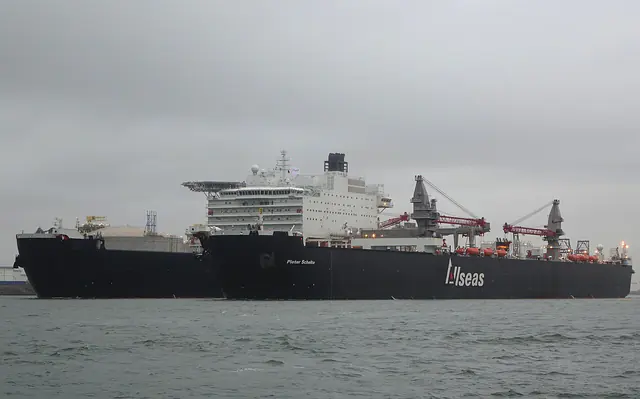
- Open-Deck Heavy-Lift Vessels: These ships feature vast, unobstructed deck areas and are equipped with massive, high-capacity cranes (often referred to as “heavy-lift cranes”) capable of lifting thousands of tonnes directly from a quay or another vessel.
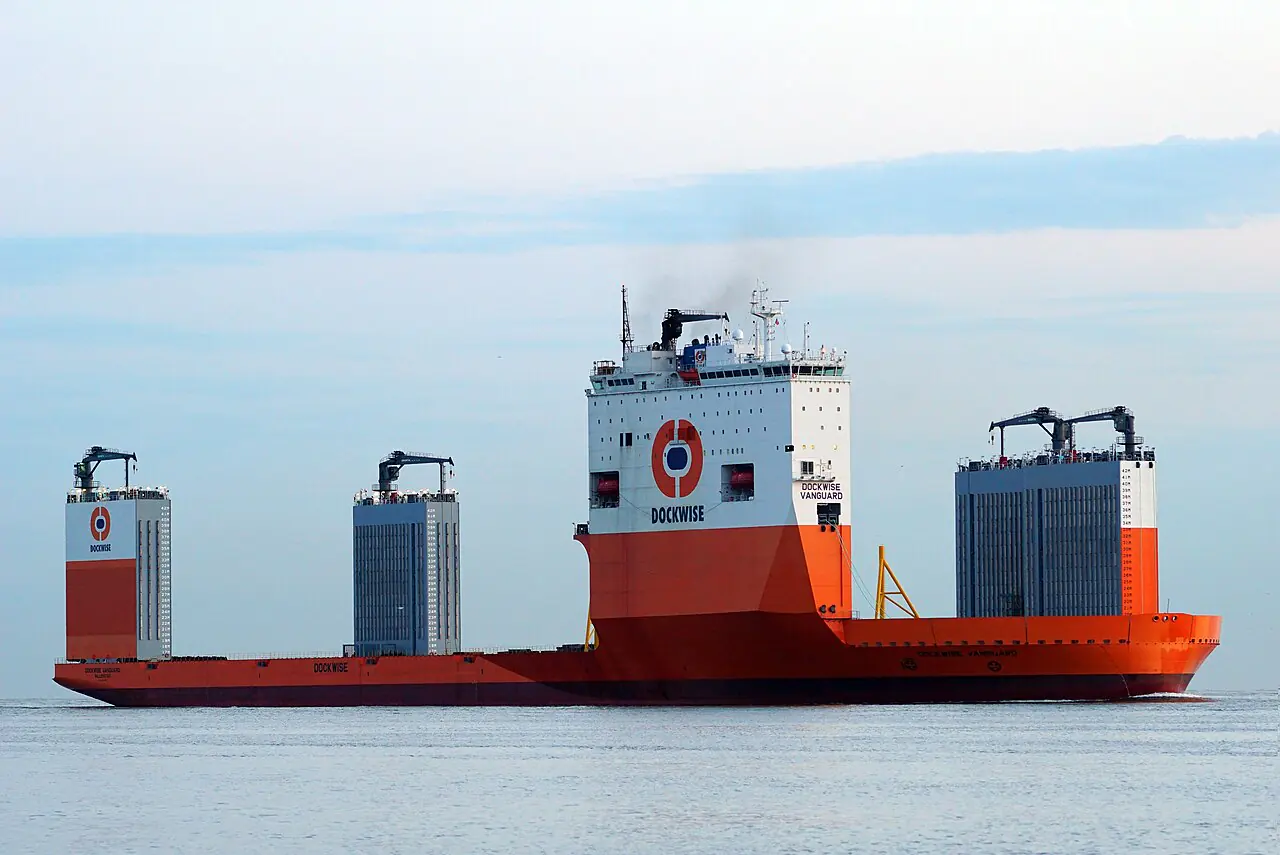
- Semi-Submersible Heavy Transport Ships: These are the giants of the industry. They are designed with a unique hull structure that allows them to partially submerge their main deck. This capability enables a “float-on/float-off” (Flo/Flo) operation, where cargo can be floated over the submerged deck and then carried as the ship de-ballasts and resurfaces.
Both types are critical to the energy, construction, and defense sectors, providing the “muscle” required to move the world’s largest structures across oceans.
2. Mission and Operations
The primary mission of these vessels is the safe, stable, and efficient transport of cargo that exceeds the physical dimensions or weight capacities of standard maritime logistics.
Float-On/Float-Off (Flo/Flo) Operations
The most distinctive operational mode for semi-submersible vessels is the Flo/Flo process. Unlike traditional loading where cargo is lifted by cranes, Flo/Flo relies on the principles of buoyancy and controlled ballasting. The operation follows a rigorous, multi-step sequence:
- Preparation and Arrival: The vessel arrives at the loading site, often assisted by tugs. The crew performs extensive stability calculations based on the specific dimensions, weight, and Center of Gravity (CoG) of the cargo.
- Ballasting (Submersion): The vessel begins to fill its dedicated ballast tanks with seawater. This is done in a precisely controlled, sequenced order to maintain the vessel’s trim (fore-and-aft balance) and list (side-to-side balance). As the tanks fill, the main deck sinks below the water’s surface.
- Positioning: Once the deck is at the required depth (often several meters below the waterline), the cargo—which is typically already floating or being towed—is maneuvered into position directly above the submerged deck. This requires extreme precision, often utilizing dynamic positioning systems and tug assistance.
- De-ballasting (Refloating): Once the cargo is perfectly aligned, the crew reverses the process. High-capacity pumps begin to expel the ballast water. As the water leaves the tanks, the vessel’s buoyancy increases, and the deck begins to rise.
- Cradling the Load: The deck rises “through” the cargo. The cargo, which was floating, is now supported by the ship’s structure. The vessel must rise evenly to avoid creating dangerous moments or uneven loads on the deck.
- Securing: Once the deck is fully clear of the water, the crew secures the cargo using heavy-duty sea fastenings, such as specialized cradles, chains, and tensioners, to ensure it remains immobile during the ocean transit.
Heavy-Lift Crane Operations
For open-deck heavy-lift vessels, the mission centers on mechanical lifting. These ships use massive cranes to perform “pick-and-place” operations. The challenges here are primarily related to the ship’s stability. Every time a crane lifts a load, the vessel’s Center of Gravity (CoG) shifts, and a “heeling moment” is created. To counter this, these vessels use advanced ballast management to compensate for the weight as it is being lifted.
3. Hull, Size, and Design
The design of these vessels is a masterclass in naval architecture, where every curve and compartment is optimized for extreme load cases.
Semi-Submersible Hull Design
A semi-submersible vessel’s hull is typically composed of three main elements:
- Pontoons/Sponsons: Large, watertight compartments located at the bottom of the vessel. These provide the primary buoyancy required to lift the heavy deck and cargo out of the water during transit.
- Structural Columns: Large vertical structures that connect the pontoons to the main deck. These columns provide much of the vessel’s stability and carry the structural loads of the deck.
- The Main Deck (Well Deck): A vast, open platform designed to support immense concentrated loads. In semi-submersibles, this deck is designed to be submerged.
The key design feature is the ability to manipulate the waterplane area. When the vessel is in “transit mode” (surfaced), it has a large waterplane area, providing high initial stability. When it is in “submerged mode” (for loading), the waterplane area is significantly reduced to the area of the columns, which reduces the effect of wave action on the vessel while it is submerged.
Open-Deck Heavy-Lift Hull Design
Open-deck vessels look more like traditional ships but feature:
- Reinforced Decks: The deck plating is significantly thicker and reinforced with longitudinal and transverse girders to handle the massive “point loads” exerted by cranes and cargo.
- Large Open Areas: To allow for the movement of oversized cargo, these ships often have minimal superstructure and fewer obstructions on the deck.
| Feature | Semi-Submersible | Open-Deck Heavy-Lift |
|---|---|---|
| Primary Loading Method | Float-on/Float-off (Buoyancy) | Crane Lift (Mechanical) |
| Hull Profile | Pontoons and Columns | Traditional ship hull |
| Deck Configuration | Submersible well deck | Large, reinforced open deck |
| Stability Focus | Controlled submersion/refloating | Counteracting crane moments |
4. Propulsion and Engines
To move these massive vessels—especially when they are carrying heavy cargo—high power and extreme maneuverability are required.
Engine Types
Most heavy-lift vessels utilize large, slow-speed or medium-speed diesel engines.
- Main Propulsion: Typically twin-screw configurations using large diesel engines. For semi-submersibles, the engines must provide enough thrust to move the vessel even at a deep draft.
- Auxiliary Engines: A large number of diesel generators are required to provide electricity for the massive ballast pumps, heavy-lift cranes, and dynamic positioning systems.
Maneuverability
Because these vessels often operate in tight quarters (near ports or offshore installations), standard rudders are often insufficient.
- Azimuth Thrusters: Many modern heavy-lift vessels use azimuth thrusters (also known as podded propulsion), which can rotate 360 degrees. This allows the ship to direct thrust in any direction, providing incredible maneuverability without the need for tugs in some cases.
- Tug Assistance: Despite advanced propulsion, the sheer mass of these ships means that tugboats remain an essential part of most heavy-lift operations.
5. Electrical System and Power
The electrical load on a heavy-lift vessel is immense and highly variable.
Power Demand Profiles
- Transit Mode: Power is primarily consumed by the main propulsion engines.
- Loading/Unloading Mode: This is the period of peak demand. The ballast pumps (which can move thousands of cubic meters of water per hour), the heavy-lift cranes, and the dynamic positioning systems all require massive amounts of electrical power simultaneously.
- Station Keeping: While waiting for cargo or performing delicate maneuvers, the power demand is dominated by the DP system and thrusters.
Power Management and Redundancy
To prevent a catastrophic loss of power during a critical lift or ballasting operation, these vessels employ:
- Integrated Power Management Systems (PMS): These systems automatically balance the load across multiple generators and can “load shed” non-essential equipment to prioritize critical systems like DP or pumps.
- High Redundancy: Electrical systems are typically designed with “N+1” or “N+2” redundancy, meaning if one or two generators or switchboards fail, the ship can still maintain its most critical functions.
- Distributed Switchboards: Large, high-voltage switchboards are distributed throughout the ship to ensure that a local fire or failure doesn’t disable the entire electrical grid.
6. Equipment and How It Is Used
The equipment on these vessels is characterized by its scale and its ability to handle extreme forces.
Heavy-Lift Cranes
The defining feature of an open-deck heavy-lift vessel is its crane(s).
- Capacity: These cranes can have lifting capacities ranging from 1,000 to over 20,000 tonnes.
- Mechanics: They utilize advanced wire rope systems, massive drums, and often specialized “active heave compensation” to mitigate the effects of vessel motion.
- Stability Management: As mentioned previously, the crane’s operation is tightly integrated with the vessel’s ballast system. As the crane takes a load, ballast is pumped into counteracting tanks to keep the ship level.
For more on the specific mechanics of these systems, see Offshore Cranes and AHC.
Ballast Systems
The ballast system is the “engine room” of the Flo/Flo operation.
- Pumps: High-capacity centrifugal or axial-flow pumps are used to move massive volumes of water quickly.
- Tanks: A complex network of tanks (fore, aft, wing, and center tanks) allows for precise control over the vessel’s trim and list.
- Valves and Piping: Large-diameter, heavy-duty piping and motorized valves are required to handle the high flow rates and pressures.
Cargo Securing Gear
Once cargo is on deck, it must be “sea-fastened” to prevent any movement during transit.
- Cradles: Custom-built steel structures that fit the unique shape of the cargo.
- Tensioners and Turnbuckles: Used to apply constant tension to the securing chains.
- Grillage: Heavy steel plating welded or bolted to the deck to distribute the concentrated loads from the cargo or its cradles.
7. Navigation, Communications, and Safety
Navigating a vessel that is carrying an entire oil platform requires more than just standard maritime tools.
Dynamic Positioning (DP)
The most critical navigation technology is Dynamic Positioning (DP). DP systems use a combination of GPS, motion sensors, and hydroacoustic sensors to automatically maintain the ship’s position and heading. This is essential during the “positioning” phase of Flo/Flo operations, where the vessel must remain perfectly still relative to the floating cargo.
Communications and Monitoring
- GMDSS: Standard Global Maritime Distress and Safety System for long-range communications.
- Real-time Load Monitoring: Sensors on the cranes and throughout the deck provide real-time data on the weight and distribution of the cargo.
- Stability Monitoring Systems: Continuous monitoring of the ship’s GM, trim, and list is performed, providing the crew with immediate alerts if stability limits are approached.
Safety Protocols
The risks associated with heavy-lift operations are extreme.
- Strict Operational Windows: Operations are often restricted to very specific “weather windows” to minimize the impact of wind and waves.
- Simultaneous Operations (SIMOPS): When multiple activities (like crane lifting and ballasting) happen at once, strict protocols are in place to manage the overlapping risks.
- Emergency Procedures: Specialized procedures for “emergency de-ballasting” or “emergency crane release” are part of the crew’s training.
8. Crew and Organization
The crew of a heavy-lift or semi-submersible vessel is a highly specialized team.
Specialized Roles
In addition to the standard deck and engine officers, these vessels often require:
- Heavy-Lift Supercargo: An expert who oversees the technical aspects of the cargo loading and securing.
- Crane Operators: Highly skilled specialists capable of managing extreme loads and dynamic forces.
- Ballast Control Officers: Personnel dedicated specifically to managing the complex ballasting sequences.
- DP Operators: Specialists trained to manage and monitor the dynamic positioning systems.
Training and Competency
Crew members must undergo extensive training that goes beyond standard STCW (Standards of Training, Certification, and Watchkeeping) requirements. This includes specialized training in:
- Heavy-lift stability and moment calculations.
- Advanced ballast system management.
- DP competency certification.
- Emergency response for heavy-lift failures.
9. Certificates and Training Requirements
Operating these vessels requires a rigorous certification framework.
Vessel Certificates
- Class Certificates: Issued by societies like DNV, ABS, or LR, verifying the vessel meets strict design and construction standards for heavy lift.
- Stability Certificates: Verifying the vessel’s ability to remain upright under various loading conditions.
- Special Service Certificates: Specific permits required for operating in certain jurisdictions or for certain types of cargo (e.g., hazardous materials).
Crew Certificates
- Advanced DP Certificate: Mandatory for DP operators.
- Heavy-Lift Endorsements: Specific training recognized by maritime authorities and shipping companies.
- STCW Certifications: The baseline requirement for all professional seafarers.
10. Regulations, Class, and Inspections
Because the stakes are so high, heavy-lift vessels are subject to intense scrutiny.
Classification Societies
Organizations like ABS (American Bureau of Shipping), DNV (Det Norske Veritas), and Lloyd’s Register (LR) play a critical role. They establish the rules for:
- Hull strength and design.
- Crane and lifting equipment standards.
- Ballast and stability requirements.
Regulatory Bodies
- IMO (International Maritime Organization): Sets the global standards for safety, security, and environmental performance (e.g., the 2008 IS Code for Intact Stability).
- National Maritime Authorities: Enforce international regulations within their respective waters.
Inspections
- Annual Surveys: To ensure the vessel remains in compliance with class rules.
- Special Surveys: Every 5 years, a much more intensive inspection of the hull and major machinery.
- Pre-loading Inspections: A detailed check of all equipment (cranes, pumps, securing gear) specifically before a major heavy-lift operation begins.
11. Notable Shipyards, Operators, and Example Vessels
The heavy-lift industry is dominated by a few specialized players.
Leading Operators
- Boskalis (including Dockwise): The global leader in semi-submersible heavy transport.
- BigLift: A major player in heavy-lift and multipurpose transport.
- Spliethoff: Known for their specialized heavy-lift vessels.
Notable Vessels
| Vessel Name | Type | Key Characteristic |
|---|---|---|
| Boka Vanguard | Semi-Submersible | One of the largest and most capable Flo/Flo vessels in the world. |
| Dockwise Vanguard | Semi-Submersible | A pioneer in the semi-submersible heavy transport sector. |
| Goliath | Heavy-Lift Crane Ship | (Example vessel known for massive lifting capacity) |
| Mighty Hawk | Heavy-Lift Vessel | Often featured in demonstrations of advanced heavy-lift techniques. |
Leading Shipyards
Shipyards capable of building these vessels must have immense facilities, including deep-water berths and heavy-duty dry docks. Notable examples include yards in South Korea (e.g., Hanwha Ocean) and Singapore (e.g., Keppel).
12. Environment and Future Outlook
As the maritime industry moves toward a greener future, heavy-lift vessels are also facing significant changes.
Decarbonization
- Alternative Fuels: Research into using LNG (Liquefied Natural Gas), ammonia, or hydrogen as fuel for the massive engines.
- Hybrid Propulsion: Using batteries to assist in peak power demands (e.g., during crane operations) to reduce fuel consumption and emissions.
- Wind-Assisted Propulsion: While challenging for these ship types, technologies like rotor sails are being explored.
Automation and Digitalization
- Autonomous Operations: Increasing levels of automation in crane operations and ballast management.
- Digital Twins: Using virtual models of the vessel to predict stability and stress during complex loading operations.
- Remote Monitoring: Real-time data from sensors being used to optimize maintenance and operational safety.
13. Facts, Records, and Common Misconceptions
Common Misconceptions
- “It’s just a big crane”: While cranes are important, the true complexity lies in the fluid dynamics and stability management during the lifting and ballasting processes.
- “The ship is sinking”: During a Flo/Flo operation, it may look like the ship is sinking, but it is actually a highly controlled process of managing buoyancy to reach a specific draft.
Interesting Facts
- Weight vs. Buoyancy: The entire Flo/Flo operation is a delicate dance between the weight of the cargo and the buoyancy provided by the displaced water.
- Extreme Loads: Some single lifts can exceed the weight of several entire conventional cargo ships.
14. Glossary
- Ballast: Water held in tanks to improve a ship’s stability, trim, or draft.
- De-ballasting: The process of pumping ballast water out of tanks.
- Flo/Flo (Float-on/Float-off): A method of loading cargo by submerging the ship’s deck.
- GM (Metacentric Height): A measurement of the initial stability of a floating vessel.
- GZ (Righting Arm): The horizontal distance between the center of gravity and the center of buoyancy, which provides the “righting” force.
- Heeling Moment: A turning force caused by weight being placed on one side of the ship.
- Trim: The difference between the draught at the bow and the draught at the stern.
- Waterplane Area: The area of the ship’s hull at the waterline.