1. What Is This Ship?
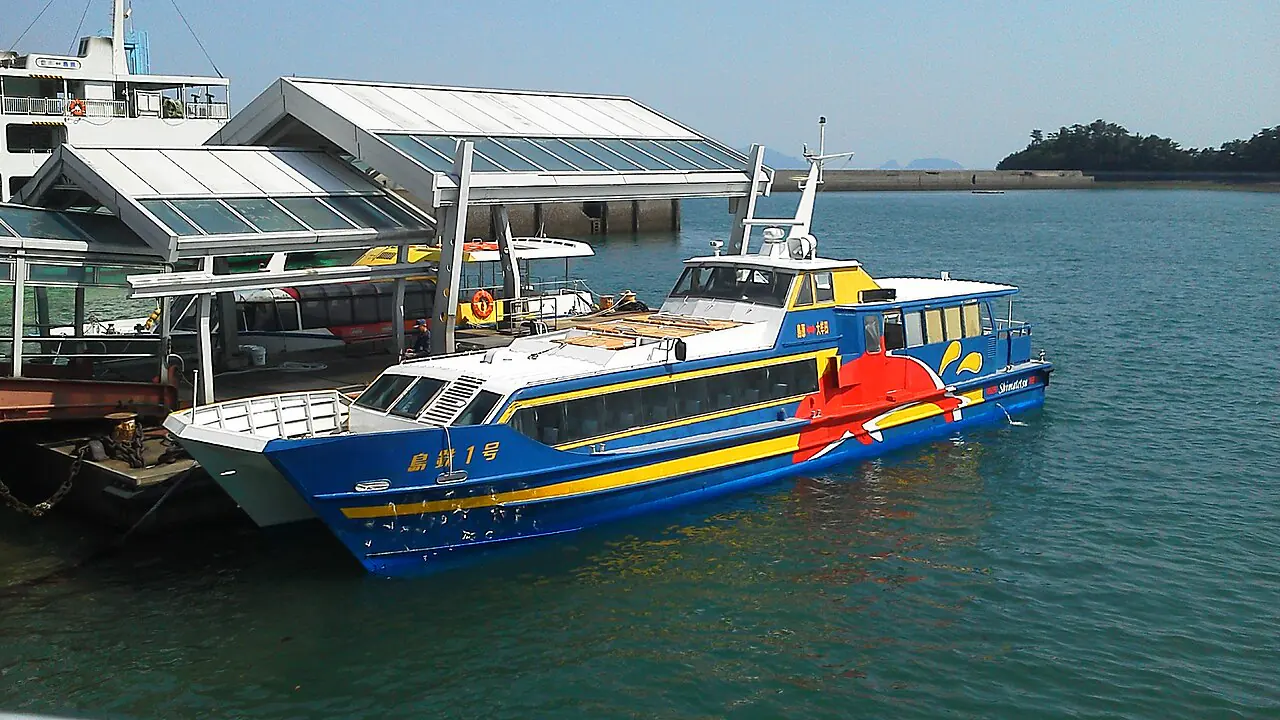
A high-speed passenger catamaran (or ferry) is a specialized maritime vessel designed to transport large numbers of passengers and, frequently, light vehicles (cars, coaches, or small trucks) across relatively short to medium distances at significantly higher velocities than conventional displacement vessels.
Technically, these vessels are often categorized under the broader umbrella of High-Speed Craft (HSC). According to the International Maritime Organization (IMO) and the SOLAS Chapter X regulations, a vessel is formally classified as an HSC if it meets a specific speed-to-displacement threshold. This statutory criterion is defined by the formula:
Where:
- is the maximum operational speed in meters per second (m/s).
- is the volumetric displacement corresponding to the design waterline in cubic meters ().
Unlike conventional ships that rely primarily on hydrostatic buoyancy (displacement) to stay afloat and move through the water, high-speed catamarans often utilize hydrodynamic lift. This allows them to “break” the traditional hull speed barrier, which limits the speed of displacement vessels due to the wave-making resistance they create. By utilizing slender, multi-hull geometries—most commonly the catamaran configuration—these vessels minimize wave resistance and maximize stability, making them the preferred choice for modern rapid transit between islands or coastal hubs.
2. Mission and Operations
The primary mission of a high-speed passenger catamaran is to minimize transit time for commuters, tourists, and logistics providers. They serve as “marine bridges,” providing a high-frequency, reliable alternative to air or road travel in archipelagic or coastal regions.
Typical Operational Profiles
- Service Speed: Most modern high-speed catamarans operate within a service speed range of 30 to 45 knots, though advanced models can exceed 50 knots.
- Capacity: Depending on the vessel size, capacity can range from small 15-meter commuter craft (50–100 passengers) to massive 130-meter vessels carrying over 2,000 passengers and hundreds of vehicles.
- Route Characteristics: They are optimized for “short-sea” shipping, typically operating on routes where the transit time is less than 4 hours from a port of refuge.
- Weather Limitations: High-speed craft are more sensitive to sea states than heavy displacement ferries. Most operators impose service suspensions when significant wave heights exceed 2.5 to 4.0 meters to ensure passenger comfort and structural integrity against “slamming” (the impact of the hull hitting waves).
3. Hull, Size, and Design
The efficiency of a high-speed catamaran is dictated by its hull architecture. The catamaran design consists of two parallel hulls (demi-hulls) connected by a wide, structural bridging deck.
Primary Hull Architectures
| Architecture | Lift Mechanism | Typical Speed | Key Characteristics |
|---|---|---|---|
| Wave-Piercing Catamaran (WPC) | Hydrostatic displacement + slender hull wave suppression. | 35–45 knots | Features an ultra-slender design and a central wave-piercing bow to minimize slamming in head seas. |
| Hydrofoil Craft | Hydrodynamic lift from submerged wing profiles (Bernoulli lift). | 40–55 knots | Foils lift the entire hull out of the water, nearly eliminating frictional resistance. |
| Surface Effect Ship (SES) | Aerostatic air cushion (80–85%) + rigid sidehulls. | 45–60 knots | Uses centrifugal fans to pressurize a central cavity, providing lift through air pressure. |
| Planing Monohull | Hydrodynamic dynamic pressure on an angled bottom. | 32–42 knots | Uses a hard chine and spray rails to deflect water downwards, creating lift. |
| Trimaran | Hydrostatic displacement + slender central hull. | 32–40 knots | Features a main central hull and two smaller outrigger hulls for enhanced stability. |
Design Engineering Principles
- Slenderness Ratio (L:B): To achieve high speeds, the demi-hulls of a WPC must be extremely slender, often with a Length-to-Beam ratio exceeding 15:1. This minimizes the wave-making-resistance-to-displacement ratio.
- Wave-Piercing Bow: In a WPC, the central part of the bridging deck often features a “bow” that sits between the two hulls. This design is intended to pierce through waves rather than riding over them, which reduces the vertical accelerations (pitching) that cause discomfort and structural stress.
- Materials of Construction:
- Marine-Grade Aluminum: The industry standard for high-speed vessels. It offers an excellent strength-to-weight ratio, which is critical for maintaining the high power-to-weight ratios required for high speeds. It is also highly resistant to corrosion if properly maintained.
- Fiber-Reinforced Plastics (FRP) & Composites: Used in smaller vessels or high-end luxury craft. Materials like carbon fiber provide even greater weight savings and stiffness but come at a significantly higher cost and complexity in repair.
4. Propulsion and Engines
High-speed operation requires immense power. Conventional propellers often become inefficient or cause excessive cavitation at the speeds required by catamarans. Consequently, waterjet propulsion has become the dominant technology for this ship type.
Waterjet Propulsion Systems
A waterjet works on the principle of jet propulsion (Newton’s Third Law). An impeller inside a pump unit accelerates water through a nozzle, creating thrust.
Key Components:
- Intake: Located on the bottom of the hull, drawing water into the system.
- Impeller: A high-speed rotating component that provides the energy to accelerate the water.
- Steering Nozzle: A movable nozzle at the exit of the jet that redirects the water flow to provide precise port and starboard maneuvering.
- Reversing Bucket: A mechanism that can deflect the water jet forward, allowing the vessel to move in reverse without the need for separate reverse gears.
Advantages of Waterjets over Propellers:
- High Efficiency at Speed: Waterjets outperform propellers at service speeds typically above 25–30 knots.
- Maneuverability: The ability to steer the thrust vector and use a reversing bucket allows for exceptional agility, even at low speeds.
- Shallow Draft: Because there are no exposed propeller shafts or rudders below the hull, waterjets allow catamarans to operate in very shallow waters.
- Safety and Noise: There are no rotating blades beneath the surface, making them safer for marine life and reducing underwater noise.
Engine Types and Power Generation
- High-Speed Diesel Engines: The most common choice for large catamarans. Manufacturers like MAN and MTU provide high-output, medium-speed diesel engines (e.g., MAN 28/33D series) designed for continuous high-load operation.
- Gas Turbines: Occasionally used in extremely high-speed craft where power density is the absolute priority, though they are more expensive to operate and maintain.
- Dual-Fuel and LNG: To meet environmental regulations, newer vessels (such as the 130m Incat Flyer) are being built with LNG-powered dual-fuel engines.
- Hybrid and Electric Propulsion: A major research and development frontier. Integrating battery-electric systems allows for zero-emission operation in port areas and provides a way to optimize engine loads during transit.
5. Electrical System and Power
The electrical system on a high-speed catamaran must be robust, redundant, and capable of handling high transient loads from propulsion, ride-control systems, and passenger amenities.
Typical Configuration
- Generation: Power is typically provided by multiple diesel generators (e.g., MTU or Caterpillar units). In larger vessels, these are often configured in a diesel-electric arrangement where generators power an electrical bus, which in turn powers electric motors driving the waterjets.
- Redundancy: Critical systems (navigation, steering, emergency lighting) are connected to multiple independent power sources to ensure that a single generator failure does not lead to a loss of control.
- Battery Integration: Modern “hybrid-ready” designs include large battery banks to assist during peak loads or to allow for silent, emission-free maneuvering in sensitive coastal areas.
6. Equipment and How It Is Used
Beyond propulsion, high-speed catamarans require specialized equipment to maintain stability and comfort at high velocities.
Ride Control Systems
One of the greatest challenges for high-speed craft is “slamming” and pitching. To mitigate this, advanced Active Ride Control systems are used.
- Active Trim Tabs: Automatically adjusted at the stern to control the longitudinal trim (pitch) of the vessel.
- T-Foils: Hydrodynamic foils mounted to the hull (often below the waterline) that generate lift to counteract pitching motions. These are actively controlled by sensors that detect wave impacts in real-time.
- Example: The Saint John Paul II utilizes a Naiad active ride-control system, combining both trim tabs and T-foils to ensure a smooth passenger experience even in moderate seas.
Navigation and Communication
High-speed operations require high-precision navigation. Standard suites include:
- X-Band and S-Band Radars: For detecting small objects and navigating in heavy rain or fog.
- High-Speed GPS/GNSS: For precise positioning and route following.
- AIS (Automatic Identification System): Essential for collision avoidance in busy coastal waters.
7. Navigation, Communications, and Safety
Safety is the paramount concern for high-speed passenger vessels, as their high kinetic energy and lightweight construction necessitate stringent protocols.
Passenger Safety Features
- Seating Requirements: Under the HSC Code, all passengers must be provided with a seat. Unlike conventional cruise ships, there are no enclosed sleeping berths allowed for passengers on high-speed craft.
- Emergency Evacuation: Vessels are equipped with specialized MES (Marine Evacuation Systems), such as inflatable slides or life rafts, designed for rapid deployment.
- Fire Suppression: High-speed craft require fast-acting fire-suppression systems (often water mist or CO2) due to the difficulty of fighting fires in a lightweight, high-speed environment.
Operational Safety
- Stability in Damaged Conditions: The HSC Code imposes much higher standards for stability than the standard SOLAS requirements. This is because the slender hulls of catamarans can be particularly vulnerable to flooding.
- Redundancy: Critical navigation and communication equipment must have built-in redundancy to ensure continuous operation during high-speed transits.
8. Crew and Organization
Because high-speed catamarans are designed for efficiency and speed, their crew complements are typically smaller than those of large conventional ferries.
Crew Roles and Numbers
- Typical Complement: For a fast ferry carrying 300–500 passengers, the crew is often between 5 and 10 people.
- Command: Led by a Master (Captain), supported by Deck Officers.
- Deck Department: Includes Deckhands responsible for mooring, passenger boarding, and vessel maintenance.
- Engine Department: Includes Engineers responsible for the complex propulsion and electrical systems.
- Passenger Service: On larger Ro-Pax catamarans, additional crew may be assigned to passenger amenities and vehicle deck management.
9. Certificates and Training Requirements
Operating an HSC requires specialized certification that goes beyond standard maritime licenses.
Professional Certifications
- Type Rating Certificate (TRC): This is the most critical requirement. Masters and officers with an operational role must hold a valid TRC specific to the particular craft design and route they are operating.
- Revalidation: TRCs are not permanent; they must be revalidated (typically every two years) by providing evidence of qualifying service (e.s., 3 months of service on that specific type of craft).
- Familiarization Training: All ratings (deckhands, engineers) must undergo specific familiarization training related to the unique handling characteristics and emergency procedures of high-speed craft.
Vessel Certification
- HSC Safety Certificate: Issued following rigorous inspection to prove compliance with the HSC Code.
- Permit to Operate: A formal authorization required for any vessel engaged in high-speed passenger or cargo service.
10. Regulations, Class, and Inspections
High-speed catamarans operate within a strict international regulatory framework to ensure they are fit for purpose.
Regulatory Framework
- IMO HSC Code: The primary international standard. It provides comprehensive requirements for design, construction, equipment, and operation.
- SOLAS Chapter X: The legal mechanism that makes the HSC Code mandatory for all high-speed craft built after January 1, 1996.
- ISM Code: High-speed craft must also comply with the International Safety Management (ISM) Code, which focuses on the safe management and operation of ships and pollution prevention.
Classification Societies
To ensure structural integrity and technical compliance, vessels are “classed” by recognized organizations. Common societies for high-speed craft include:
- DNV (Det Norske Veritas)
- Lloyd’s Register (LR)
- American Bureau of Shipping (ABS)
- Bureau Veritas (BV)
- Korean Register (KR)
Inspections are performed regularly by these societies to verify that the vessel’s condition and systems continue to meet the requirements of their class rules.
11. Notable Shipyards, Operators, and Example Vessels
The high-speed ferry market is dominated by a few specialized shipyards and global operators.
Notable Shipyards
- Incat Crowther: A world leader in high-speed catamaran design and construction, based in Australia.
- Austal Ships: A major Australian shipbuilder known for high-speed aluminum vessels and trimarans.
- Wight Shipyard Co.: A UK-based yard specializing in high-speed Ro-Pax catamarans.
- Gladding-Hearn: A US-based builder of high-speed aluminum vessels.
Notable Operators
- Virtu Ferries: A major operator in the Mediterranean, particularly on the Malta-Sicily route.
- Buquebus: A leading South American operator providing high-speed services between Argentina and Uruguay.
Example Vessels
| Vessel Name | Builder | Type | Capacity | Speed | Key Specs |
|---|---|---|---|---|---|
| Saint John Paul II | Incat | WPC | 900 Pax / 23 Trailers | 38 knots | Wärtsilä waterjets, MTU generators, Naiad ride control. |
| 130m Flyer | Incat | WPC | 2,100 Pax / 220 Cars | >40 knots | LNG-powered dual-fuel engines, world’s largest aluminum ship. |
| MV Ava Pearl | Gladding-Hearn | Catamaran | 150 Pax | High-speed | Aluminum construction, coastal service. |
12. Environment and Future Outlook
As the maritime industry moves toward decarbonization, the high-speed ferry sector faces significant challenges due to the massive energy requirements of high-velocity travel.
Environmental Challenges
- Emissions: High speeds require high power, which traditionally means high fuel consumption and significant and emissions.
- Noise and Vibration: High-speed craft, particularly those with aluminum hulls, can experience elevated noise levels in passenger and engine spaces, leading to crew fatigue.
- Underwater Noise: The high-frequency operation of waterjets can contribute to underwater noise pollution, impacting marine ecosystems.
Future Trends
- Decarbonization Pathways: The industry is exploring several “green” solutions:
- Battery-Electric: Ideal for short-range, low-speed routes, though energy density remains a challenge for true high-speed transit.
- Hydrogen/Fuel Cells: Provides a zero-emission option but requires significant infrastructure and weight management.
- LNG/Dual-Fuel: A current transitional technology to reduce carbon footprints.
- Hydrofoil Integration: There is renewed interest in hydrofoils as a way to “smash through” the energy barrier. By lifting the hull, hydrofoils can reduce energy consumption by up to 38%, making electric propulsion more viable for high-speed services.
- Lightweight Materials: Continued advancement in carbon fiber and advanced composites will allow for even lighter vessels, further reducing the energy required for operation.
13. Facts, Records, and Common Misconceptions
- Misconception: “Catamarans are always faster than monohulls.” While catamarans are generally more efficient at high speeds, speed is a product of power-to-weight ratio and hull design. A well-designed planing monohull can match or exceed a poorly designed catamaran.
- Fact: The “Hull Speed” Barrier. The reason catamarans are so effective at high speeds is that their two slender hulls create much smaller individual waves than a single large hull, allowing them to bypass the wave-making resistance that slows down traditional ships.
- Fact: Aluminum is the “Gold Standard” for a reason. While composites are lighter, aluminum’s predictability in fatigue and its ease of repair in remote port locations make it the practical choice for most commercial operators.
14. Glossary
- (Carbon Dioxide): A primary greenhouse gas emitted by diesel combustion.
- (Nitrogen Oxides): Pollutants produced during high-temperature combustion in diesel engines.
- Aluminium: A lightweight, corrosion-resistant metal widely used in high-speed vessel construction.
- Bernoulli’s Principle: The principle behind hydrodynamic lift, where a difference in fluid pressure creates a lifting force.
- Catamaran: A vessel with two parallel hulls.
- Damaged Stability: The ability of a ship to remain upright and afloat after taking on water in one or more compartments.
- Demi-hull: One of the two hulls that make up a catamaran.
- Dual-Fuel Engine: An engine capable of running on both liquid fuel (like diesel) and gas (like LNG).
- FRP (Fiber-Reinforced Plastic): A composite material used in boat building.
- HSC Code: The International Code of Safety for High-Speed Craft.
- Hydrofoil: A wing-like structure used to provide hydrodynamic lift.
- Hydrostatic Lift: The upward force exerted by a fluid that keeps a vessel afloat (buoyancy).
- IMO (International Maritime Organization): The United Nations specialized agency responsible for the safety and security of shipping.
- LNG (Liquefied Natural Gas): A cleaner-burning fossil fuel used as a transitional energy source.
- Naiad Ride Control: An example of an active system used to stabilize vessels.
- Ro-Pax: A vessel that carries both passengers (Pax) and vehicles (Roll-on/Roll-off).
- Slamming: The forceful impact of a hull against a wave.
- SOLAS: The International Convention for the Safety of Life at Sea.
- Trim: The longitudinal orientation of a vessel (fore-and-aft balance).
- Waterjet: A propulsion system that uses a high-velocity stream of water to create thrust.
- Wave-Piercing: A hull design intended to cut through waves rather than ride over them.