1. What Is This Ship?
A hospital ship is a specialized maritime vessel designed and equipped to provide advanced medical, surgical, and intensive care services while underway or at anchor. Unlike standard transport vessels that might carry medical supplies or basic infirmaries, a true hospital ship functions as a complete, mobile medical facility, capable of performing complex surgeries, providing radiological imaging, and offering long-term patient recovery.
These vessels serve two primary, often overlapping, roles:
- Military Support: Providing rapid, mobile medical support to combatant forces in theater, particularly in areas where land-based medical infrastructure is damaged or non-existent.
- Humanitarian Aid: Serving as part of international relief efforts during natural disasters, pandemics, or in underserved coastal regions to provide specialized care that is otherwise unavailable.
The defining characteristic of a hospital ship is its status under international law. Under the Geneva Conventions, hospital ships are granted specific protections that distinguish them from other combatant or non-combatant vessels, provided they adhere to strict requirements regarding marking, armament, and mission.
2. Mission and Operations
The mission of a hospital ship is fundamentally centered on the preservation of life and the provision of medical care. However, the operational modes vary significantly depending on the operator and the context.
2.1 Military Medical Operations
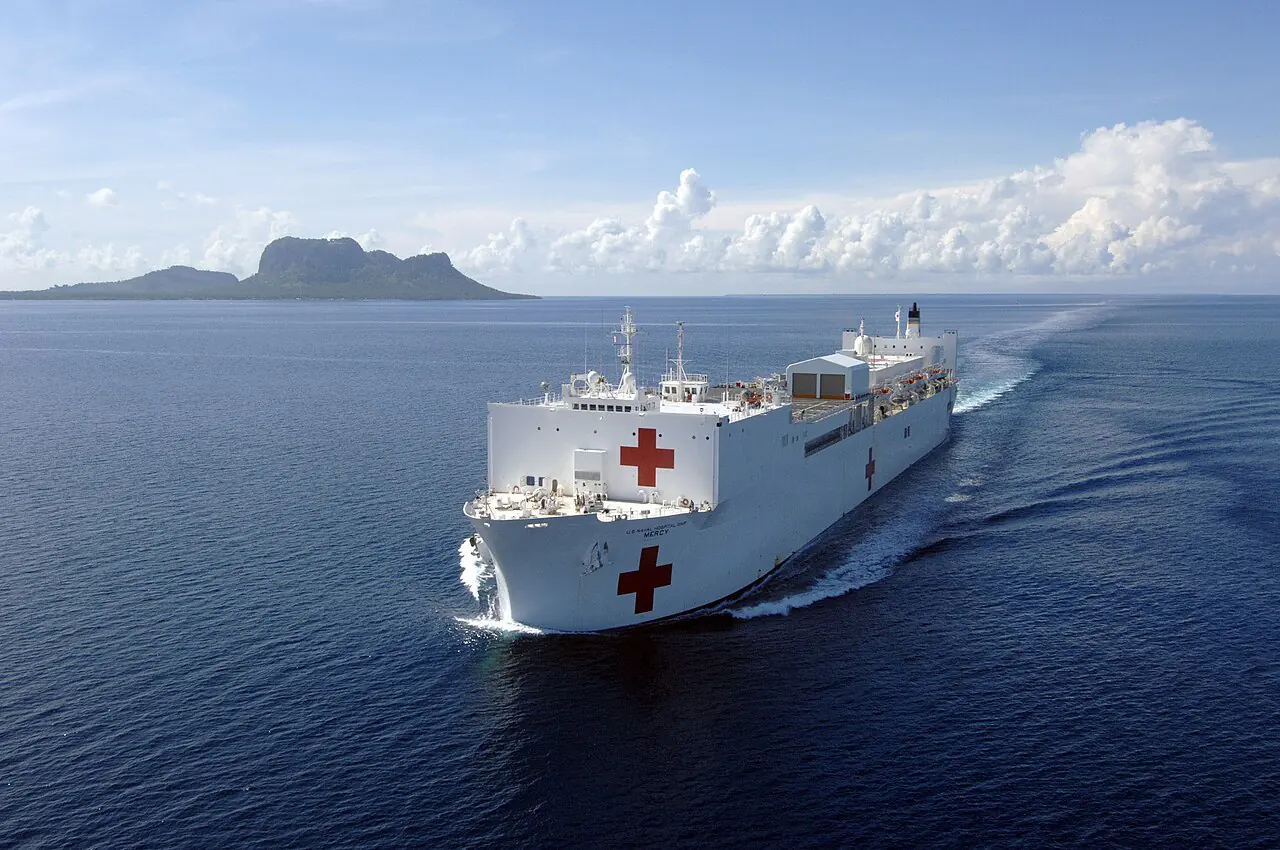
In a military context, hospital ships like the United States Navy’s Mercy-class provide “Role 3” medical care—the highest level of medical support available in the field. This includes:
- Casualty Evacuation (CASEVAC/MEDEVAC): Receiving wounded personnel via helicopter or small boats.
- Trauma Surgery: Immediate life-saving surgical interventions for combat injuries.
- Stabilization and Intensive Care: Managing critically wounded patients until they can be moved to a permanent facility or until they have recovered sufficiently.
- Medical Logistics: Serving as a hub for medical supplies and personnel within a maritime task force.
2.2 Humanitarian and Disaster Relief (HADR)
Humanitarian hospital ships, such as those operated by Mercy Ships, focus on long-term community health and acute surgical needs in developing nations. Their operations include:
- Specialized Surgery: Performing high-volume, high-impact surgeries (e.g., cataract removal, cleft lip repair, orthopedic corrections).
- Outreach Programs: Deploying small teams to coastal villages to provide basic care and screening.
- Capacity Building: Training local medical professionals to sustain improved healthcare standards after the ship departs.
- Disaster Response: Deploying rapidly to zones affected by earthquakes, tsunamis, or floods where local hospitals have been destroyed.
3. Hull, Size, and Design
The design of a hospital ship must reconcile the stability and endurance required of a sea-going vessel with the precision and hygiene required of a high-tech medical facility.
3.1 Hull Configurations and Conversions
Historically, many hospital ships have been converted from existing commercial hulls to maximize cost-effectiveness and rapid deployment.
- Tanker Conversions: The USNS Mercy and USNS Comfort were originally San Clemente-class oil tankers. Their large, voluminous hulls provided the necessary internal space for extensive medical wards, operating theatres, and support systems, despite the inherent challenges of converting a liquid-cargo vessel into a medical one.
- Purpose-Built Designs: Modern vessels like the Global Mercy are designed from the keel up as hospital ships. These vessels often feature more optimized layouts, better stability profiles, and more efficient integration of medical and maritime systems.
3.2 Layout and Zoning
A critical design requirement is the logical separation of “dirty” (industrial/engine) and “clean” (medical) zones.
- Medical Deck Hierarchy: Typically, surgical and intensive care units are located on higher, more stable decks to minimize the impact of hull vibration and pitch.
- Patient Flow: Design must ensure efficient “flow”—from the arrival point (helideck or boat landing) to triage, then to surgery or wards, and finally to recovery or discharge.
- Stretcher Accessibility: As noted in maritime medical design principles, there must be clear, unobstructed paths for stretcher-borne patients from all arrival points to the medical core.
3.3 Stability and Motion Control
Surgery requires an extremely stable platform. Ship motion (roll, pitch, and heave) can make delicate procedures impossible.
- Anti-Roll Systems: Many hospital ships utilize active or passive anti-roll stabilizers (such as fins or anti-roll tanks) to minimize lateral motion.
- Vibration Isolation: High-precision medical equipment, such as CT scanners and surgical microscopes, must be mounted on specialized vibration-dampening platforms to isolate them from the ship’s main engines and propellers.
4. Propulsion and Engines
Propulsion systems for hospital ships prioritize reliability and endurance over extreme speed, though a certain level of mobility is required for rapid deployment.
4.1 Steam Turbine Systems
Older generations of hospital ships, like the Mercy-class, utilize traditional steam turbine propulsion.
- Pros: High power output and proven reliability for large vessels.
- Cons: Lower fuel efficiency and longer “warm-up” times compared to modern diesel systems.
4.2 Diesel-Electric and Azipod Systems
Modern hospital ships increasingly employ diesel-electric propulsion, often combined with Azimuth thrusters (Azipods).
- Maneuverability: Azipods allow for exceptional maneuverability, which is critical when operating near coastlines or in crowded ports during humanitarian missions.
- Vibration Management: Diesel-electric systems can be tuned to minimize low-frequency vibrations that might interfere with medical operations.
- Redundancy: Multiple independent generators ensure that power to critical medical systems is never lost.
5. Electrical System and Power
The electrical system is the lifeblood of a hospital ship. A failure in power can be fatal for patients in intensive care or during active surgery.
5.1 Redundancy and Uninterruptible Power Supply (UPS)
- Tiered Power Architecture: Hospital ships typically employ multiple layers of redundancy. Main generators provide base load, while auxiliary generators handle peaks.
- Medical-Grade UPS: Critical medical equipment (ventilators, monitors, life-support) is connected to dedicated UPS systems that provide instantaneous power during the transition between main and emergency power.
- Emergency Power: Dedicated emergency generators, often located in separate, protected compartments, are reserved solely for life-safety and critical medical systems.
5.2 Specialized Medical Power Requirements
Medical equipment often requires “clean” power—electricity free from the voltage fluctuations and electrical noise (harmonics) typically generated by heavy maritime machinery. Transformers and power conditioners are used to ensure that sensitive imaging and surgical equipment receive stable, high-quality electricity.
6. Equipment and How It Is Used
A hospital ship’s equipment suite is comparable to a large regional hospital, but with the added challenge of being able to function in a maritime environment.
6.1 Surgical and Intensive Care
- Operating Theatres (OR): Equipped with surgical lights, anesthesia machines, and laparoscopy suites. Modern designs aim for multiple, simultaneous ORs.
- Intensive Care Units (ICU): High-dependency wards with continuous monitoring, ventilators, and specialized nursing support.
- Recovery Wards: Post-operative areas designed for patient stabilization and monitoring.
6.2 Diagnostic and Support Services
- Radiology/Imaging: Includes CT scanners, X-ray, and ultrasound. These require specialized shielding and vibration isolation.
- Laboratory Services: Onboard pathology and hematology labs for rapid diagnostic testing.
- Medical Oxygen Generation: Rather than relying solely on large, vulnerable oxygen tanks, many modern ships use Oxygen Generation Plants (OGPs) that utilize electrolysis to produce medical-grade oxygen from seawater or fresh water.
6.3 Logistics and Patient Transfer
- Helidecks: Essential for rapid CASEVAC/MEDEVAC. The deck must be sized to accommodate large military or civilian helicopters and include firefighting and refueling capabilities.
- Casualty Boat Transfer: For operations in shallow waters or where helicopters cannot land, specialized small craft (often painted white with red crosses) are used to transfer patients from shore to ship.
7. Navigation, Communications, and Safety
While standard maritime navigation and communication tools are used, hospital ships have specialized requirements.
- Medical Communications (Telemedicine): High-bandwidth satellite links are crucial for telemedicine, allowing onboard surgeons to consult with specialists worldwide or for remote training.
- Safety of Life at Sea (SOLAS): Hospital ships must comply with all SOLAS regulations, but with an emphasis on the safe evacuation of non-combatant medical staff and patients.
- Identification: As per the Geneva Convention, the ship must be clearly identifiable via its marking and flags to prevent accidental engagement.
8. Crew and Organization
The crew of a hospital ship is a unique hybrid of maritime professionals and medical specialists.
| Role Category | Primary Responsibilities | Typical Personnel |
|---|---|---|
| Maritime Crew | Navigation, propulsion, deck operations, engineering, and ship maintenance. | Officers, Engineers, Deckhands, Chefs. |
| Medical Staff | Surgeons, Anesthesiologists, Nurses, Physicians, Pharmacists, Technicians. | Doctors, RNs, Specialists. |
| Support Staff | Medical logistics, sterile processing, laundry (for medical linens), administration. | Technicians, Medics, Administrators. |
In military vessels, the crew is often a mix of active-duty Navy personnel and civilian contractors (Merchant Marine). In humanitarian vessels, the crew is often comprised of volunteers from around the world.
9. Certificates and Training Requirements
Hospital ships operate under a complex web of certifications:
- Maritime Certificates: IMO, SOLAS, STCW (for crew), and various classification society approvals (e.g., DNV, Lloyd’s Register).
- Medical Standards: Compliance with international healthcare standards and, in some cases, accreditation by medical boards.
- Specialized Training: Crew must be trained in both maritime emergencies (fire, flooding) and medical emergencies (mass casualty incidents, infection control).
10. Regulations, Class, and Inspections
The legal and regulatory framework for hospital ships is two-fold: maritime law and international humanitarian law.
10.1 The Geneva Convention II
This is the most critical regulation for hospital ships. It provides the legal basis for their protection.
- Protection: Hospital ships shall in no circumstances be attacked or captured.
- Requirements for Protection:
- Distinctive marking (White hull, red crosses).
- Notification of names and descriptions to warring parties.
- Non-combatant status (no offensive weaponry).
- No use for military purposes other than medical care.
10.2 Classification and Inspection
Ships are typically “classed” by organizations like DNV or ABS to ensure structural and mechanical integrity. Regular inspections ensure that both the maritime and medical systems remain operational and compliant with international standards.
11. Notable Shipyards, Operators, and Example Vessels
The following table provides a comparison of some of the most significant hospital ships in history and service today.
| Vessel Name | Class/Type | Operator | Primary Mission | Key Capability |
|---|---|---|---|---|
| USNS Mercy | Mercy-class | US Navy (MSC) | Military/Humanitarian | 1,000 beds; high-capacity trauma care. |
| USNS Comfort | Mercy-class | US Navy (MSC) | Military/Humanitarian | 1,000 beds; rapid deployment. |
| Global Mercy | Purpose-built | Mercy Ships | Humanitarian | 102 acute beds; 6 operating theatres; Azipod propulsion. |
| Africa Mercy | Purpose-built | Mercy Ships | Humanitarian | Extensive outreach and surgical capacity. |
12. Environment and Future Outlook
The future of hospital ships is being shaped by technological advancement and changing global needs.
- Digital Health & Telemedicine: Increased connectivity will allow for even more sophisticated remote diagnostics and surgical assistance.
- Automation & Robotics: Robotic surgical systems and autonomous ship operations (for support vessels) may increase efficiency and reduce crew requirements.
- Decarbonization: As the maritime industry moves toward net-zero, hospital ships will transition to greener fuels (LNG, Hydrogen, or electric-hybrid) and more efficient hull designs.
- Modular Design: The ability to rapidly reconfigure medical spaces (e.g., converting a ward into an ICU) will become more common through modular, prefabricated medical units.
13. Facts, Records, and Common Misconceptions
- Misconception: Hospital ships are “unarmed”: While they cannot carry offensive weapons, they are permitted to carry light defensive weapons (e.g., small arms for self-defense against piracy) in some contexts, though this is strictly regulated to maintain their non-combatant status.
- Fact: Protection is conditional: The protections of the Geneva Convention are lost if a hospital ship is used to shield combatants, transport munitions, or engage in hostile acts.
- Fact: They are not “floating hospitals” in the sense of being permanent: They are highly mobile assets designed to go where the need is greatest.
14. Glossary
- Azipod: An azimuth thruster that allows for 360-degree rotation, providing high maneuverability.
- CASEVAC: Casualty Evacuation; the movement of wounded personnel from the field to a medical facility.
- Geneva Convention II: An international treaty providing protections for the wounded, sick and shipwrecked members of armed forces at sea.
- IMO: International Maritime Organization.
- MEDEVAC: Medical Evacuation; the transport of sick or injured persons to a medical facility.
- Role 3 Care: The highest level of medical support available in a field environment, including surgery and intensive care.
- SOLAS: International Convention for the Safety of Life at Sea.
- USNS: United States Naval Ship; denotes a vessel owned by the US Navy but operated by the Military Sealift Command.