1. What Is This Ship?
An LNG carrier is a purpose-built ocean-going vessel designed to transport liquefied natural gas (LNG) over long distances. Unlike conventional tankers that carry crude oil or petroleum products, LNG carriers operate in a cryogenic environment, maintaining cargo at approximately -162°C (-260°F) to keep the natural gas in liquid form.
LNG represents a globally traded energy commodity, bridging the gap between natural gas production regions and markets where pipeline infrastructure is unavailable. The LNG carrier industry developed in the 1960s following the commercial realization that natural gas could be safely liquefied, stored, transported, and regasified at destination terminals. Today, these vessels are among the most technically sophisticated ships in the maritime fleet.
What makes LNG carriers unique is their cargo containment system—a complex arrangement of highly insulated tanks that function like giant thermos flasks. These systems must prevent LNG from boiling off excessively during transit, maintain structural integrity at cryogenic temperatures, and ensure zero leakage of cargo into the marine environment. The ships also require specialized propulsion systems capable of running on boil-off gas, making them pioneers in dual-fuel technology.
2. Mission and Operations
LNG carriers perform a precise logistical function in the global energy supply chain. Their operation follows a strict cycle:
Loading Phase: At the export terminal, LNG is pumped into the ship’s cargo tanks. The entire loading process typically takes 12-24 hours. Loading rates are carefully controlled to prevent thermal shock to the containment system. The ship’s tanks are gradually cooled from ambient temperature to cryogenic conditions as LNG enters.
Transit Phase: Once loaded, the vessel steams to import terminals, typically following established trade routes between major production regions (Middle East, Russia, North America, Australia, Qatar) and consumption centers (East Asia, Europe, North America). Voyage times range from 10-35 days depending on distance and weather conditions. During transit, boil-off gas systems maintain tank pressure, and some vessels use the gas as fuel for propulsion and auxiliary systems.
Discharge Phase: At the destination terminal, LNG is卸loaded over 12-24 hours into regasification facilities. The ship then returns for another voyage or proceeds to a storage facility.
Who Uses Them: The primary operators are specialized LNG shipping companies such as Frontline, Euronav, Yang Ming LNG, and regional carriers. Major gas producers (National Iranian Oil Company, Gazprom, Petronas) often own or charter vessels through their shipping arms. Import terminals contract carriers for scheduled deliveries.
Operational Constraints: LNG carriers cannot load or discharge at arbitrary liquid levels—membrane systems typically require 10-70% fill to control sloshing forces. This requires careful port scheduling. The ships must also maintain precise temperature and pressure monitoring throughout operations, with continuous nitrogen purging of insulation spaces.
3. Hull, Size, and Design
LNG carriers are large, specialized vessels with distinctive hull forms optimized for cryogenic cargo transport. Typical dimensions for modern conventional LNG carriers range as follows:
- Length Overall (LOA): 290–310 meters (950–1,020 feet)
- Beam (Width): 46–50 meters (151–164 feet)
- Draft: 12–12.5 meters (39–41 feet)
- Deadweight Tonnage (DWT): 80,000–100,000 tonnes
- Gross Tonnage (GT): 100,000–120,000 tonnes
- Cargo Capacity: 125,000–175,000 cubic meters
Larger vessels known as Q-Max or ultra-large LNG carriers (ULNG) push these boundaries:
- Length: 340–360 meters
- Beam: 52–55 meters
- Draft: 12–12.2 meters
- Deadweight Tonnage: 140,000–160,000 tonnes
- Gross Tonnage: 150,000–170,000 tonnes
- Cargo Capacity: 215,000–266,000 cubic meters (Q-Max)
The hull design features a double-hull construction throughout, with ballast water tanks filling the space between inner and outer hulls. This provides enhanced safety in the event of collision or grounding and accommodates the irregular tank arrangements required by the cargo containment systems.
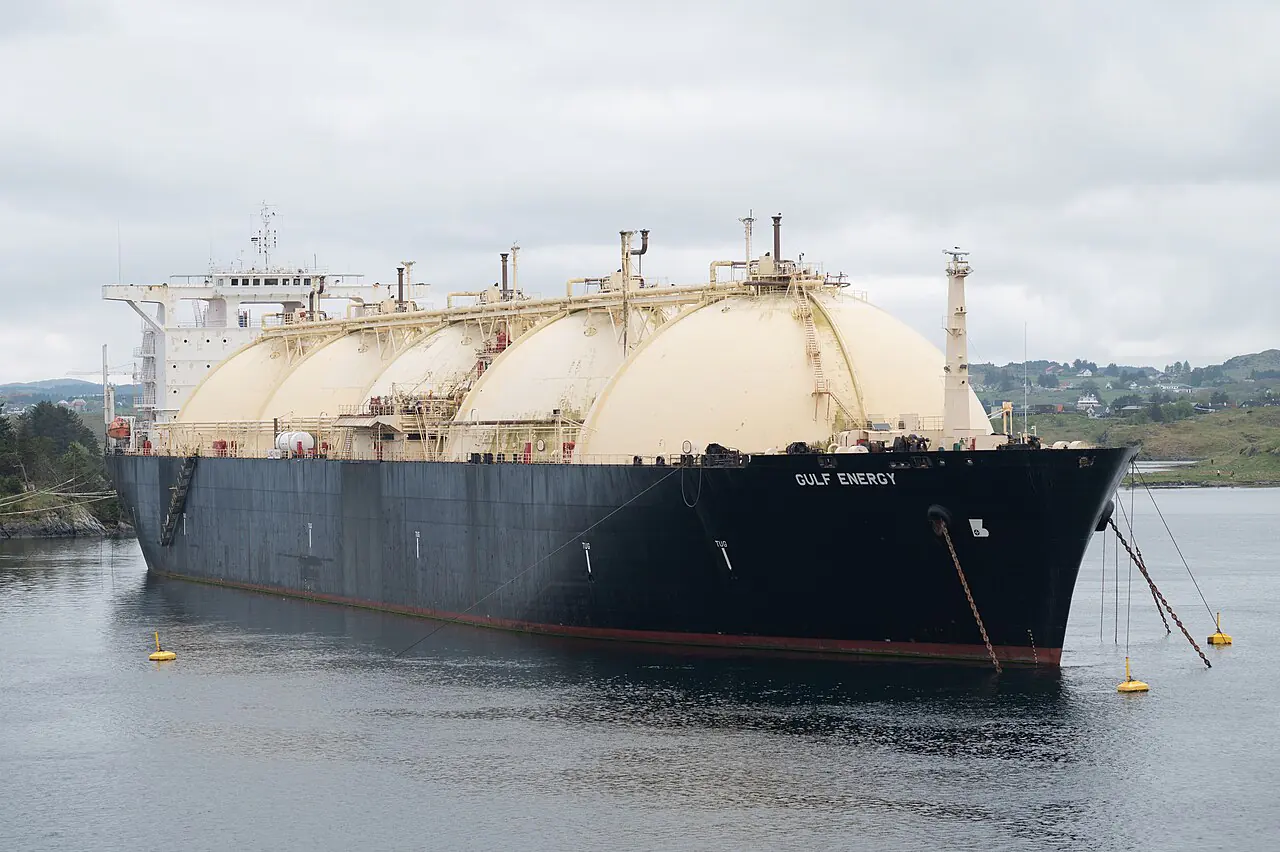
The most recognizable feature of LNG carriers is the arrangement of cargo tanks along the centerline. Membrane-type vessels typically have five tanks (one centerline, two inner pairs, two outer pairs), while Moss spherical tank vessels have four or five tanks positioned in a similar pattern. The tank arrangement creates a distinctive silhouette, especially for Moss vessels where the spherical tanks protrude above the main deck.
4. Propulsion and Engines
LNG carriers use conventional marine propulsion systems, but with a critical innovation: the ability to run on boil-off gas (BOG), the natural vapor produced as LNG warms during transit. This makes LNG carriers pioneers in dual-fuel technology.
Engine Types:
-
Traditional LNG carriers use medium-speed 2-stroke diesel engines manufactured by MAN Energy Solutions, Wärtsilä, or MaK. Power output typically ranges from 16,000 to 24,000 kilowatts (22,000–32,000 horsepower).
-
Dual-fuel (DF) engines dominate newbuilds. These engines can burn diesel oil or liquefied natural gas as fuel, switching seamlessly between modes. DF engines are manufactured by Wärtsilä (X-DF series), MAN Energy Solutions (ME-GA series), and WinGD (X-DF series, developed with MAN Energy Solutions).
-
Dual-fuel diesel-electric (DFDE) systems on FSRUs use medium-speed diesel generators that can operate on BOG or diesel fuel, producing electricity for terminal regasification operations.
Propeller Configuration:
-
Single propeller: Most common arrangement, typically a fixed-pitch or controllable-pitch propeller at the stern.
-
Azipods: Increasingly common on modern vessels, providing superior maneuverability and fuel efficiency. Azipods can be pitched and turned electrically, enabling precise positioning during loading and docking operations.
Operational Characteristics:
- Service Speed: 18–20 knots typical cruising speed
- Maximum Speed: Up to 22 knots
- Fuel Consumption: Dual-fuel vessels can achieve 15–20% fuel savings when operating primarily on BOG
The dual-fuel capability is not merely a fuel option—it’s essential for BOG management. During transit, boil-off gas is continuously produced as LNG warms from ambient temperature to its operating temperature. Without consuming this gas, tank pressure would rise uncontrollably. The engines provide a practical solution: BOG is vaporized, scrubbed, and fed directly to the engine’s gas fuel system, displacing diesel or fuel oil.
5. Electrical System and Power
LNG carriers employ robust electrical systems to support cargo operations, propulsion, and safety systems.
Main Electrical System:
- Voltage: 3,300V or 6,600V three-phase AC for main propulsion motors and heavy loads
- Auxiliary Power: 440V/60Hz or 440V/50Hz three-phase AC for deck machinery, pumps, and services
- Control Power: 220V/440V single-phase AC and 24V/110V DC for control circuits and instrumentation
Generator Arrangement:
- Main Generator: One large generator (1,000–2,500 kW) supplies power during cruising
- Standby Generator: One independent generator (600–1,500 kW) automatically starts in emergency or during maintenance
- Shaft Generator: Optional on some vessels, generating power from the main propulsion shaft during transit to reduce fuel consumption
Redundancy and Safety:
- Automatic generator synchronization systems maintain power quality
- Black start capability allows emergency restoration of critical loads
- All electrical equipment in and near cargo tanks must be certified for cryogenic/hazardous areas (per IEC 60092)
- Emergency shutdown systems cut power to non-essential loads and isolate cargo handling equipment
Shore Power (Cold Ironing):
At terminal berths, LNG carriers connect to shore power to eliminate emissions while docked. This requires:
- Shore power connection boxes with high-current, cryogenic-rated cables
- Automatic shore power synchronization systems
- Backup diesel generators that can take over if shore power fails
6. Equipment and How It Is Used
Cargo Containment Systems
The cargo containment system is the defining feature of an LNG carrier. There are two primary designs in commercial use:
GTT Membrane Systems (Type A):
-
GTT No.96: Uses Invar (36% nickel-iron alloy) membranes for both primary and secondary barriers. Invar’s near-zero thermal expansion prevents stress at cryogenic temperatures. The thin membranes (0.5mm lock parts, 0.7mm column plates) are anchored to plywood boxes filled with perlite insulation. Nitrogen continuously purges the inter-barrier space.
-
GTT Mark III: Employs a corrugated 304L stainless steel primary membrane (1.2mm thick) that absorbs thermal expansion through its grooved ribs. The secondary barrier uses glass fiber cloth sandwiched between aluminum foil layers. Reinforced polyurethane foam provides insulation.
-
GTT CS1: A newer hybrid design combining Mark III and No.96 features, using 0.7mm Invar primary membrane with a triplex aluminum-glass fiber composite secondary barrier.
-
Advantages: Optimized cargo capacity, flat deck profile, reduced wind resistance, lower boil-off rates (as low as 0.07% per day)
-
Limitation: Cannot load at arbitrary liquid levels; 10–70% fill required to minimize sloshing
Moss Spherical Tanks (Type B):
-
Design: Independent spherical tanks made of 9% nickel steel or 5083 aluminum alloy, supported by equatorial skirts that allow thermal expansion. The tanks are self-supporting and sit on the deck, protruding above it.
-
Insulation: Thick foam insulation (polyester, phenolic, or polystyrene) surrounds each sphere. An annular nitrogen-filled space between tank and insulation provides leak detection and thermal protection.
-
Advantages: Can load at any liquid level, no sloshing issues due to spherical geometry, simpler construction timeline
-
Disadvantage: Larger overall ship dimensions for same cargo capacity, tanks protrude above deck affecting stability and windage
Boil-Off Gas (BOG) Handling Systems
BOG management is critical for LNG carrier operations. As LNG warms during transit, it naturally vaporizes at a rate of approximately 0.3–0.5% per day. This gas must be managed to prevent pressure buildup.
Primary Methods:
-
BOG Engines: Vaporized gas is scrubbed and fed to dual-fuel engines. This is the most common and efficient method, converting what would be waste into useful propulsion energy.
-
Reliquefaction Systems: BOG compressors cool and condense vapor back into liquid, which returns to cargo tanks. Used on some FSRUs and large carriers. Requires significant electrical power.
-
Thermal Oxidation: BOG is burned in flare stacks or waste heat boilers. Used as emergency relief or on vessels without engine capacity.
BOG Compression:
- High-pressure centrifugal compressors vaporize and compress BOG from cargo tanks
- Refrigeration systems cool BOG to remove heat and prevent excessive pressure
- Pressure control valves maintain tank pressure below relief valve settings
Safety Systems
LNG carriers operate with rigorous safety monitoring throughout the vessel:
Cargo Tank Monitoring:
- Continuous pressure, temperature, and level monitoring for each tank
- Dual pressure/vacuum relief valves per tank with remote actuation
- Hydrocarbon gas detection in insulation spaces, machinery spaces, and cargo areas
- Automatic nitrogen pressurization to prevent air ingress
Emergency Shutdown (ESD):
- ESD system isolates cargo handling equipment, closes valves, and shuts down engines upon detecting gas leaks, fire, or emergency conditions
- Redundant manual and automatic activation points throughout the vessel
Firefighting:
- Fixed CO2 or foam systems for cargo tank spaces
- Deluge systems protecting deck areas near cargo tanks
- Engine room with dedicated fire detection and suppression
- All equipment certified for cryogenic/hazardous areas
Structural Protection:
- Double hull with ballast tanks throughout
- Watertight bulkheads separating cargo tanks from engine rooms
- Collision bulkheads forward and aft of cargo area
- Secondary containment (drip trays) beneath cargo tanks
7. Navigation, Communications, and Safety
LNG carriers employ the same navigation and communication systems as other ocean-going vessels, with enhanced safety instrumentation for their specialized cargo.
Navigation Equipment:
- ECDIS: Electronic Chart Display and Information System with multiple redundant units
- Radar: X-band and S-band with ARPA capability for collision avoidance
- AIS: Automatic Identification System (Class A) for vessel tracking
- GNSS: Dual-redundant GPS/GLONASS systems
- Speed and Distance: Doppler log for accurate speed over ground
Communications:
- GMDSS: Global Maritime Distress and Safety System with satellite (Inmarsat/Iridium) and HF radio
- VHF/HF: Voice and data communications for port operations and distress
- Satellite Phones: Redundant emergency communication
- FMC: Fleet Management Center connectivity for operators
Classification and Safety Classifications:
- Most modern LNG carriers operate under DP1 or DP2 (Dynamic Positioning) capability for port maneuvering, though this is less common than on offshore vessels
- Damage stability requirements per IGC Code ensure vessels remain afloat even with partial flooding
- Collision bulkheads provide additional compartmentalization
8. Crew and Organization
Typical Crew Size:
- Total Crew: 22–26 persons
- Officers: 5–6 (Captain, 3–4 deck officers, chief engineer, 1–2 engine officers)
- Ratings: 10–14 (able seamen, ordinary seamen, fitters, electricians, stewards)
Key Roles:
- Master/Captain: Overall command, navigation decisions, cargo operations oversight
- Chief Officer: Cargo operations, deck maintenance, port communications
- Chief Engineer: Engine operations, BOG systems, mechanical systems
- Third Engineer: Engine room watchkeeping, maintenance coordination
- Fourth Engineer: Assistant to chief engineer, auxiliary systems
- AB/OB: Deck watchkeeping, cargo monitoring, navigation assistance
- Oiler/Engine Rating: Engine room watchkeeping and maintenance
- Steward: Accommodation and mess duties
Watch System:
- Standard: 4-on/4-off watch schedule (8 hours on, 8 hours off, 8 hours rest)
- During Cargo Operations: All hands may work on loading/discharge
- Watchkeepers: Must maintain continuous monitoring of cargo tank parameters
Daily Operations:
- Cargo monitoring (pressure, temperature, level) every 4 hours minimum
- Insulation space nitrogen pressure checks
- Engine room BOG system monitoring
- Navigation and weather routing decisions
- Maintenance and housekeeping
9. Certificates and Training Requirements
LNG carrier crews require specialized certifications beyond standard merchant marine qualifications due to the cryogenic and hazardous nature of their cargo.
International Certificates (IMO/STCW):
-
Safety Construction Certificate (IGF Code): Indicates vessel complies with the International Code of Safety for Ships Using Gases or Other Low-Flashpoint Fuels
-
International Cargo Ship Safety Construction Certificate (SOLAS Chapter II-1): Special provisions for gas carriers per IGC Code
-
International Cargo Ship Safety Equipment Certificate (SOLAS Chapter III): Emergency and liferaft equipment
-
International Cargo Ship Safety Radio Certificate (SOLAS Chapter IV): GMDSS compliance
-
International Load Line Certificate: Safe freeboard for cargo operations
Officer Training and Certifications:
-
STCW Basic Safety Training: All crew (personal survival, fire prevention, first aid, personal safety)**
-
STCW Advanced Fire Fighting: Deck and engine officers
-
MARPOL Oil/Chemical/Gas tanker Familiarization: Required for officers (STCW A-VI/3-3)
-
IGF Code Training: Specialized training on LNG safety systems, BOG handling, and emergency procedures for deck and engine officers
-
Polar Code Training: Required if operating in Arctic waters (STCW A-VI/11-3)
-
Dynamic Positioning Operator (DPO) Certification: For vessels with DP capability (DP1/DP2)
-
BOSIET/HUET: Basic Offshore Safety Induction and Emergency Training / Helicopter Underwater Escape Training (particularly for vessels calling offshore terminals)
National Frameworks:
- UK MCA: D1–D5 (deck) and M1–M5 (engine) ratings with IGC Code endorsements
- USCG: OUPV with gas carrier endorsement or unrestricted master’s license
- Norwegian Directorate of Fisheries: D1–D5 equivalent ratings with specialized gas carrier training
Career Progression:
- Engineer Ladder: Ordinary Rating → Fourth Engineer → Third Engineer → Second Engineer → Chief Engineer → Chief Engineer Superintendent
- Deck Ladder: AB → OBP → Chief Mate → Master → Captain Superintendent
- LNG carriers offer competitive pay due to specialized requirements
10. Regulations, Class, and Inspections
LNG carriers operate under strict international regulations due to the hazardous nature of their cargo.
Key IMO Conventions:
-
SOLAS (International Convention for Safety of Life at Sea): Hull construction, equipment, emergency procedures
-
MARPOL (International Convention for Prevention of Pollution): Annex I (oil), Annex VI (air pollution), special provisions for LNG in Annex I
-
STCW (International Convention on Standards of Training, Certification and Watchkeeping): Crew qualifications
-
IGC Code (International Code for Construction and Equipment of Ships Carrying Liquefied Gases in Bulk): The critical code for LNG carriers, covering:
- Cargo containment system requirements
- Tank insulation and monitoring
- BOG management systems
- Safety systems and emergency arrangements
-
IGF Code (International Code of Safety for Ships Using Gases or Other Low-Flashpoint Fuels): Covers dual-fuel engines, fuel gas systems, and electrical safety
-
Polar Code: Additional requirements for operations in Arctic waters
Classification Societies:
- DNV (Det Norske Veritas): Extensive LNG design rules and experience
- Lloyd’s Register (LR): Specialized gas carrier rules
- Bureau Veritas (BV): LNG certification and inspection
- American Bureau of Shipping (ABS): Gas carrier rules
- Germanischer Lloyd (GL): Technical standards for gas carriers
Class Notations:
- Gas Carrier: Base notation for all LNG carriers
- IGC Code: Compliance with international gas carrier code
- Membrane Tanks or Spherical Tanks: Specific containment type
- BOG Management System: BOG engines, reliquefaction, or other systems installed
- Hull & Machinery: General seaworthiness and equipment
Inspections:
- Annual Survey: Major hull and machinery inspection
- Intermediate Survey: Every 2.5 years
- Special Survey: Every 5 years, including complete tank inspection
- Port State Control: Random inspections by foreign authorities
11. Notable Shipyards, Operators, and Example Vessels
Major Shipbuilders:
- Samsung Heavy Industries (South Korea): Built over 100 LNG carriers
- Hyundai Heavy Industries (South Korea): Major builder of Q-Max vessels
- Daewoo Shipbuilding & Marine Engineering (DSME) / Hanwha Ocean (South Korea)
- Vard (Norway): Specialized in smaller LNG carriers and FSRUs
- Eisenwerk (Germany): Smaller LNG carriers and specialized vessels
- Fincantieri (Italy): Specialized construction for premium vessels
Example Vessels (Verified):
| Vessel Name | Year | Builder | Operator | LOA (m) | Capacity (m³) | Containment |
|---|---|---|---|---|---|---|
| Global Sea Spirit | 2021 | Hanwha Ocean | E-Gas Transport | 299 | 174,000 | Membrane |
| Independence (IMO 9629536) | 2014 | HD Hyundai | Klaipedos Nafta (FSRU) | 294 | 170,100 | Membrane |
| Spirit Of Hela | 2009 | HD Hyundai | AET LNG | 298 | 177,000 | Membrane |
| Beidou Star | 2015 | Hanwha Ocean | E-Gas Transport | 290 | 138,000 | Membrane |
| FLEX Endeavour | 2018 | Samsung Heavy | FLEX Marine | 295 | 138,000 | Membrane |
| Al Ghuwairiya | 2008 | Samsung Heavy | Saudi Aramco | 345 | 266,000 | Membrane |
12. Environment and Future Outlook
Emissions Profile:
- CO₂: Approximately 12–15 tonnes per 1,000 nautical miles, comparable to medium oil tankers
- SOₓ: Near-zero when operating on LNG as fuel (negligible sulfur)
- NOₓ: Compliant with IMO Tier III in emission control areas; uses SCR/EOE systems
- Particulate Matter: Minimal compared to diesel-fueled vessels
Alternative Fuels and Technology Trends:
-
Ammonia-Fueled Engines: Companies like MAN Energy Solutions, Yara, and WinGD are developing ammonia dual-fuel engines for LNG carriers and beyond
-
Methanol: Increasing interest as a bridge fuel; several newbuilds ordered with methanol capability
-
Wind-Assisted Propulsion: Flettner rotors and rigid wing sails being tested on LNG carriers
-
Battery Hybrid Systems: Auxiliary battery banks to reduce fuel consumption during low-load operations
-
Autonomous Operations: Remote monitoring and partial autonomy for cargo operations
Upcoming Regulations:
- IMO GHG Strategy: Targets 40% reduction in CO₂ intensity by 2030 (vs 2008) and net-zero by 2050
- FuelEU Maritime: Gradual reduction in carbon intensity of maritime fuel
- 2025 IGF Code Amendment: Enhanced requirements for BOG management at berth, requiring reliquefaction or other systems on new vessels
- MARPOL Annex VI: Potential future regulations on ammonia and methanol handling
13. Facts, Records, and Common Misconceptions
Interesting Facts:
-
The first commercial LNG carrier, the Methane Princess, was built in 1959 and operated until 1973
-
Moss Maritime’s spherical tank design has been used on over 145 LNG carriers worldwide
-
A typical 174,000 m³ LNG carrier contains over 120 kilometers of welds in its cargo containment system
-
The Q-Max class vessel (266,000 m³) can carry approximately 11.5 million cubic meters of gas when regasified
-
LNG carriers typically have a service life of 25–30 years due to specialized equipment and strict regulatory requirements
World Records:
-
Largest by Capacity: Bauhinia Spirit (IMO 9913105) with 263,000 m³ capacity, delivered 2017
-
Largest by Gross Tonnage: Al Ghuwairiya with 168,189 GT, delivered 2008
-
Longest Voyage: Record LNG carrier voyage from Qatar to China exceeds 12,000 nautical miles
Common Misconceptions:
-
“LNG carriers carry ‘cold gas’”: LNG is at atmospheric pressure, not pressurized. The coldness is the defining characteristic.
-
“They’re dangerous to operate”: Modern LNG carriers have extremely sophisticated safety systems. The industry has an excellent safety record compared to other tanker types.
-
“All LNG carriers are the same”: There are significant differences between membrane-type and Moss-type vessels in operations, dimensions, and tank management.
-
“BOG is wasted”: Modern dual-fuel engines convert 90%+ of BOG into useful propulsion energy, making the system energy-efficient.
14. Glossary
-
BOG (Boil-Off Gas): Natural gas vapor produced as LNG warms during transit; typically managed by dual-fuel engines
-
Containment System: The specialized tank arrangement (membrane or spherical) that holds cryogenic LNG cargo
-
DWT (Deadweight Tonnage): Maximum weight a vessel can carry (cargo, fuel, stores, passengers)
-
Double Hull: Two parallel outer hulls providing structural protection and safety in case of collision or grounding
-
FSRU (Floating Storage and Regasification Unit): A specialized vessel that stores LNG and regasifies it for onshore distribution; can operate as a carrier
-
GTT (Gaztransport & Technigaz): French company that owns the patent for membrane-type cargo containment systems
-
IGC Code: International Code for Construction and Equipment of Ships Carrying Liquefied Gases in Bulk
-
Invar: Nickel-iron alloy with extremely low thermal expansion, used in membrane tank construction
-
Liquefaction: Process of converting natural gas from gaseous to liquid state at approximately -162°C
-
Membrane Tank: Non-self-supporting cargo containment system using thin metallic or composite membranes
-
Moss Tank: Self-supporting spherical cargo containment system developed by Moss Maritime
-
Q-Max: Ultra-large LNG carrier class with capacity of approximately 266,000 m³
-
Regasification: Process of converting liquid LNG back to gaseous natural gas at destination terminals
-
Spherical Tank (Moss Type): Independent spherical cargo tanks that protrude above deck and support their own weight
-
Reliquefaction: Process of converting boil-off gas back into liquid LNG for storage or return to cargo tanks
-
Dual-Fuel (DF): Engine technology that can run on both diesel oil and liquefied natural gas (or BOG)
15. Sources
-
Bureau Veritas Marine & Offshore. How to build a large-scale LNG carrier. https://marine-offshore.bureauveritas.com/insight/how-build-large-scale-lng-carrier
-
UK P-I Club. Chapter 24 – Liquefied Natural Gas (LNG), Carefully to Carry 2023. https://www.ukpandi.com/fileadmin/uploads/ukpandi/Documents/uk-p-i-club/carefully-to-carry/2023/UKPI_Carefully_to_Carry_2023_24.pdf
-
China Classification Society. Technologies of LNG Cargo Containment System. https://www.ccs.org.cn/ccswzen/articleDetail?id=202402070269643439
-
CE Delft. LNG boil-off gas at berth. https://cedelft.eu/wp-content/uploads/sites/2/2026/02/CE_Delft_240546_LNG_boil-off_gas_at_berth_Def.pdf
-
Coast Guard Design Center. Liquefied Natural Gas as Fuel Design Considerations. https://www.dco.uscg.mil/Portals/9/DCO%20Documents/5p/LGCNCOE/docs/LNGF-DesignConsiderations.pdf
-
MetaCAD. LNG Carriers - Vessel Dimensions, DWT and Stability Data. https://metacad.io/en/vessels/lng/
-
LNG Atlas. Independence (IMO 9629536). https://lngatlas.org/carrier/independence-9629536/
-
LNG Atlas. LNG carriers — the world fleet and order book. https://lngatlas.org/carriers/
-
Wikipedia. LNG carrier (containment systems section). https://en.wikipedia.org/wiki/LNG_carrier
-
Nautilus Shipping. LNG & LPG Tanker Operations: Practical Guide. https://www.nautilusshipping.com/news-and-insights/lng-lpg-tanker-operations-practical-guide-for-safe-efficient-gas-carrier-management
-
GTT. Membrane Technology for Offshore LNG. https://www.gtt.fr/sites/default/files/20131005-otc-membrane-technology-for-offshore-lng-2003-10-06.pdf
-
IMO. International Code of Safety for Ships Using Gases or Other Low-Flashpoint Fuels (IGF Code). https://www.imo.org/