1. What Is This Ship?
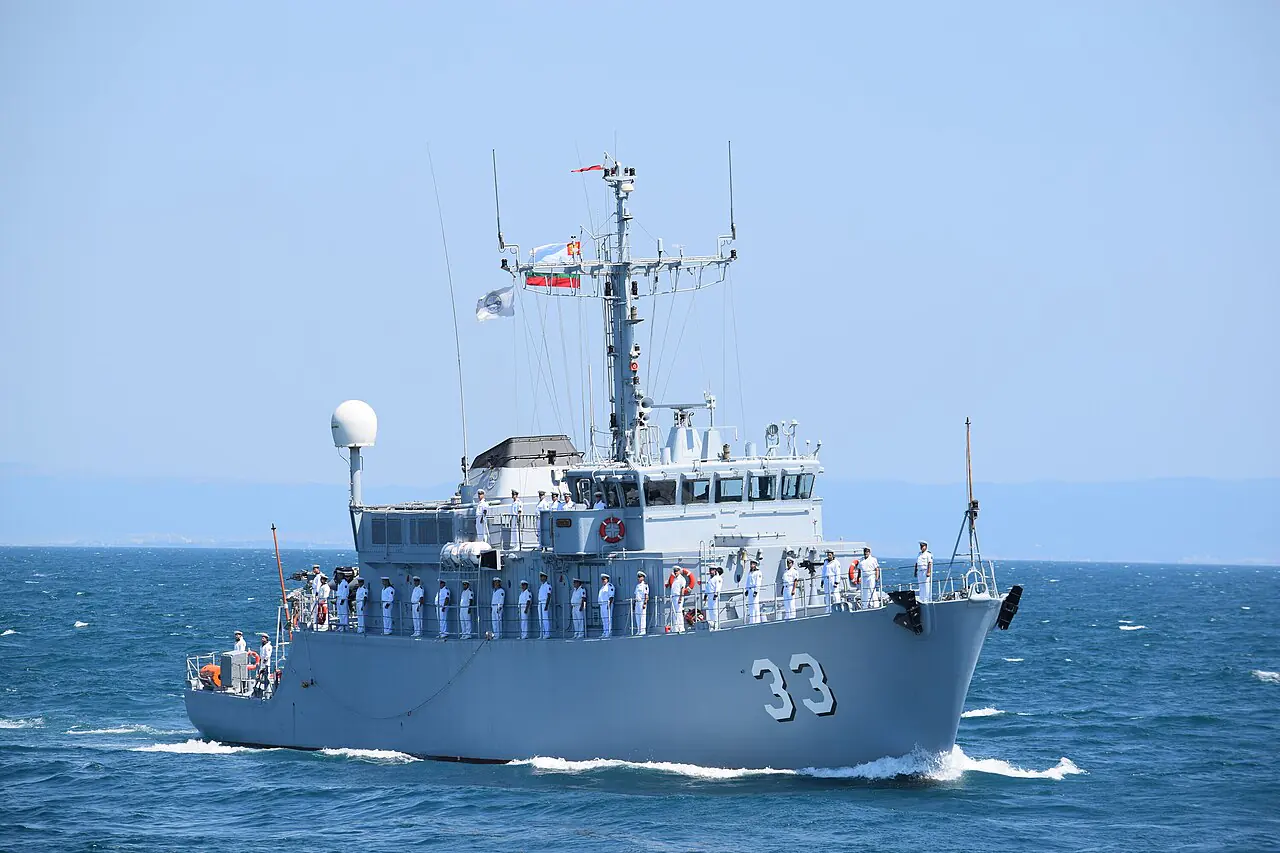
A Mine Countermeasures Vessel (MCMV) is a specialized class of warship dedicated to the high-stakes mission of ensuring sea lanes remain clear of naval mines. Naval mines—whether moored, bottom-dwelling, or influence-type—pose a significant asymmetric threat to maritime commerce, naval task groups, and amphibious operations. The presence of a single mine can close a vital strait, delay an entire fleet, or sink a high-value asset.
Historically, MCM missions were divided into two primary tactical approaches: minesweeping and minehunting.
- Minesweeping involves the use of mechanical or influence tools (such as cables or acoustic generators) to trigger mines at a safe distance from the ship, effectively “sweeping” a path.
- Minehunting is a more precise, surgical approach. It utilizes high-resolution sonar to locate a mine, cameras or electro-optical sensors to identify it, and remotely operated vehicles (ROVs) or divers to neutralize it.
As naval warfare evolves, the paradigm is shifting toward stand-off operations. Modern MCM vessels are increasingly designed as “motherships” or command-and-control hubs. Rather than the ship itself entering the danger zone, it remains at a distance, deploying a swarm of unmanned systems—Unmanned Surface Vehicles (USVs), Unmanned Underwater Vehicles (UUVs), and Unmanned Aerial Vehicles (UAVs)—to perform the hazardous work of detection and destruction. This transition minimizes risk to human crews and increases the operational tempo and safety of the mission.
2. Mission and Operations
The operational lifecycle of an MCM mission is categorized by the type of threat being addressed: contact mines, moored mines, bottom mines, and influence mines.
Mine Countermeasures Mission Profiles
Detection and Classification (Minehunting)
The primary objective of a minehunter is to find “contacts” on the seabed or within the water column. This is achieved using sophisticated sonar systems, often deployed via a Variable Depth Sonar (VDS) or hull-mounted arrays. Once a contact is found, the vessel must classify it (distinguishing a mine from a rock or debris) using high-frequency sonar or optical cameras.
Neutralization (Mine Disposal)
Once a mine is identified, it must be neutralized. This is rarely done by the ship itself. Instead, the crew deploys specialized tools:
- ROVs (Remotely Operated Vehicles): Tethered underwater robots equipped with manipulators and explosives to destroy the mine.
- Autonomous UUVs/AUVs: Self-navigating drones that can map large areas of the seabed.
- Diver Teams: In specific littoral or shallow-water environments, combat divers may still be used for manual clearance.
Influence Sweeping (Minesweeping)
Influence mines are triggered by a ship’s “signature”—its magnetic field, its acoustic noise, or the pressure wave it creates. Minesweepers combat this by:
- Mechanical Sweeping: Towed cables that cut the moorings of contact mines.
- Acoustic Sweeping: Towed acoustic generators that simulate the sound of larger ships to trigger acoustic mines.
- Magnetic Sweeping: Large cables that pulse electric currents to create a magnetic field, mimicking the presence of a large hull to trigger magnetic mines.
Tactical Stand-off and Unmanned Integration
The latest generation of MCM technology focuses on the “Stand-off” principle. By utilizing a suite of unmanned systems, a modern MCM vessel can conduct entire operations from several kilometers away from the actual minefield. This “collaborative” approach uses a mix of USVs for surface-level influence sweeping and UUVs for precision bottom-mine hunting, all controlled via a centralized command system on the mothership.
3. Hull, Size, and Design
The design of an MCMV is dictated by the physics of mine triggers. Because many mines are “influence mines” that respond to magnetic or acoustic signals, the ship’s own presence must be minimized.
Non-Magnetic Construction
To counter magnetic mines, MCMVs are built using non-ferrous materials.
- Wood: Historically, many minesweepers were built of high-quality timber to eliminate magnetic signatures. However, wood requires high maintenance and lacks the structural rigidity needed for modern high-tech sensors.
- GRP (Glass Reinforced Plastic) / Composites: Most modern minehunters utilize GRP or carbon-fiber sandwich construction. These materials are entirely non-magnetic and offer excellent strength-to-weight ratios. They also provide superior resistance to the massive shockwaves produced by underwater explosions.
- Aluminum: While some USV/UUV platforms use aluminum, it is less common for large manned MCMVs due to its magnetic properties (though far lower than steel).
Acoustic Signature Management
To avoid acoustic mines, MCMVs are designed for extreme “quietness.” This involves:
- Vibration Isolation: Mounting engines and heavy machinery on specialized rubber or hydraulic dampening mounts to prevent structural noise.
- Hull Design: Utilizing smooth, hydrodynamic hulls to reduce flow noise and cavitation.
- Machinery Silencing: Using electric motors and sophisticated cooling systems that operate with minimal acoustic output.
Size and Displacement Ranges
MCMVs vary significantly in size depending on their intended role:
- Coastal Minehunters: Small, highly maneuverable vessels (typically 40–70 meters, 300–800 tonnes) used for littoral/shallow water defense.
- Ocean-Going MCMVs/Motherships: Larger vessels (80–100+ meters, 2,000–3,000+ tonnes) capable of long-endurance operations and supporting large drone swarms.
- Unmanned Platforms (USVs/UUVs): Ranging from small, portable units (1–5 meters) to large, autonomous surface vessels.
4. Propulsion and Engines
Propulsion for an MCMV must balance two conflicting requirements: high maneuverability (to maintain precise station-keeping over a mine) and extreme acoustic/magnetic quietness.
Common Propulsion Types
- Diesel-Electric Drive: This is the gold standard for modern MCMVs. Diesel generators provide electrical power, which then drives electric propulsion motors. This allows the engines to be operated at optimal, quiet levels and provides the fine-grained control necessary for maneuvering.
- Water Jets: Many small minehunters (like the Oksøy-class) use water jets instead of traditional propellers. Water jets have no external moving parts (like shafts or propellers) that could create magnetic signatures or significant cavitation noise. They also provide exceptional maneuverability.
- Voith Schneider Propellers (VSP): These specialized propellers use vertical blades to provide instantaneous thrust in any direction, making them ideal for the precision station-keeping required during mine-hunting operations.
Quiet Operation Techniques
To maintain a low acoustic profile, MCMVs often employ “Quiet Ship” protocols. This includes reducing speed to prevent propeller cavitation and, in some cases, utilizing “Prairie/Masker” systems—small air compressors that release a curtain of bubbles around the hull and propeller to mask machinery and flow noise.
5. Electrical System and Power
The electrical architecture of an MCMV is far more complex than that of a standard cargo ship. It must support not only propulsion and basic services but also high-power sensor arrays and the energy-intensive requirements of drone deployment.
Key Electrical Requirements
- Degaussing Systems: A critical component of the electrical system. Degaussing consists of a network of electrical coils installed throughout the hull. By passing controlled direct currents (DC) through these coils, the ship can generate a magnetic field that almost perfectly cancels out its own permanent and induced magnetism.
- Power for Unmanned Systems: MCM motherships must have robust power management to charge UUV/USV batteries and operate high-bandwidth communication links for remote-control operations.
- Redundancy and Isolation: To ensure mission success and safety, electrical systems are highly redundant. Power for critical sensors and navigation is often isolated from the main propulsion grid to prevent electrical interference (Electromagnetic Compatibility - EMC).
6. Equipment and How It Is Used
The equipment suite of an MCMV is what defines its tactical capability. It is a combination of “finding” tools and “fixing” tools.
Sensors and Detection Equipment
| Equipment | Type | Purpose |
|---|---|---|
| Variable Depth Sonar (VDS) | Towed Acoustic | Searches deep water by lowering a sonar transducer below thermal layers. |
| Hull-Mounted Sonar | Fixed Acoustic | Provides constant situational awareness and obstacle avoidance. |
| Side-Scan Sonar | Towed Acoustic | Provides high-resolution imagery of the seabed to identify potential mines. |
| Electro-Optical (EO) Cameras | Visual | Used for final identification of a contact via ROV or drone. |
| Magnetic Anomaly Detectors (MAD) | Magnetic | Detects disturbances in the Earth’s magnetic field caused by metallic mines. |
Neutralization and Disposal Equipment
- ROVs (Remotely Operated Vehicles): These are the “hands” of the minehunter. Equipped with cameras, sensors, and often a small explosive charge (shaped charge), they are sent to a target to destroy it.
- USVs (Unmanned Surface Vehicles): Used for influence sweeping (towing acoustic/magnetic generators) or as mobile sensor platforms.
- UUVs (Unmanned Underwater Vehicles): High-endurance autonomous drones that can perform long-range search patterns or precision identification.
- Mechanical Sweeps: Towed structures designed to physically snag and cut the moorings of contact mines.
7. Navigation, Communications, and Safety
Navigating a minefield requires extreme precision. An MCMV cannot afford to drift off course or experience sudden, uncontrolled movements.
Navigation and Positioning
- Inertial Navigation Systems (INS): Provides highly accurate positioning by tracking movement relative to a known starting point, crucial when GPS is unavailable or unreliable.
- Dynamic Positioning (DP): An automated system that uses sensors (like GPS and DVL) and thrusters to automatically maintain the ship’s position and heading, allowing it to stay perfectly still over a mine.
- Differential GPS (DGPS): Provides the centimeter-level accuracy required for precise mine location reporting.
Communications and Command (C2)
Modern MCM operations rely on high-bandwidth, secure data links. The ship must maintain constant contact with its drones (USVs/UUVs) and communicate real-time sensor data to command centers. This requires advanced satellite communications (SATCOM) and specialized radio frequency (RF) equipment that is designed to be compatible with the ship’s own electronic warfare and sensor suites.
8. Crew and Organization
The role of the crew on an MCMV is undergoing a fundamental transformation.
Traditional Crew Roles
In traditional minehunters, the crew is specialized and high-stakes. Key roles include:
- Mine Warfare Officers: Coordinate the overall tactical approach and drone deployment.
- Sonar Technicians: The “eyes” of the ship, responsible for interpreting complex acoustic data.
- Divers/EOD Technicians: Highly trained specialists who may still be required for complex or shallow-water neutralization.
- Marine Engineers: Manage the complex, quiet propulsion and degaussing systems.
The Shift to Remote Operators
In the “Mothership” model, the crew size is often reduced. A significant portion of the “operators” may actually be located in a shore-based command center, controlling the USVs and UUVs via remote data links. The ship’s crew shifts from being active “doers” in the minefield to being “managers” of a distributed, unmanned system.
9. Certificates and Training Requirements
Operating an MCMV requires specialized certifications that go far beyond standard merchant marine or general naval training.
Specialized Training
- Mine Warfare (MW) Qualification: A core naval specialty involving the study of mine types, deployment tactics, and the use of specialized sonar.
- Diving and EOD Certification: For personnel involved in manual mine clearance.
- UAV/UUV Pilot Certification: For operators controlling the ship’s autonomous systems.
- Sonar Interpretation Training: Intense training in acoustic signature analysis.
Regulatory Compliance
MCMVs must comply with strict naval standards for shock resistance (surviving near-miss explosions) and electromagnetic compatibility (ensuring the ship’s own electronics don’t interfere with its sensors or drones).
10. Regulations, Class, and Inspections
Because MCMVs operate in high-risk environments and utilize highly specialized technology, they are subject to rigorous oversight.
Classification Societies
Organizations like DNV, Lloyd’s Register (LR), and the American Bureau of Shipping (ABS) provide classification services. For MCMVs, they focus on:
- Shock Resistance: Verifying the hull and internal machinery can withstand underwater explosions.
- Non-Magnetic Integrity: Ensuring the materials and construction methods meet strict magnetic signature limits.
- Specialized Equipment Standards: Certifying that sonar and ROV systems meet military-grade requirements.
Inspections
Regular inspections are mandatory to ensure that degaussing coils, vibration mounts, and acoustic silencing systems remain in peak condition. Even a minor failure in a vibration mount could lead to an acoustic signature that triggers a mine.
11. Notable Shipyards, Operators, and Example Vessels
The production of MCMVs is a niche industry dominated by specialized naval shipyards and technology providers.
Key Manufacturers and Providers
- Naval Group (France): A leader in MCM technology and the designer of the City-class.
- Saab (Sweden): A major provider of MCM systems and specialized GRP hulls.
- Thales (France/UK): A dominant player in MCM sonar and sensor technology.
- Atlas Elektronik (Germany): A key provider of mine disposal and C2 systems.
Example Vessels
| Vessel Class | Operator(s) | Primary Role | Key Feature |
|---|---|---|---|
| City-class / Vlissingen | Belgium, Netherlands | MCM Mothership | Massive drone integration (USV/UUV/UAV) |
| Sandown-class | UK, Estonia, Saudi Arabia | Minehunter | Highly advanced non-magnetic design |
| Oksøy-class | Norway | Minesweeper/Hunter | High-speed water jet propulsion |
| Avenger-class | United States | Minehunter/Sweeper | Fiberglass-sheathed wooden hull |
12. Environment and Future Outlook
The future of mine countermeasures is undeniably autonomous.
Trends to Watch
- Massive Swarm Intelligence: Instead of one large ROV, future missions may deploy dozens of small, cheap, expendable UUVs that work together to map and clear a field.
- Artificial Intelligence (AI) in Detection: Machine learning algorithms are becoming essential for processing the massive amounts of data generated by high-resolution sonar, allowing for faster and more accurate mine classification.
- Increased Stand-off Distances: As drone technology improves, the “mothership” will move further and further away from the hazard, potentially operating from outside the immediate threat zone entirely.
- Cost-Effective Attrition: Moving away from multi-million dollar single vessels toward fleets of lower-cost, autonomous platforms that can be lost without catastrophic strategic or human cost.
13. Facts, Records, and Common Misconceptions
- Misconception: “Minehunters and Minesweepers are the same.”
- Fact: While the terms are often used interchangeably in casual conversation, they represent two distinct tactical approaches (searching/identifying vs. clearing/triggering).
- Misconception: “MCM ships are just small boats.”
- Fact: While some are small, modern MCM “motherships” like the City-class are large, sophisticated warships comparable in complexity to frigates.
- Fact: The “Silent War.” Mine warfare is often called the “silent war” because it is a high-tension, low-visibility conflict where the threat is often invisible until it is too late.
14. Glossary
- AUV (Autonomous Underwater Vehicle): A self-propelled, unmanned, untethered underwater vehicle.
- Degaussing: The process of reducing a ship’s magnetic signature using electrical coils.
- GRP (Glass Reinforced Plastic): A composite material (fiberglass) used for non-magnetic hulls.
- Influence Mine: A mine triggered by a change in the magnetic, acoustic, or pressure environment.
- MCM (Mine Countermeasures): The general term for all operations to detect and neutralize mines.
- Minehunter: A vessel designed to find and identify mines through sonar and ROVs.
- Minesweeper: A vessel designed to clear minefields using mechanical or influence tools.
- ROV (Remotely Operated Vehicle): A tethered underwater robot controlled by a human operator.
- USV (Unmanned Surface Vehicle): An autonomous or remotely controlled boat operating on the surface.
- UUV (Unmanned Underwater Vehicle): A general term for any unmanned vehicle operating underwater.
- VDS (Variable Depth Sonar): A sonar system that can be lowered to different depths to optimize detection.
15. Sources
- U.S. Navy: Mine Countermeasures Unmanned Surface Vehicle (MCM USV)
- U.S. Navy: Mine Countermeasures Ships (MCM)
- U.S. Navy: Avenger-class MCM Fact File
- Wikipedia: Oksøy-class mine hunter
- Wikipedia: Sandown-class minehunter
- Wikipedia: City-class mine countermeasures vessel
- Naval News: Belgian-Dutch City-class MCM
- The Defense Post: Belgian Navy Accepts First City-Class Minehunter