1. What Is This Ship?
Naval replenishment and support ships, often categorized under the broader umbrella of Naval Auxiliaries, are the unsung heroes of maritime warfare. Unlike combatant vessels—such as destroyers, cruisers, or aircraft carriers—which are designed to engage enemy forces, support ships are specialized non-combatant platforms tasked with a singular, vital mission: extending the reach and endurance of a naval fleet.
At their core, these vessels function as mobile, floating logistics hubs. They carry the essential consumables required for modern warships to operate continuously in high-intensity environments. This includes liquid commodities like fuel (both ship and aviation), potable water, and lubricants; solid commodities like ammunition, food, medical supplies, and spare parts; and even specialized services like mobile repair facilities or command and control capabilities.
The capability of a navy to project power across vast oceans—often referred to as “blue water” capability—is directly proportional to the efficiency and robustness of its support ship fleet. Without these vessels, a combatant fleet would be tethered to land-based ports, severely limiting its strategic mobility and making it vulnerable to blockade or predictable movement.
Subtypes and Classifications
Because the logistical needs of a fleet are diverse, support ships are highly specialized. Common designations include:
| Designation | Name | Primary Mission |
|---|---|---|
| AO | Oiler | Transfer of liquid fuels and lubricants. |
| AOR | Replenishment Oiler | Combined transfer of fuel, dry stores, and refrigerated goods. |
| AE | Ammunition Ship | Dedicated transport and transfer of ordnance (missiles, shells, bombs). |
| AFS | Combat Store Ship | Combined transfer of food, general stores, and dry/refrigerated cargo. |
| AOE | Fast Combat Support Ship | High-speed, integrated support (Fuel + Ammunition + Stores). |
| AS | Submarine Tender | Mobile base providing repairs, torpedoes, and supplies to submarines. |
| AGS | Surveying Ship | Hydrographic and oceanographic data collection for safe navigation. |
| AR | Repair Ship | Floating industrial workshop for structural and mechanical repairs. |
2. Mission and Operations
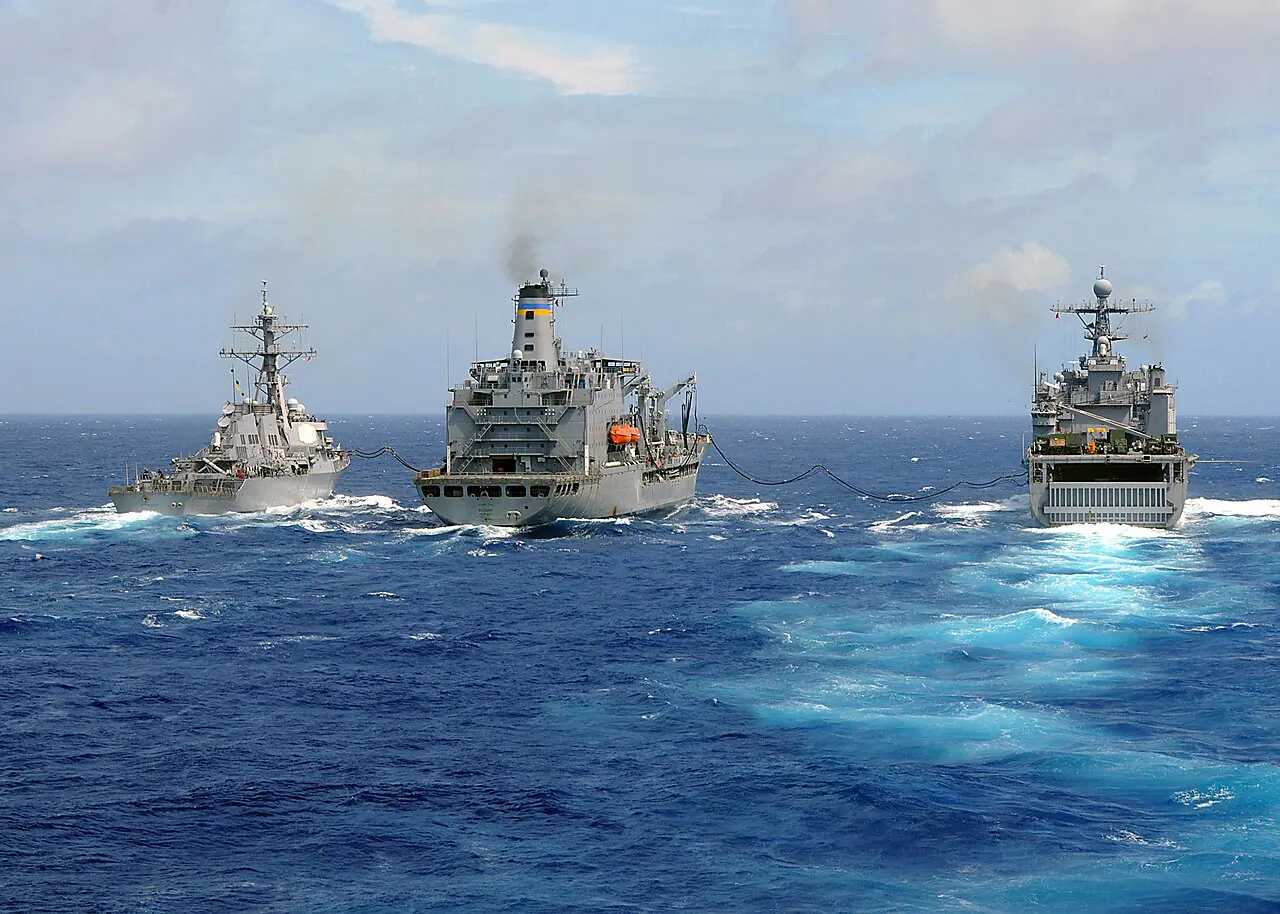
The primary operational doctrine for support ships revolves around Underway Replenishment (UNREP), also known as Replenishment at Sea (RAS). This is the process of transferring supplies between two ships while they are both moving through the water, typically at a constant speed and heading, maintaining a parallel course at a distance of only a few dozen meters.
Methods of Replenishment
To accommodate different cargo types and tactical situations, several methods are employed:
Abeam Replenishment (RAS)
This is the most common method for high-volume transfers. The support ship and the receiving combatant sail side-by-side. A “span wire” is passed between the ships, upon which a trolley system carries hoses (for liquids) or cargo bags/pallets (for solids).
Astern Replenishment
In this method, the receiving ship follows the support ship. While less common for heavy cargo transfers due to the complex hydrodynamics and safety risks, it can be used for specific types of transfers or in restricted waters.
Vertical Replenishment (VERTREP)
VERTREP utilizes helicopters or unmanned aerial vehicles (UAVs) to transport supplies from the support ship’s flight deck to the combatant’s deck. This method is exceptionally fast for moving palletized stores and is often used in conjunction with abeam RAS to offload dry cargo while simultaneously transferring liquids via hoses.
The Combat Logistics Force (CLF)
In many navies, particularly the United States Navy, support ships are organized into a Combat Logistics Force (CLF). These ships are the “supply lines” of the fleet. Some act as “station ships,” remaining within a specific theater to act as a hub, while others serve as “shuttle ships,” moving supplies from major logistical bases to the combatant groups at sea.
3. Hull, Size, and Design
The design of a support ship is driven by three competing requirements: massive carrying capacity, high stability, and sufficient speed to maintain pace with a carrier strike group or task force.
Dimensions and Capacity
Support ships are typically much larger than the combatants they serve. While a destroyer might be 150m long, a large fast combat support ship (AOE) can exceed 250m.
- Volume vs. Weight: Support ships are often “volume-limited,” meaning they run out of space for bulky items (like food or empty containers) before they reach their maximum weight (displacement) limit. Conversely, dedicated tankers (AO) are often “weight-limited” due to the extreme density of liquid fuel.
Stability and Naval Architecture
Stability is the most critical design factor for replenishment ships.
- The Righting Lever (GZ) Curve: During RAS, the ship’s center of gravity (CoG) shifts as heavy loads are moved across the deck or as large volumes of liquid are transferred. The hull must be designed with a robust GZ curve to ensure it can right itself even at significant angles of heel.
- Free Surface Effect: When transferring large quantities of liquid, the “sloshing” of fuel in partially full tanks can create a massive destabilizing force. Support ships use extensive longitudinal and transverse bulkheads (baffling) to minimize this effect.
- Maneuverability: To maintain a steady station during RAS, these ships require excellent low-speed handling. Many utilize twin-skeg or multi-shaft arrangements with advanced rudder systems to provide the precision required to sail mere meters from a combatant.
Hull Form
Modern support ships almost universally utilize double-hull construction to prevent environmental catastrophes in the event of a collision or grounding. The hull is also optimized for “seakeeping”—the ability to maintain a steady platform in rough seas—which is essential for safe helicopter operations (VERTREP) and the steady tensioning of RAS wires.
4. Propulsion and Engines
The propulsion system of a support ship must balance high endurance (to cross oceans) with sufficient speed (to keep up with combatants).
Evolution of Propulsion
Traditionally, support ships used mechanical-drive diesel engines. However, the industry has moved toward more flexible and efficient systems:
- Diesel-Electric Propulsion: The most common modern standard. Large diesel generators produce electricity, which then powers electric propulsion motors. This allows for highly efficient operation across a wide range of speeds and provides massive amounts of auxiliary power for RAS equipment.
- Combined Diesel-Electric and Diesel (CODLAD): This system provides the efficiency of electric drive for cruising and the high-power output of direct mechanical drive for high-speed sprints.
- Integrated Electric Propulsion (IEP): An advanced system where a single set of generators provides both propulsion power and shipboard electrical power. This is increasingly common in next-generation designs as it offers superior fuel economy and better management of the ship’s total energy budget.
Typical Specifications
| Parameter | Typical Range |
|---|---|
| Propulsion Type | Diesel-Electric / CODLAD |
| Service Speed | 18–25 knots |
| Maximum Speed | 25–30 knots (for AOE/Fast Support) |
| Endurance | 20,000–40,000 nautical miles |
5. Electrical System and Power
Replenishment operations are energy-intensive. The electrical system is not just for lighting and navigation; it is a critical part of the ship’s combat logistics capability.
Powering the RAS Rig
The tensioning winches used in abeam RAS must be able to compensate for the relative motion of two ships in a seaway. This requires massive, rapid, and precise torque. Modern systems have moved from hydraulic to all-electric drives (e.g., Kongsberg Maritime solutions), which offer:
- Greater Precision: Faster response times for tension control.
- Reduced Maintenance: Eliminates hydraulic leaks and complex plumbing.
- Higher Efficiency: Power is only drawn when needed by the motors.
Electrical Specifications
RAS equipment typically operates on high-voltage AC systems to minimize transmission losses across the large ship:
- Standard Voltages: 440V or 690V, 3-phase AC.
- Load Requirements: Large-scale MHP (Movable Highpoint) units can require loads ranging from 39 kVA (for 2-tonne loads) to over 90 kVA (for 6-tonne loads).
6. Equipment and How It Is Used
The “business end” of a support ship is its replenishment gear. This equipment must be rugged, reliable, and capable of operating in punishing maritime environments.
The Replenishment at Sea (RAS) Rig
A standard abeam RAS station consists of:
- Span Wire: A heavy-duty steel cable that provides the tensioned bridge between the ships.
- Tensioning Winch: An automated system that maintains constant tension on the span wire, compensating for wave action to prevent the cable from snapping or going slack.
- Trolley and Shuttle: A mechanism that travels along the span wire to carry cargo.
- NATO Probe (Liquid): A specialized coupling used for the rapid, leak-proof transfer of fuels and water.
- Hose (Liquid): A heavy-duty, reinforced hose that follows the probe to facilitate fluid transfer.
Vertical Replenishment (VERTREP) Equipment
- Flight Deck: A reinforced area for helicopter landings.
- Hangar: For storing and maintaining embarked helicopters (e.g., MH-60S).
- Lifting Gear: Specialized cranes and forklifts for moving palletized loads from the deck to the aircraft.
Summary of Transfer Gear
| Equipment Type | Commodity | Primary Mechanism |
|---|---|---|
| Liquid RAS | Fuel, Water, Lube | Tensioned hose + NATO probe |
| Solid RAS | Food, Spares, Ammo | Span wire + Trolley + Pallets |
| VERTREP | Rapid/Small Cargo | Helicopter / UAV |
7. Navigation, Communications, and Safety
Operating a massive support ship within meters of a combatant requires extraordinary precision.
Precision Navigation
Support ships rely on highly accurate Electronic Chart Display and Information Systems (ECDIS), high-resolution radar, and often advanced Dynamic Positioning (DP) systems to maintain their station. Any error in course or speed during RAS can lead to a catastrophic collision or the snapping of tensioned lines.
Communications
Coordination is maintained through several layers:
- Visual Signals: Flaghoists and signal lamps for standardized, non-electronic communication.
- Radio Communication: Encrypted VHF/UHF channels for tactical coordination.
- Light Signals: For nighttime operations.
Safety and Emergency Procedures
The most dangerous moment in RAS is an unexpected change in sea state or a mechanical failure. Ships are trained in Emergency Breakaway procedures, where the connection is instantly severed (via quick-release couplings or cutting the line) to allow the vessels to move apart immediately.
8. Crew and Organization
The crew of a support ship is a blend of technical specialists and logistical experts. While smaller than a carrier crew, they are highly trained in the unique demands of underway transfer.
Key Personnel and Roles
- Supply Department: Responsible for the inventory, storage, and accounting of all consumables. Includes Logistics Specialists (LS).
- Engineering Department: Manages the propulsion, electrical, and fluid transfer systems. Includes Engineers (EN).
- Deck Department: Executes the physical RAS/UNREP operations, handles lines, and manages the span wires. Includes Boatswain’s Mates (BM).
- Aviation/Flight Crew: Pilots and maintainers for VERTREP operations.
- Medical Staff: Many large support ships carry medical facilities and personnel to provide care to the fleet.
9. Certificates and Training Requirements
Due to the high-risk nature of their work, crew members must undergo rigorous training and hold specific certifications.
Training Pipelines
- Technical Schooling: Enlisted sailors attend specialized schools (e.g., Class “A” for personnel, specialized LS or BM training) to learn the mechanics of supply and deck operations.
- Team Training: Before commissioning, “nucleus crews” undergo intensive team training to ensure seamless integration of the ship’s specialized RAS systems.
- Safety & Damage Control: All crew must be proficient in firefighting, flooding control, and emergency medical response.
Certifications
- USCG/Maritime Certifications: Many crew members hold Merchant Mariner Credentials (MMC) or USCG licenses.
- Naval Enlisted Classification (NEC): Specific to US Navy sailors, these denote mastery of specialized systems like RAS tensioning or aviation support.
10. Regulations, Class, and Inspections
Naval support ships operate under a complex framework of international and national regulations.
Classification Societies
Even though they are military vessels, most support ships are built and maintained to the standards of major classification societies to ensure structural integrity and safety. These include:
- ABS (American Bureau of Shipping)
- DNV (Det Norske Veritas)
- LR (Lloyd’s Register)
- BV (Bureau Veritas)
The Naval Ship Classification Association (NSCA) provides a forum for these societies to develop rules specifically for naval vessels.
Regulatory Frameworks
- MARPOL: International convention for the prevention of pollution from ships (critical for tankers).
- SOLAS: International convention for the safety of life at sea.
- IMO Standards: Used for many auxiliary vessels operating in international waters.
11. Notable Shipyards, Operators, and Example Vessels
Major Shipyards and Operators
- Shipyards: NASSCO (USA), Damen Shipyards (Netherlands), Rheinmetall (Germany).
- Operators: Military Sealift Command (USA), Royal Navy (UK), French Navy (France), Royal Netherlands Navy (Netherlands).
Example Vessels
| Vessel Name | Class / Type | Country | Notable Feature |
|---|---|---|---|
| HNLMS Karel Doorman (A833) | Joint Support Ship | Netherlands | Multi-functional; combines sealift and RAS. |
| USN Supply-class | AOE | USA | Extremely high speed; integrates fuel, ammo, stores. |
| UK Tide-class | T23 (LSS) | UK | Modern, versatile replenishment platform. |
| Henry J. Kaiser-class | T-AO | USA | The backbone of US Navy liquid replenishment. |
| NTV 130 | Naval Tender | Germany | Versatile “mothership” for unmanned systems. |
12. Environment and Future Outlook
The landscape of naval logistics is undergoing a paradigm shift driven by two main forces: Distributed Maritime Operations (DMO) and Automation.
Distributed Maritime Operations (DMO)
Modern warfare is moving away from large, centralized strike groups toward more dispersed, distributed forces. This requires a more agile and decentralized logistics network. Support ships must be able to operate in “austere” environments, perhaps tending to smaller, more numerous combatants in remote locations.
Automation and Unmanned Systems
The integration of Unmanned Surface Vessels (USVs) and Unmanned Aerial Vehicles (UAVs) is the next frontier.
- Autonomous Resupply: Future support ships may use autonomous “shuttle” USVs to ferry supplies to combatants, reducing the risk to human crews.
- Drone Integration: As seen in the Rheinmetall NTV 130, the next generation of support vessels is being designed as “motherships” for drone-based combat and surveillance.
Environmental Sustainability
Pressure to reduce the carbon footprint of global navies is driving the adoption of hybrid-electric propulsion and the use of alternative fuels (e.g., biofuels or hydrogen-derived fuels) in support ship designs.
13. Facts, Records, and Common Misconceptions
- Fact: A support ship is often a higher-value target for an enemy than a destroyer. While they lack heavy weapons, their destruction can effectively “starve” an entire combat group, forcing it to retreat.
- Fact: They are not “just tankers.” A modern AOR handles a cocktail of highly sensitive, incompatible commodities (e.g., high-explosive ordnance and volatile aviation fuel) on a single hull.
- Misconception: “They are slow and vulnerable.” While slower than a destroyer, modern AOEs are designed to keep pace with carrier groups, and their survivability is enhanced by advanced electronic warfare and defensive systems.
14. Glossary
- Abeam: To the side of a vessel.
- DMO: Distributed Maritime Operations.
- GZ Curve: The plot of a ship’s righting lever against the angle of heel, used to measure stability.
- NATO Probe: A standardized coupling for rapid liquid transfer.
- RAS: Replenishment at Sea.
- UNREP: Underway Replenishment.
- VERTREP: Vertical Replenishment (using aircraft).
15. Sources
- Military Sealift Command (MSC) - https://www.msc.usff.navy.mil/
- Damen Shipyards - Naval Auxiliaries Brochure - https://medialibrary.damen.com/
- Global Security - Combat Logistics Force - https://www.globalsecurity.org/military/systems/ship/logistics.htm
- Global Security - Auxiliary Classes - https://www.globalsecurity.org/military/systems/ship/auxiliary-classes.htm
- Kongsberg Maritime - Replenishment at Sea - https://www.kongsbergmaritime.com/
- Lloyd’s Register - Naval Classification - https://www.lr.org/en/expertise/segments/naval/
- Congressional Research Service (CRS) - Navy Ship Types - https://www.congress.gov/