1. What Is This Ship?
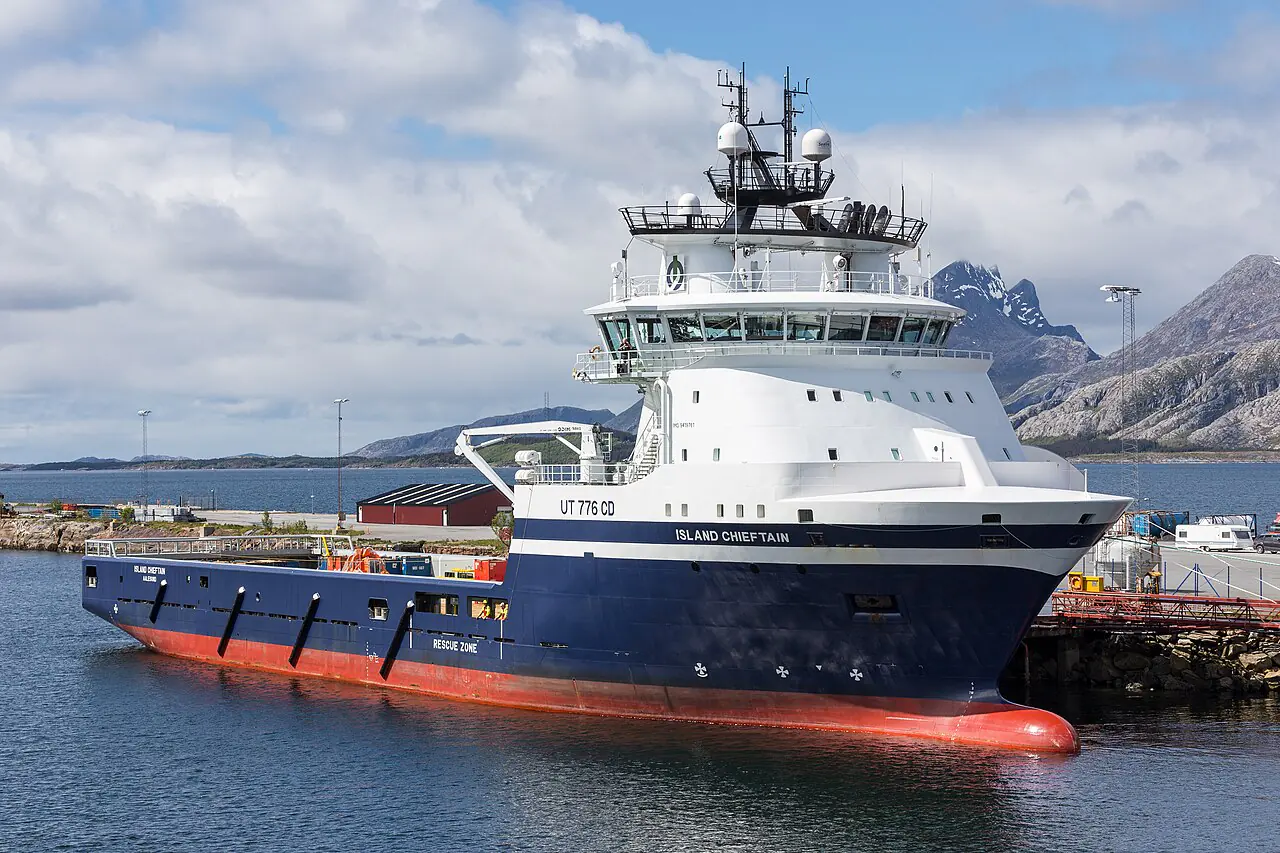
A Platform Supply Vessel (PSV) is a specialized type of offshore support vessel (OSV) designed primarily to transport essential supplies, equipment, and resources to offshore installations, such as oil and gas platforms, drilling rigs, and increasingly, offshore wind farms.
In the complex ecosystem of offshore energy production, the PSV serves as the vital logistics link between onshore supply bases and the remote assets located hundreds of miles out at sea. Unlike many other offshore vessels that focus on towing (such as Anchor Handling Tug Supply vessels, or AHTS), the PSV is optimized for cargo capacity and station-keeping stability.
The defining characteristics of a PSV are its expansive, high-strength aft cargo deck and its sophisticated Dynamic Positioning (DP) systems. These systems allow the vessel to maintain a fixed position relative to a platform without the use of anchors, which is critical in deep water or in environments where seabed-mounted equipment must be protected.
2. Mission and Operations
The primary mission of a PSV is the continuous replenishment of offshore assets. Offshore installations are essentially self-contained cities that require a constant influx of materials to maintain operations and support the crew.
Typical Cargo Categories
PSVs are designed to handle a diverse array of cargo, often requiring segregated storage systems to prevent contamination:
- Dry Cargo: Equipment in shipping containers, drill pipes, subsea components, and general consumables (food, spare parts).
- Liquid Cargo: Fuel (Diesel/MGO), potable water, drilling muds, brines, and cement.
- Specialized Cargo: Hazardous materials, chemicals, and oxygen/nitrogen cylinders.
The Operational Cycle
- Loading: The vessel arrives at a specialized onshore supply base. Large cranes or heavy-lift equipment load the cargo deck, while specialized pumps and hoses are connected for liquid transfers.
- Transit: The vessel travels from the base to the offshore field. During this phase, efficiency and fuel economy are prioritized.
- Station Keeping: Upon arrival at the installation, the PSV must “hold station.” This involves maneuvering close to the platform’s side or beneath its cantilevered sections using its DP system.
- Discharge: Cargo is transferred. Dry cargo is moved via deck cranes or platform cranes; liquids are transferred through specialized manifolds and hoses.
- Return: Once empty or partially depleted, the vessel returns to the base to repeat the cycle.
3. Hull, Size, and Design
The design of a PSV is driven by the requirement for a massive, usable cargo area combined with excellent stability in heavy seas.
Hull Architecture
Most modern PSVs feature a “flat-aft” design. The hull is shaped to maximize the clear deck area, with the bridge and accommodation block located far forward. This layout provides the crew with excellent visibility of the cargo deck and ensures that the vessel’s center of gravity is managed effectively even when carrying heavy deck loads.
Typical Specifications
While designs vary based on the specific requirements of an oil field (e.g., North Sea vs. Gulf of Mexico), typical ranges include:
| Feature | Typical Range |
|---|---|
| Length (Overall) | 85 – 100 meters |
| Beam (Width) | 18 – 22 meters |
| Deadweight (DWT) | 5,000 – 7,500 metric tonnes |
| Clear Deck Area | 1,000 – 1,500 m² |
| Deck Strength | 5 – 10 MT/m² |
| Cruising Speed | 13 – 16 knots |
Stability and Sea Keeping
Because PSVs often carry heavy, concentrated loads on their aft deck, they must possess high transverse stability. Designers utilize specialized ballast systems to counteract the effect of heavy deck cargo and the shifting of liquid cargo in tanks. The hull form is also optimized to minimize “pitching” (the up-and-down motion of the bow), which is vital for maintaining a steady platform during cargo transfer operations.
4. Propulsion and Engines
To fulfill the requirement of precise station-keeping, PSVs utilize advanced propulsion systems that allow for instantaneous changes in thrust direction.
Diesel-Electric Propulsion
Most modern, high-specification PSVs use a diesel-electric arrangement. Instead of the engines being directly connected to the propellers via shafts, the diesel generators produce electricity, which is then distributed through a power grid to electric motors. This provides:
- Flexibility: Power can be redirected quickly to whichever thruster needs it most.
- Efficiency: Generators can be turned on or off based on the current power demand (peak shaving).
- Precision: Electric motors provide much smoother and more responsive control than mechanical drives.
Thrusters and Propellers
- Azimuth Thrusters: These are propeller units that can rotate 360 degrees. They provide the primary propulsion and allow the vessel to move in any direction.
- Tunnel Thrusters: Often located in the bow or stern, these provide lateral (sideways) movement, aiding in docking and tight maneuvering.
- Bow and Stern Thrusters: These are critical for the DP system to counteract wind, waves, and currents.
5. Electrical System and Power
The electrical system is the “brain and muscle” of a PSV, particularly for its Dynamic Positioning capabilities.
Power Management System (PMS)
The PMS automatically manages the vessel’s power distribution. It monitors the load on each generator and ensures that there is always enough “spinning reserve” to handle a sudden increase in demand (e.g., if the DP system needs to compensate for a sudden gust of wind).
Redundancy and DP Classes
The reliability of the electrical system is categorized by Dynamic Positioning (DP) Classes:
- DP1: The vessel has no redundancy. A single failure in a generator or thruster could lead to a loss of position.
- DP2: The vessel has redundancy. It is designed so that a single failure (e.g., one engine or one circuit) will not result in a loss of position. This is the industry standard for most offshore operations.
- DP3: High-level redundancy designed to withstand even a fire or flooding in a specific compartment. DP3 vessels are required for the most hazardous and critical operations.
6. Equipment and How It Is Used
Beyond the engines and hull, a PSV is a floating warehouse equipped with specialized transfer tools.
Cargo Handling Equipment
- Manifolds: Located along the side of the vessel, these are connection points for liquid cargo hoses (fuel, water, mud).
- Pumps: High-capacity pumps are used to transfer liquid cargo from the vessel’s internal tanks to the offshore platform.
- Deck Lashings: Specialized securing points (D-rings and sea chests) allow heavy containers and equipment to be bolted to the deck.
- Craneage: While many PSVs rely on platform-mounted cranes, many are equipped with their own deck cranes for moving smaller items or assisting in cargo securing.
Liquid Transfer Systems
PSVs carry dedicated, segregated tanks to prevent cross-contamination. A typical setup includes:
- Fuel Tanks: For Diesel/MGO.
- Potable Water Tanks: For fresh water.
- Mud/Brine Tanks: For drilling fluids.
- Cement/Bulk Tanks: For specialized drilling materials.
7. Navigation, Communications, and Safety
Operating close to massive, stationary steel structures in high seas requires state-of-the-art technology.
Navigation and DP Control
The bridge is equipped with standard marine navigation tools:
- Radar & ARPA: For detecting other vessels and landmasses.
- ECDIS (Electronic Chart Display and Information System): For digital navigation.
- AIS (Automatic Identification System): For vessel tracking.
The most critical component is the DP Console. This station provides the operator with real-time data on the vessel’s position, heading, and the environmental forces (wind, wave, current) acting upon it. The operator uses this to fine-tune the vessel’s position.
Safety Systems
- Life-Saving Appliances (LSA): Fast-response lifeboats (often enclosed) and life rafts.
- Firefighting (FiFi): Many PSVs are equipped with FiFi-1 or FiFi-2 class systems, including high-pressure water monitors (cannons) to fight fires on platforms.
- Emergency Shut-Down (ESD): Systems that can instantly stop all cargo transfers and shut down engines in an emergency.
8. Crew and Organization
A PSV typically carries a crew of 12 to 25 people, depending on the vessel’s size and the complexity of its operations.
Crew Hierarchy
- Deck Department: Led by the Master (Captain), followed by the Chief Officer, Bosun, Able Seamen (AB), and Ordinary Seamen (OS). They handle navigation, deck operations, and cargo securing.
- Engine Department: Led by the Chief Engineer, followed by the Second Engineer, Electrical Engineer (ETO), and Motormen. They maintain the engines, generators, and electrical systems.
- Dynamic Positioning Department: While DPOs are often officers, they are specialized roles responsible for the precision movement of the ship.
- Catering Department: Includes the Chief Cook and Stewardesses, responsible for the health and well-being of the crew.
9. Certificates and Training Requirements
Working on a PSV requires rigorous certification, governed by international standards.
Core Certifications
- STCW (Standards of Training, Certification and Watchkeeping): The baseline requirement for all professional mariners.
- DP Certification: Essential for officers. This is divided into DP Induction, DP Basic, and DP Advanced, typically validated through simulator training and sea time.
- Endorsements: Specialized training for handling hazardous cargo (e.g., oil tanker endorsements) or advanced firefighting.
Medical and Safety Training
- BOSIET (Basic Offshore Safety Induction and Emergency Training): A mandatory course for anyone entering the offshore environment, including helicopter ditching and firefighting.
- Medical First Aid: Standard requirement for key crew members.
10. Regulations, Class, and Inspections
The offshore industry is one of the most heavily regulated sectors in the world.
Regulatory Bodies
- IMO (International Maritime Organization): Sets global standards for safety (SOLAS), pollution prevention (MARPOL), and DP operation (MSC.1/Circ.1580).
- Flag State: The country where the vessel is registered, responsible for enforcing IMO standards.
Classification Societies
Vessels are “classed” by organizations like DNV, ABS, Lloyd’s Register, and Bureau Veritas (BV). Classification ensures that the vessel’s hull, machinery, and electrical systems are built to strict technical standards. A vessel’s “Class Notation” (e.g., DNV +1A1, DYNPOS-AUT) tells operators exactly what the vessel is capable of.
Inspections
Vessels undergo regular:
- Annual Surveys: To maintain class notation.
- Port State Control (PSC): Random inspections by national authorities to ensure compliance with international law.
- Oil Major Inspeents: Large energy companies often conduct their own private inspections before hiring a vessel.
11. Notable Shipyards, Operators, and Example Vessels
The PSV market is dominated by a few highly specialized players.
Leading Shipyards
- Ulstein Group (Norway): Famous for the “Ulstein X-design,” which offers superior stability and sea-keeping.
- Vard (Norway): A major global player in advanced offshore vessel construction.
- Various Asian Yards: High-volume producers of standard PSV designs for the global market.
Major Operators
- Tidewater: One of the largest offshore vessel owners globally.
- Bourbon Offshore: A major player in the logistics and supply segment.
- Maersk Supply Service: A key operator in the North Sea and West Africa.
Example Vessels
- The Polaris Class: (Note: Reference to Tidewater vessels).
- Ulstein X-Series Vessels: High-specification vessels used in harsh environments like the North Sea.
12. Environment and Future Outlook
The maritime industry is undergoing a massive transition toward decarbonization, and PSVs are at the forefront of this shift.
Alternative Fuels
To meet IMO greenhouse gas reduction targets, new PSVs are being designed to run on:
- LNG (Liquefied Natural Gas): Reduces CO2 and SOx emissions significantly.
- Biofuels: A drop-in solution for existing diesel engines.
- Hydrogen and Ammonia: The long-term frontier for zero-emission shipping.
Hybridization and Electrification
The use of Battery Hybrid Systems is rapidly becoming standard. Large battery banks allow for “peak shaving”—using electricity for sudden power demands rather than running an extra diesel generator. This reduces fuel consumption and lowers local emissions during station-keeping.
Support for Offshore Wind
As the energy transition progresses, PSVs are being adapted to support the Offshore Wind sector. This includes carrying larger components for wind turbine installation and providing logistics for the maintenance of offshore wind farms.
13. Facts, Records, and Common Misconceptions
Common Misconceptions
- “PSVs are just big tugs”: While both are offshore vessels, a PSV’s primary function is cargo and supply, whereas a tug’s (AHTS) primary function is towing and anchoring.
- “Dynamic Positioning is Autopilot”: Autopilot follows a pre-set course. DP is an active, constant feedback loop that fights environmental forces to maintain a specific point in space.
Key Facts
- Station Keeping: A well-tuned DP system can hold a vessel within a few meters of a target, even in heavy seas.
- Redundancy: The difference between DP2 and DP3 is not just about having more engines; it is about the separation of cables, switchboards, and control systems to prevent a single failure from being catastrophic.
14. Glossary
- AHTS: Anchor Handling Tug Supply vessel.
- Azimuth Thruster: A propeller unit that can rotate 360 degrees.
- BOSIET: Basic Offshore Safety Induction and Emergency Training.
- DWT (Deadweight Tonnage): The total weight a ship can carry (cargo, fuel, etc.).
- DP (Dynamic Positioning): A computer-controlled system for position maintenance.
- IMO: International Maritime Organization.
- MANIFOLD: A connection point for fluid transfer.
- OSV: Offshore Support Vessel.
- STCW: Standards of Training, Certification and Watchkeeping.