1. What Is This Ship?
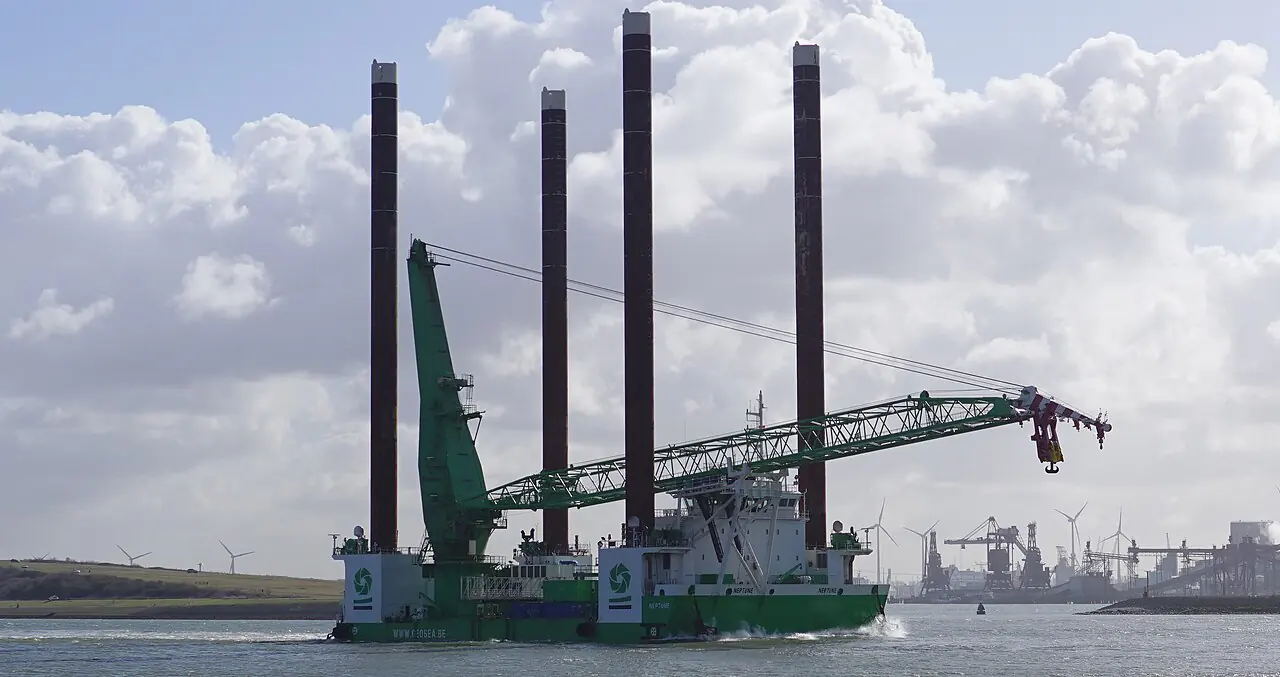
A Wind Turbine Installation Vessel (WTIV), often referred to as a “jack-up” vessel in the context of offshore wind, is a highly specialized class of offshore construction ship. Its primary purpose is the installation and sometimes the maintenance of offshore wind turbines, including their foundations (monopiles or jackets), towers, nacelles, and blades.
Unlike standard cargo or service vessels, a WTIV is designed to overcome the two greatest challenges of offshore wind construction: extreme weight and unstable sea states. To address these, WTIVs are “self-elevating.” They are equipped with massive, retractable legs that can be lowered to the seabed, effectively “jacking” the ship’s hull out of the water and onto the seafloor. This transforms the vessel from a floating ship into a stable, stationary platform, providing the steady environment required for the precision lifting and assembly of massive turbine components.
As the global transition toward renewable energy accelerates, WTIVs have become the backbone of the offshore wind industry. The continuous evolution of wind turbine technology—with single turbines growing from a few megawatts to over 15 or even 20 megawatts—has driven a parallel evolution in WTIV design, requiring ever-larger cranes, taller legs, and more robust jacking systems.
2. Mission and Operations
The mission of a WTIV is centered on the construction and commissioning phases of an offshore wind farm. Its operations are highly choreographed and involve several distinct stages:
A. Logistics and Component Transport
Before installation begins, the WTIV serves as a heavy-lift transport vessel. It carries massive loads, including:
- Foundations: Large steel monopiles or complex lattice jackets.
- Towers: Multiple sections of steel tower.
- Nacelles: The “brain” and generator housing of the turbine.
- Blades: Extremely long, lightweight, yet fragile composite structures.
B. Positioning and Jacking Up
The vessel arrives at the wind farm site using Dynamic Positioning (DP) systems to maintain its location relative to the installation point. Once positioned, the jacking mechanism is engaged. The vessel’s legs (spuds) are lowered to the seabed. Once the legs have reached the seafloor, the vessel initiates a “preload” operation—filling ballast tanks to apply controlled downward force on the legs. This ensures the soil bearing capacity is sufficient and the legs are firmly settled. Finally, the hull is lifted (jacked up) above the wave action, creating a stable work platform.
C. Installation Sequence
Once stabilized, the WTIV begins the assembly process:
- Foundation Installation: If the vessel is designed for it, it may install the foundation (e.g., driving a monopile or placing a jacket).
- Tower Assembly: The crane lifts the lower tower section onto the foundation, followed by subsequent sections.
- Nacelle Installation: The heaviest single component, the nacelle, is lifted and precision-placed atop the tower.
- Blade Installation: This is often the most delicate phase. Modern vessels use specialized “blade grippers” or specialized crane configurations to install three blades simultaneously or one by one in high-wind environments.
D. Decommissioning and Moving
After a turbine is completed, the vessel “jacks down” (lowers the hull back into the water) and moves to the next site.
3. Hull, Size, and Design
The design of a WTIV is dominated by the need for stability and lifting capacity.
The Jack-Up Mechanism
The defining feature is the jacking system. Most modern WTIVs use a Rack and Pinion system. Large vertical steel beams (the racks) are attached to the legs, and electric or hydraulic motors (the pinions) crawl up or down these racks to raise or lower the hull. Some older or smaller vessels may use purely hydraulic systems, but rack and pinion is the industry standard for large-scale wind installations due to its reliability and ability to handle massive loads.
Leg Design
WTIV legs are typically long, slender truss structures. At the bottom of each leg is a Spud Can—a large, wide foot designed to distribute the weight of the vessel and prevent the legs from sinking too deeply into the seabed. The length of the legs dictates the “operating water depth” of the vessel; as wind farms move into deeper waters, WTIVs must be designed with increasingly longer legs.
Hull and Deck Space
The hull must be large enough to provide significant deck area for storing turbine components. A typical modern WTIV might have a deck area of 5,000 to 7,000 m². The deck must also be capable of handling extremely high “point loads” from heavy components and the weight of the crane.
Typical Dimensions (Typical Ranges)
| Feature | Typical Range |
|---|---|
| Length Overall (LOA) | 150 – 185 m |
| Breadth (Beam) | 50 – 65 m |
| Operating Water Depth | 40 – 80 m |
| Leg Length | 100 – 140 m |
| Deck Area | 5,000 – 7,500 m² |
| Max Deck Load | 15 – 25 t/m² |
4. Propulsion and Engines
WTIVs require two distinct types of propulsion capability: high efficiency during transit and extreme precision during positioning.
Transit Propulsion
For moving between ports and wind farms, WTIVs use standard marine diesel engines driving azimuth thrusters or tunnel thrusters. Transit speeds are typically modest, ranging from 10 to 13 knots, as the priority is fuel efficiency and stability of the heavy cargo.
Dynamic Positioning (DP)
The most critical aspect of WTIV propulsion is the Dynamic Positioning (DP) system. During the approach to an installation site, the vessel must maintain its position with millimeter precision to avoid damaging the turbine or the vessel itself.
- DP2 and DP3: Most modern WTIVs are rated as DP2 or DP3. A DP2 system has redundancy in its sensors and thrusters, meaning it can maintain position even if a single component (like a thruster or a computer) fails. DP3 is even more robust, designed to withstand more severe failures and environmental conditions.
- Thrusters: A combination of Azimuth thrusters (which can rotate 360 degrees) and Tunnel thrusters (fixed thrusters in the hull) provides the necessary vector control to counteract wind, waves, and currents.
5. Electrical System and Power
WTIVs are among the most power-intensive vessels in the maritime industry. They require immense electrical power for three main purposes:
- The Jacking System: Lifting a multi-thousand-ton hull requires massive bursts of energy.
- The Heavy-Lift Crane: Modern cranes require significant power for hoisting, slewing, and luffing.
- Onboard Systems: Accommodation, DP systems, and auxiliary machinery.
Hybrid and Battery Systems
A significant recent trend is the integration of Battery Energy Storage Systems (BESS). Modern WTIVs (like the Cadeler A-Class) often feature large battery banks (e.g., 5+ MWh). This “hybrid” approach offers several advantages:
- Peak Shaving: The batteries can provide immediate power during high-demand events (like jacking or heavy lifting), preventing the main diesel generators from being overloaded.
- Emissions Reduction: Batteries can handle low-load operations, allowing engines to run more efficiently or even be shut down temporarily.
- Improved Response: Batteries can react much faster to sudden changes in load than diesel engines, which is critical for stable crane operations.
6. Equipment and How It Is Used
The “tools of the trade” for a WTIV are its crane and its jacking system.
Heavy-Lift Cranes
The crane is the heart of the vessel. WTIVs typically use a large Pedestal Crane located midship or near the bow.
- Capacity: Modern cranes must have lifting capacities often exceeding 3,000 to 4,000 metric tons at certain radii to handle the next generation of nacelles and tower sections.
- Reach/Height: As turbines grow, cranes must be taller. A typical crane may have a hook height of 160 to 200 meters above the deck.
- Precision: Advanced control systems allow the crane to perform “active heave compensation” (if operating in a floating mode) and extremely smooth movements to prevent the “pendulum effect” when lifting large, wind-sensitive components.
Jacking Systems
As discussed, the jacking system (usually Rack and Pinion) is used to elevate the hull. The precision of the jacking system is vital; the hull must be raised perfectly level to ensure the stability of the crane and the safety of the crew.
Deck Handling Equipment
To move components from the deck to the crane hook, WTIVs utilize various tools, such as:
- Multi-axial transporters: To move components across the deck.
- Specialized Grippers: For handling turbine blades.
- Hydraulic Jacks: For fine-tuning the position of components during mating.
7. Navigation, Communications, and Safety
Navigation and Positioning
In addition to standard marine radar, AIS, and GPS, WTIVs rely heavily on:
- DGPS (Differential GPS): For high-precision positioning.
- Laser/Radio-based positioning systems: Used for centimeter-level accuracy during the final stages of installation.
- Motion Sensors: To monitor the vessel’s pitch, roll, and heave, which is critical for crane operations.
Safety Systems
- Lifeboats/Life Rafts: Standard maritime survival equipment.
- Firefighting Systems: High-capacity water monitors and foam systems, especially near the engine room and crane.
- Emergency Shutdown (ESD): Systems to immediately halt jacking or crane operations in the event of a critical failure.
8. Crew and Organization
A WTIV requires a highly specialized and multi-disciplinary crew. The organization typically includes:
- Deck/Marine Department: Master (Captain), Officers, Deckhands, and specialized DP Operators.
- Engine Department: Chief Engineer, Engineers, and Electricians.
- Crane/Technical Department: Highly skilled Crane Operators and specialized heavy-lift technicians.
- Subsea/Technical Team: Technicians responsible for the maintenance of the jacking and subsea components.
- Accommodation/Service Staff: Catering and housekeeping to support the crew.
The crew size can vary from 30 to over 60 personnel depending on the vessel’s size and the complexity of the project.
9. Certificates and Training Requirements
Crew members must hold several specialized certifications beyond standard maritime training:
- STCW (Standards of Training, Certification, and Watchkeeping): The baseline for all maritime professionals.
- DP Certification (DP Maintenance/Operations): Essential for officers and engineers working with DP2/DP3 systems.
- Crane Operator Certification: Specialized training for heavy-lift offshore operations.
- GWO (Global Wind Organisation) Standards: Critical for all personnel working in the wind industry, covering basic safety, sea survival, and manual handling.
10. Regulations, Class, and Inspections
WTIVs are subject to rigorous international and national regulations:
- IMO (International Maritime Organization): Sets global standards for safety (SOLAS), environment (MARPOL), and navigation.
- Classification Societies: Major organizations like DNV, ABS, and Bureau Veritas (BV) develop and certify the technical standards for hull construction, jacking mechanisms, and machinery.
- Flag State Inspections: Regular inspections by the country where the vessel is registered.
- Coastal State Requirements: Specific regulations for operating within the territorial waters of a country (e.g., the UK, Denmark, or the USA).
11. Notable Shipyards, Operators, and Example Vessels
The WTIV market is dominated by a few highly specialized players.
Key Operators
- Cadeler: A leading global player in offshore wind services.
- Jan De Nul: A major Belgian dredging and offshore construction company.
- DEME: Another Belgian giant specializing in large-scale offshore projects.
- Fred. Olsen Wind Carriers: A specialist in offshore wind logistics and installation.
- Heerema Marine Contractors: Known for heavy-lift offshore operations.
Example Vessels
| Vessel Name | Operator | Notable Feature |
|---|---|---|
| Cadeler A-Class | Cadeler | Large battery capacity (5.2 MWh) and DP2. |
| Voltaire | Jan De Nul | Massive payload (16,000 t) and high crane height. |
| Wind Osprey | Fred. Olsen | Specialized for efficient turbine installation. |
| Wind-class vessels | Various | Representing the next generation of high-capacity WTIVs. |
Key Shipyards
Leading WTIVs are often built in major Asian shipyards, such as Hanwha Ocean (formerly DSME) in South Korea or Hyundai Heavy Industries (HHI), as well as specialized yards in Europe.
12. Environment and Future Outlook
The WTIV industry is facing a period of rapid transformation driven by two factors: the scale of wind turbines and the push for decarbonization.
The “Mega-Turbine” Challenge
As turbines grow to 20MW and beyond, WTIVs must become larger and more capable. This means:
- Taller Legs: To accommodate higher nacelle heights.
- Larger Cranes: To lift heavier components.
- Greater Deck Space: To carry more components per trip.
Decarbonization and Automation
The maritime industry’s push toward “net zero” is reaching the offshore wind sector.
- Hybrid/Electric Power: As seen with the Cadeler A-Class, batteries are becoming standard to reduce emissions and improve efficiency.
- Hydrogen/Ammonia Fuels: Future research is looking into alternative fuels for long-distance transit.
- Automation: Remote-controlled cranes and autonomous positioning systems are being developed to increase safety and reduce the number of personnel required on board.
13. Facts, Records, and Common Misconceptions
The “Preload” Fact
A common misconception is that a vessel simply “sits” on its legs. In reality, a critical phase called Preload is required. By intentionally overloading the legs with ballast water, engineers ensure that the seabed is compressed and the legs won’t suddenly “sink” or “punch through” once the vessel is jacked up.
WTIV vs. SOV
It is common to confuse WTIVs with SOVs (Service Operation Vessels).
- WTIV: A “construction” vessel that jacks up to provide a stable platform for installation.
- SOV: A “maintenance” vessel that remains floating (often using walk-to-work gangways) to provide accommodation and supplies for technicians during the turbine’s operational life.
14. Glossary
- Azimuth Thruster: A propeller that can rotate 360 degrees, providing full control of thrust direction.
- DP (Dynamic Positioning): A computer-controlled system that maintains a vessel’s position and heading by using its own propellers and thrusters.
- Jack-up: A vessel capable of elevating its hull above the water using retractable legs.
- Nacelle: The enclosure at the top of a wind turbine tower that houses the generator and gearbox.
- Rack and Pinion: A mechanism where a circular gear (pinion) moves along a linear notched bar (rack).
- Spud Can: The large, wide foot at the bottom of a jack-up leg.
- WTIV: Wind Turbine Installation Vessel.