1. Incident Overview and Key Facts
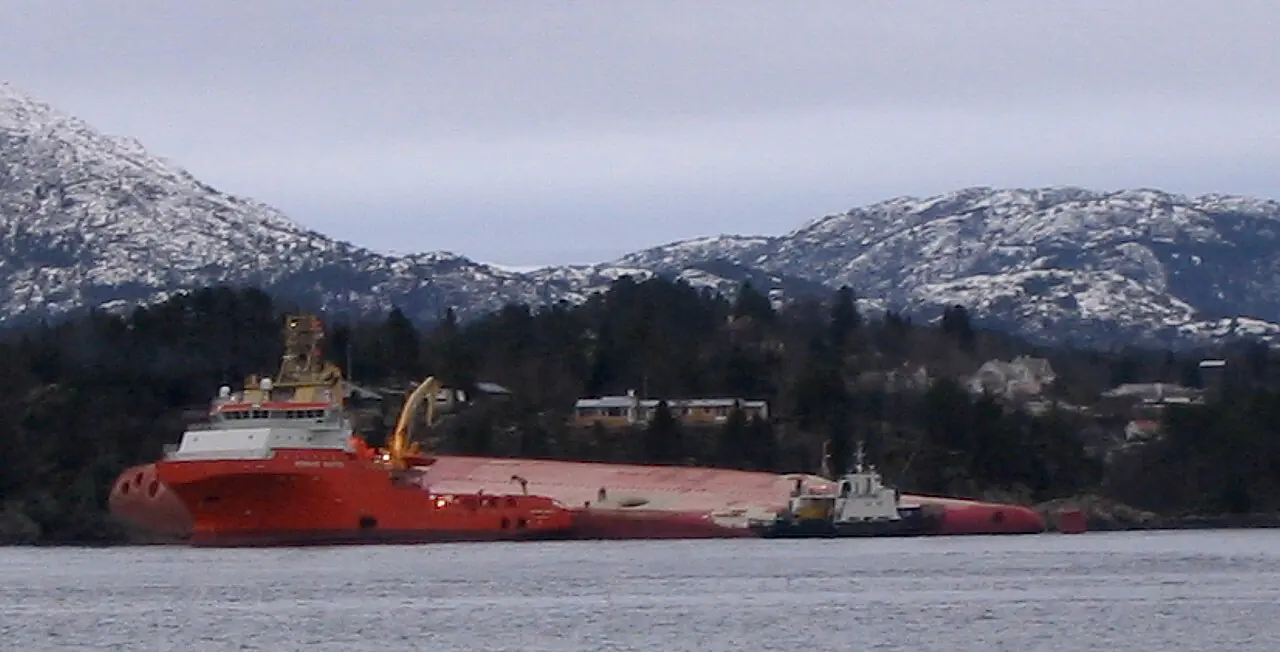
The capsizing of the MS Rocknes remains one of the most significant maritime disasters in modern Norwegian history, serving as a stark case study in the catastrophic intersection of navigational error, hydrographic inaccuracy, and fundamental stability mismanagement. On the afternoon of January 19, 2004, the vessel, carrying a heavy load of gravel, struck a submerged reef in the narrow and challenging waters of the Vatlestraumen passage. The subsequent sequence of events—comprising hull breach, asymmetric flooding, and an immediate, uncontrollable shift of cargo—led to the vessel turning keel-up in less than four minutes.
| Fact | Details |
|---|---|
| Date of Incident | January 19, 2004 |
| Time of Capsize | Approximately 16:32 - 16:36 CET |
| Vessel Name | MS Rocknes |
| Vessel Type | Fallpipe Rock-Dumping Vessel / Bulk Carrier |
| Flag State | Norway |
| Location | Vatlestraumen, off Bergen, Norway |
| Fatalities | 18 Crew Members |
| Primary Cause | Grounding on uncharted/shallow reef (Revskolten) |
| Contributing Causes | Improper loading, lack of cargo trimming, high Center of Gravity (CoG), asymmetric flooding |
| Investigating Authority | Norwegian Maritime Directorate (NMD) |
2. The Vessel and Crew Context
Vessel Specifications and Design
The MS Rocknes was a relatively young vessel at the time of the accident, having been built in 2001. It was a specialized 26,000-dwt (deadweight tonnage) bulker designed for fallpipe rock-dumping operations. These vessels are engineered to discharge heavy cargo (such as stones and gravel) through specialized chutes to precise locations on the seabed, a process critical for coastal protection and subsea infrastructure.
Due to its specialized role, the Rocknes had undergone modifications that impacted its weight distribution and stability profile. Specifically, the vessel’s lightweight had increased from an original 7,307 tonnes to approximately 8,960 tonnes following various equipment installations. This increase in lightweight, without a corresponding addition of fixed ballast, resulted in a significant vertical shift of the vessel’s Center of Gravity (CoG) from 9.66 meters to 10.91 meters. This higher CoG inherently reduced the vessel’s metacentric height (GM), making it more sensitive to external disturbances and internal shifts.
Operational Profile and Crew
The vessel was managed by The Jepsens Group of Bergen and was operating in the high-traffic, narrow coastal waters of Norway. The crew consisted of 30 members, including specialized officers and technical staff required for the complex rock-dumping operations. On the day of the accident, the vessel was under the guidance of a local pilot, a standard practice for navigating the intricate and narrow passages of the Norwegian fjords.
The operational environment of the Rocknes required high precision in both navigation and cargo management. The heavy, granular nature of its cargo (gravel and stones) demanded strict adherence to loading and trimming protocols to maintain the stability required for safe passage through narrow channels.
3. Chronological Timeline of Events
The following timeline reconstructs the final minutes of the MS Rocknes based on seismic data, bridge recordings, and official investigation findings.
- 16:23 CET: While navigating the Vatlestraumen passage, the Rocknes initiates a course change to port to enter the channel. At this stage, the vessel is at a maximum loaded draught, increasing its vulnerability to submerged obstacles.
- 16:27 CET: The vessel makes initial contact with the seabed. Seismic recordings from the University of Bergen later identified three distinct, severe impacts occurring in rapid succession. The vessel has struck the Revskolten rock on its starboard side.
- 16:28 CET: The grounding causes immediate structural damage to the hull. The impact ruptures ballast tanks and potentially the bottom plating of the cargo holds, leading to rapid water ingress on the starboard side.
- 16:29 CET: As the vessel begins to heel to starboard due to the asymmetric flooding, the un-trimmed cargo (gravel) begins to shift. The granular nature of the cargo, combined with the “voids” created during loading, allows the stones to slide toward the starboard side, following their natural angle of repose.
- 16:31 CET: The combined effect of the heavy list, the shifting cargo, and the high center of gravity renders the vessel’s stability untenable. The list becomes uncontrollable and rapid.
- 16:32 - 16:34 CET: The first distress messages are recorded by Bergen Radio. The vessel is already in a state of extreme heel.
- 16:36 CET: The MS Rocknes completes its capsize, lying keel-up in the freezing waters of the Vatlestraumen. The total time from the first impact to the vessel being overturned is estimated at approximately 3 minutes and 40 seconds.
4. Technical & Hydrodynamic Failure Analysis
The catastrophic loss of the Rocknes was not the result of a single failure, but a “perfect storm” of hydrodynamic and structural factors. The transition from a stable floating vessel to a capsized wreck occurred with a speed that shocked even experienced maritime professionals.
The Grounding and Hull Breach
The initiating event was the grounding on the Revskolten rock. The vessel was operating at a high draught, which reduced the clearance between the keel and the seabed. The impact was not a glancing blow but a series of heavy contacts that caused a significant rift in the hull (reportedly some 12 meters in length). This breach facilitated immediate, asymmetric flooding. In a vessel of this type, the ingress of water into a single side’s ballast tanks or cargo holds creates a massive heeling moment that must be countered by the vessel’s inherent stability.
Asymmetric Flooding and the Loss of GM
As water rushed into the starboard compartments, the vessel developed an immediate starboard list. For a vessel with a healthy Metacentric Height (GM), this list could potentially be managed or at least slowed. However, the Rocknes was critically compromised in two ways:
- The High Center of Gravity: The increased lightweight of the vessel had already raised the CoG, significantly reducing the available GM.
- The Free Surface Effect and Ingress: The rapid flooding created a “free surface effect,” where the moving water within the compartments further destabilized the vessel, effectively reducing the effective GM even further.
Cargo Dynamics: The Angle of Repose and Shifting
Perhaps the most critical technical failure was the management of the cargo. The Rocknes was carrying approximately 23,000 to 24,000 tonnes of gravel. Due to limitations in the loading equipment at the Eikefet terminal, the cargo was not evenly distributed. A loading belt failure or inadequacy resulted in “voids” or empty spaces along the starboard side of every cargo hold.
Because the cargo was not “trimmed” (leveled out to the boundaries of the hold), it sat at its natural angle of repose. This is the steepest angle at which a granular material remains stable without sliding. When the ship struck the rock and developed its initial starboard list, the cargo was already poised on the edge of stability. The slight tilt caused the gravel to slide into the starboard voids, creating a massive, rapid, and irreversible transverse shift of weight. This shift acted as a “dynamic heeling moment” that overwhelmed the ship’s remaining buoyancy and stability.
5. Human Factors, Bridge/Engine Management, and Organizational Issues
The MS Rocknes disaster was as much a failure of human and organizational systems as it was of physical stability. The investigation highlighted several critical points where the margin for error was razor-thin, and the response to those errors was inadequate.
The Pilot-Master Relationship
A central component of the investigation was the interaction between the local pilot, Vermund Halhjem, and the ship’s Captain, Jan Aksel Juvik. During the transit, the vessel adopted a slight starboard list, which the Captain reportedly viewed as “not unusual.” This perceived normalcy may have contributed to a lack of urgency in assessing the potential for a catastrophic shift.
When the vessel struck the rock, the pilot’s immediate reaction was to order “hard to the right.” However, the vessel was already experiencing a rapid, uncontrollable list to starboard. The discrepancy between the pilot’s navigational commands and the ship’s physical reality highlights the challenges of pilotage in extremely narrow channels where a single error can lead to immediate, irreversible consequences.
Bridge Management and the “Critical” Warning
Testimony during the maritime inquiry revealed that the crew was aware of potential stability issues before the grounding. A Dutch machinist testified that a computer screen in the control room had displayed a blinking red message stating “critical.” This warning, likely triggered by the vessel’s high center of gravity or improper cargo distribution, was a clear indicator that the ship’s stability margins were being exceeded. The failure of the bridge team to recognize this warning as a precursor to disaster represents a significant breakdown in bridge resource management.
Organizational Failures and Chart Accuracy
A major organizational issue involved the accuracy and dissemination of hydrographic data. The vessel struck the Revskolten rock, a hazard that had been identified by the National Mapping Authority (Sj?kartverket). However, there were significant weaknesses in the communication chain between the mapping agency and the Norwegian Coastal Administration, which employs the pilots.
While the information about the rock had been published in “Notice to Mariners” reports, it had not been effectively integrated into the electronic sea charts or the immediate briefings provided to pilots. This disconnect meant that the pilot was navigating with a mental model of the seabed that was dangerously outdated, leading to the fatal course decision in the narrow passage.
6. Emergency Response, Evacuation, and Search & Rescue
The speed of the Rocknes capsize—less than four minutes from impact to being overturned—left the crew with almost no time for a coordinated emergency response.
The Failure of Standard Evacuation Procedures
In most maritime emergencies, crews are trained to deploy lifeboats or Marine Evacuation Systems (MES). However, the Rocknes capsized so rapidly and at such an extreme angle that these systems were rendered useless. The overwhelming list prevented the proper launching of lifeboats, and the suddenness of the roll meant that many crew members were likely unable to reach their designated muster stations.
Challenges of the Search and Rescue (SAR) Operation
The rescue operation was conducted in the freezing, turbulent waters of the Norwegian coast, presenting extreme challenges for both divers and surface teams. Once the vessel had overturned, the search for survivors became a complex underwater operation. Divers had to navigate the dark, cramped, and unstable interior of the upturned hull, which was filled with shifting cargo and water.
The rescue of the pilot, who was famously able to climb onto the vessel’s up-ended keel and be airlifted by a helicopter, stands as one of the few successful extractions. However, for the 18 crew members who perished, the combination of the rapid capsize and the environment made survival nearly impossible. The search for the missing crew members continued for weeks, highlighting the immense difficulty of conducting SAR operations in the aftermath of a rapid, high-energy capsize event.
7. Salvage, Wreck Removal, or Environmental Impact
Following the capsize, the Rocknes remained a significant hazard to navigation and a complex salvage challenge. The vessel was eventually righted, a massive engineering feat that required careful management of the wreck’s stability to prevent further environmental damage or structural collapse.
The ship manager indicated that the vessel was sufficiently intact to be repaired, and indeed, the Rocknes was eventually returned to service. However, the incident served as a permanent reminder of the environmental risks associated with large-scale cargo losses, particularly in sensitive fjord ecosystems. The salvage and repair process focused on ensuring that the hull’s structural integrity was fully restored to withstand the stresses of its specialized rock-dumping duties.
8. Official Investigation Findings and Root Causes
The Norwegian Maritime Directorate (NMD) and the subsequent Bergen court inquiry concluded that the MS Rocknes disaster was caused by a convergence of several primary factors:
- Grounding on an Uncharted Hazard: The vessel struck the Revskolten rock due to navigational error in a narrow passage, exacerbated by inaccuracies in the effective hydrographic data available to the pilot.
- Improper Cargo Loading and Trimming: The cargo was not loaded in accordance with the vessel’s approved stability calculations, resulting in an excessively high center of gravity. Furthermore, the failure to trim the cargo (as required by SOLAS) created voids that allowed for rapid cargo shifting.
- Catastrophic Stability Failure: The combination of the grounding, asymmetric flooding, the high CoG, and the rapid shifting of the un-trimmed cargo created a sequence of events that led to a rapid, uncontrollable capsize.
The investigation explicitly noted that if the vessel had been loaded correctly and the cargo had been properly trimmed, it would likely still have suffered damage from the grounding, but the capsize would not have been as instantaneous, potentially allowing enough time for a successful evacuation.
9. Regulatory and Industry Reforms Triggered
The Rocknes tragedy had a profound impact on maritime regulations and industry practices, particularly regarding cargo stability and hydrographic safety.
- SOLAS Compliance and Cargo Trimming: The incident reinforced the critical importance of the International Convention for the Safety of Life at Sea (SOLAS) requirements, specifically Chapter VI, Part B, Regulation 7, which mandates that bulk cargoes be trimmed to minimize the risk of shifting.
- Improved Stability Management: There was a renewed focus on the accuracy of loading computers and the necessity of ensuring that the calculated GM accounts for all potential real-world conditions, including the effects of specialized equipment and vessel modifications.
- Enhanced Hydrographic Coordination: The disaster highlighted the need for better communication and integration between national mapping agencies and maritime authorities. It spurred improvements in how “Notice to Mariners” data is incorporated into electronic navigational charts (ENCs) and pilotage briefings.
- Enhanced Pilotage Training: The incident led to discussions regarding the training and responsibilities of pilots navigating increasingly complex and narrow coastal passages.
10. Key Takeaways for Modern Mariners
The MS Rocknes serves as a definitive warning for modern mariners and shore-based management:
- Stability is Dynamic: A vessel’s stability is not a static number in a booklet; it is a dynamic state that can be instantaneously compromised by cargo shifts, flooding, or even minor changes in trim.
- Respect the “Critical” Warning: Automated stability and machinery warnings must be treated with the highest level of professional urgency.
- The Danger of “Normalcy Bias”: A slight list or a minor deviation from the plan should never be dismissed as “not unusual.” In high-stakes environments, these are often the first symptoms of a pending catastrophe.
- Precision in Loading is Non-Negotiable: Proper trimming and weight distribution are not mere administrative tasks; they are fundamental requirements for the survival of the vessel.