1. Incident Overview and Key Facts
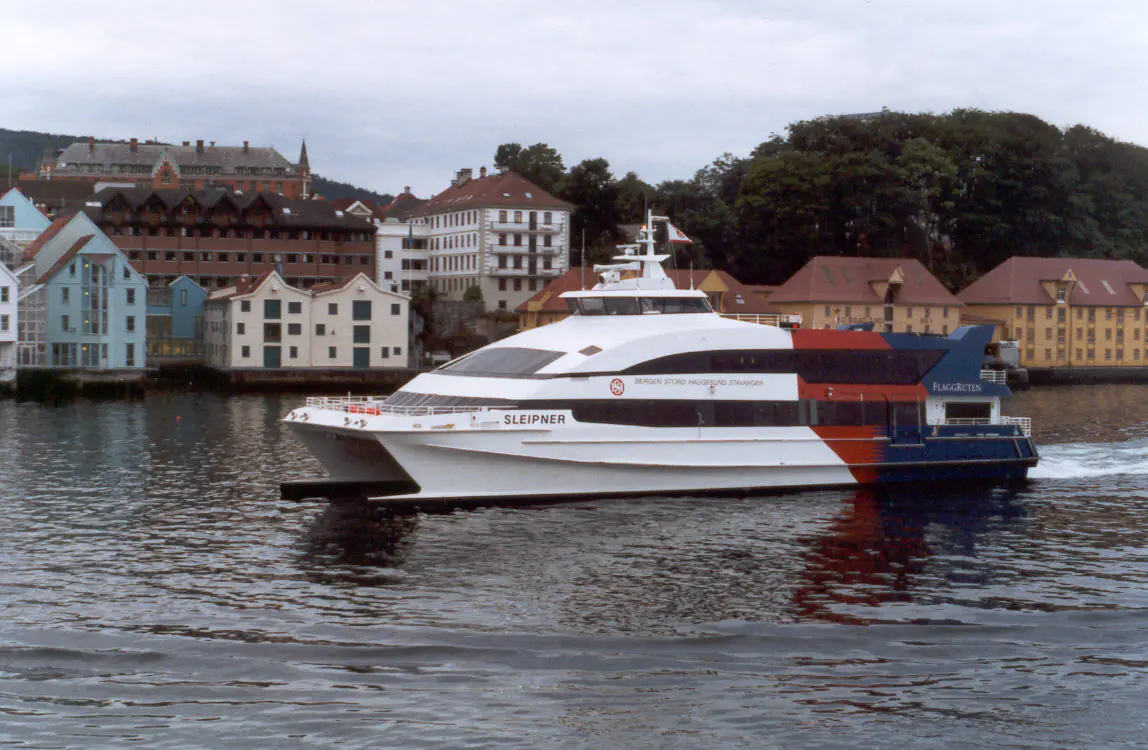
The sinking of the MS Sleipner remains one of the most significant maritime accidents in Norwegian coastal history. Occurring in the late hours of 26 November 1999, the incident involved a high-performance, high-speed craft (HSC) operating in the demanding environment of the Norwegian Sea. The vessel, a 42-meter catamaran, was performing a scheduled transit between Stavanger and Bergen when it struck the Store Bloksen rocks, a notorious hazard near the Ryvarden Lighthouse.
| Fact | Detail |
|---|---|
| Date | 26 November 1999 |
| Time of Impact | Approximately 19:08 hrs |
| Vessel Name | MS Sleipner |
| Vessel Type | High-Speed Catamaran (HSC) |
| Flag State | Norway |
| Location | Store Bloksen, Haugesund, Norway |
| Casualties | 16 |
| Survivors | 69 |
| Total Persons on Board | 85 |
| Investigating Authority | Norwegian Commission of Inquiry |
| Outcome | Vessel lost; significant loss of life due to evacuation/equipment failure |
The disaster was not merely a consequence of environmental conditions but a complex confluence of navigational errors, technical equipment failures, and systemic deficiencies in safety management and emergency response training.
2. The Vessel and Crew Context
2.1 Vessel Specifications and Design
The MS Sleipner was a cutting-edge vessel for its time, representing the pinnacle of high-speed catamaran technology in the late 1990s. Built by the renowned Australian shipbuilder Austal Ships Pty Ltd, the craft was designed for rapid passenger transit, capable of maintaining speeds in excess of 35 knots.
As a catamaran, the vessel utilized two hulls to provide a stable platform and reduce wave-making resistance. This design allowed for high speeds and a relatively shallow draft, making it ideal for coastal routes. However, the high-speed nature of the craft meant that any deviation from safe navigational practices or sudden structural compromise would occur with much greater kinetic energy than that seen in traditional displacement vessels.
2.1.1 High-Speed Hydrodynamics and Hull Design
The MS Sleipner utilized a high-speed catamaran hull design optimized for planing. At cruising speeds, the vessel’s weight is partially supported by hydrodynamic lift generated by the hulls’ geometry. This reduces the wetted surface area and significantly decreases drag, enabling the 35-knot speeds required for commercial viability on the Bergen-Stavanger route.
However, this design introduces unique stability challenges. Unlike displacement hulls, which rely primarily on static buoyancy, planing hulls are subject to dynamic forces that can fluctuate rapidly with wave frequency and amplitude. In heavy seas, the interaction between the hull’s planing surface and the oncoming waves can induce high-frequency oscillations and sudden changes in the center of pressure, demanding constant and precise helm correction. This operational reality places an increased cognitive load on the bridge team, as they must manage both the vessel’s trajectory and its dynamic stability simultaneously.
2.1.2 Structural Composition
The vessel was constructed using advanced lightweight materials to maintain a high power-to-weight ratio. While these materials provided the necessary speed, they also meant that the structural margins, while compliant with contemporary standards, were finely tuned. The impact with the Store Bloksen rocks didn’t just cause a breach; it caused a catastrophic redistribution of structural loads that the vessel’s lightweight framework was not designed to absorb during an unplanned high-energy event.
2.2 Operational Profile
At the time of the accident, MS Sleipner was in the very early stages of its operational life, having been delivered to its owners, Hardanger Sunnhordlandske Dampskipsselskap ASA (HSD), only three months prior. This period is critical in maritime operations, as it is typically when crews are still undergoing intensive familiarization with the specific nuances of a new vessel’s bridge equipment, engine room controls, and emergency systems.
The vessel was operating on a high-frequency route between Bergen and Stavanger. On the night of the incident, the weather was characterized by squalls and strong south-southwest winds, creating a challenging environment for high-speed transit.
2.3 Crew Composition and Preparedness
The crew on duty during the incident consisted of experienced maritime professionals, yet the investigation highlighted a critical gap: the lack of specific, hands-on familiarization with the MS Sleipner’s unique bridge suite. The transition from traditional vessels to highly automated, high-speed catamarans requires a shift in mental models regarding radar interpretation, chart plotting, and the management of rapid-response emergency procedures.
3. Chronological Timeline of Events
The following timeline reconstructs the events leading up to and following the grounding, based on official inquiry findings.
- 17:30 hrs: MS Sleipner departs for its northward route, bound for Bergen.
- 18:50 hrs: The vessel is navigating the coastal waters near Haugesund. Conditions are deteriorating with increasing wind speeds and wave heights.
- 19:00 - 19:05 hrs: The vessel is traveling at a high cruising speed of approximately 35 knots. The bridge team is engaged in navigation, but the combination of darkness and weather begins to impact situational awareness.
- 19:06 hrs: The vessel is approximately 400 meters off its intended course due to a navigational error.
- 19:08 hrs: The Chief Officer observes the Store Bloksen rocks directly ahead.
- 19:08:10 hrs: The Captain immediately orders full speed astern. Despite the rapid deceleration attempt, the vessel’s momentum and the proximity of the hazard make collision unavoidable.
- 19:08:30 hrs: MS Sleipner impacts the Store Bloksen rocks at high speed. The impact causes immediate, catastrophic structural damage, specifically to the forward section of the hulls.
- 19:10 hrs: The bow section of the vessel breaks off completely. A distress message is transmitted via Rogaland Radio to the Joint Rescue Coordination Centre (JRCC) in Southern Norway.
- 19:15 - 19:30 hrs: The vessel begins to take on water rapidly through the breached hulls. The main section of the craft begins to settle.
- 19:40 - 20:00 hrs: The main section of the vessel sinks. Passengers and crew are forced into the water due to the suddenness of the sinking and the failure of the primary evacuation systems.
- 20:20 hrs: The first rescue helicopter arrives on the scene, approximately 20 minutes after the vessel has submerged.
- Post-Incident: A massive Search and Rescue (SAR) operation is launched involving helicopters, coast guard vessels, and local fishing boats. 69 people are eventually rescued from the water.
4. Technical & Hydrodynamic Failure Analysis
4.1 High-Speed Impact Dynamics
The physics of the MS Sleipner’s grounding cannot be overstated. At 35 knots (approx. 65 km/h), the kinetic energy () of a 42-meter vessel is immense. When this energy is dissipated almost instantaneously against the immovable granite of the Store Bloksen rocks, the structural response is violent.
The impact resulted in a localized but extreme concentration of stress on the catamaran hulls. Unlike a single-hull vessel, where damage might be localized to one side, the collision and subsequent grounding forces acted on both hulls, potentially compromising the cross-structural members that maintain the catamaran’s integrity.
4.1.2 The Free Surface Effect and Longitudinal Stability
A critical factor in the rapid sinking of the MS Sleipner was the ‘free surface effect.’ As the bow section separated and the main hulls were breached, water began to accumulate in the large, open spaces of the catamaran’s interior. In a partially flooded vessel, this water is not stationary; it shifts in response to the vessel’s motion.
As the MS Sleipner rolled or pitched, the free surface of the water moved toward the low side, creating a shifting weight that effectively reduced the vessel’s metacentric height (GM). This reduction in GM diminishes the restoring moment that keeps a ship upright. In the case of the Sleipner, the rapid ingress of water into the wide catamaran hulls meant that the free surface effect was particularly pronounced, leading to a catastrophic loss of transverse stability that accelerated the vessel’s capsize and subsequent submersion.
4.1.3 Longitudinal Stability and Trim
The separation of the bow also caused a massive shift in the vessel’s longitudinal center of gravity (LCG). The loss of the forward weight, combined with the rapid flooding of the forward compartments of the remaining main hull, created a severe trim by the bow. This extreme trim made the vessel increasingly difficult to control and contributed to the rapid ingress of water as the bow dipped below the waterline, creating a ‘scooping’ effect that further accelerated the flooding.
5. Human Factors, Bridge Management, and Organizational Issues
5.1 The Navigational Error
The primary cause was identified as a navigational error. The vessel was approximately 400 meters off its intended course. This deviation was not the result of a single catastrophic failure but a failure in the continuous process of situational awareness.
The bridge team failed to reconcile the radar returns with the electronic charts and the physical environment. This was exacerbated by the fact that the crew was not yet fully proficient with the vessel’s specific radar and chart-plotting systems. In high-speed operations, the ‘window of opportunity’ to correct a course deviation is significantly narrower than in traditional shipping, demanding near-perfect accuracy in navigation.
5.2 Bridge Resource Management (BRM)
A critical finding was the breakdown in Bridge Resource Management (BRM). During the minutes leading up to the impact, there was a failure to effectively utilize all available information and team members to verify the vessel’s position.
The suddenness of the observation by the Chief Officer suggests that the ‘mental model’ held by the bridge team was incorrect; they believed they were in safe water when they were actually approaching a known hazard. This indicates a failure in proactive scanning and a lack of cross-verification between the radar, GPS, and manual chart plotting.
5.2 Cognitive Biases in Navigational Decision-Making
The investigation into the navigational error suggests that the bridge team may have been subject to ‘confirmation bias.’ In high-stress or high-workload environments, navigators often unconsciously seek out information that confirms their existing mental model of their position while ignoring contradictory data.
For the crew of the MS Sleipner, the mental model was that they were safely on course. Consequently, subtle discrepancies in radar returns or minor deviations in GPS data might have been dismissed as sensor noise or environmental interference rather than being recognized as signs of an actual course deviation. This ‘tunnel vision’ is a well-documented phenomenon in maritime accidents, where the focus on maintaining speed and schedule overrides the rigorous verification of position.
5.3 The Impact of High-Speed Workload
The high-speed nature of the transit significantly compressed the time available for decision-making. At 35 knots, the vessel covers nearly 18 meters per second. This high ‘velocity of error’ means that a small deviation in course translates into a large physical displacement very quickly. The psychological pressure to maintain high speeds while navigating complex coastal waters creates a high-workload environment that can degrade the quality of bridge resource management, making the crew more susceptible to the errors mentioned above.
[See more on bridge equipment in ../subsystems/marine-radar-and-arpa.md and ../subsystems/ecdis-and-electronic-charts.md]
6. Emergency Response, Evacuation, and Search & Rescue
The MS Sleipner disaster is a textbook example of how ‘compliant’ safety equipment can fail catastrophically in a real-world emergency.
6.1 Marine Evacuation System (MES) and Liferaft Failure
The vessel’s primary means of evacuation—the liferafts—failed to function as intended.
6.1.1 Engineering of Hydrostatic Release Units (HRUs)
To understand the failure of the MS Sleipner’s liferaft deployment, one must examine the engineering of the Hydrostatic Release Unit (HRU). An HRU is a critical safety component designed to automatically release a liferaft from its container when a vessel sinks to a predetermined depth (typically between 1.5 and 4 meters). This ensures that even if the crew is incapacitated or the vessel sinks too rapidly for manual deployment, the life-saving appliances are released to the surface.
The investigation revealed that the containers on the MS Sleipner were not equipped with these units. This was a fundamental oversight in the vessel’s safety provisioning. Without the automatic release mechanism, the crew was forced to rely entirely on manual deployment. In the violent, dark, and chaotic environment of the sinking MS Sleipner, the manual attempt to free the rafts from their lashings was physically impossible, rendering the liferafts useless as the vessel disappeared beneath the waves.
6.1.2 Lifejacket Buoyancy and Ergonomics
The failure of the lifejackets was not just a matter of material strength but also of ergonomic design. A lifejacket’s primary function is to keep the wearer’s airway above the water, especially when they are unconscious or incapacitated.
The investigation found that the lifejackets used on the Sleipner lacked the necessary ‘turning moment’ or buoyancy distribution to keep a head upright in heavy seas. Furthermore, the design of the fastening system—the straps and buckles—failed to account for the dynamic forces of being plunged into the water. When a wearer hits the water at speed or is tossed by waves, the sudden deceleration and the movement of the water create significant drag. Because the lifejackets were not securely fastened (due to the smooth cords and poor fit), they were easily stripped off the wearer’s body, leaving them without any buoyancy aid in the freezing Norwegian waters.
6.2 Lifejacket Deficiencies
The investigation found that the lifejackets provided on the ferry were very poor quality. Although they had been approved by British maritime authorities and accepted in Norway, they failed to meet IMO requirements.
- Buoyancy and Fit: Many passengers had great difficulty in keeping them in position. Upon entering the water, the life vests slipped off over the passengers’ head.
- Material Failure: The lifejackets were found to be prone to tearing and breaking. Their cords were smooth, which meant they could easily come undone in the motion of the waves.
- Regulatory Gap: This incident exposed a massive loophole in how ‘type-approval’ was handled across borders, where equipment that met one set of standards failed to provide the basic life-saving function required by another.
[See more on lifesaving equipment in ../subsystems/lifesaving-appliances-and-mob-boats.md]
6.3 Search and Rescue (SAR) Operations
The SAR response was a massive undertaking involving multiple agencies. While the first helicopter arrived within 20 minutes of the sinking, the initial phase of the rescue was characterized by the extreme difficulty of locating individuals in the dark, choppy waters. Many survivors faced severe hypothermia, a direct result of the prolonged exposure caused by the failure of the immediate evacuation systems.
7. Official Investigation Findings and Root Causes
The Norwegian Commission of Inquiry’s report was unambiguous in its conclusions. While the navigational error was the trigger, the disaster’s scale was driven by systemic deficiencies.
7.1 Summary of Findings
- Primary Cause: Navigational error leading to grounding.
- Systemic Root Causes:
- Inadequate Training: Failure to ensure crew proficiency with new, high-performance vessel systems.
- Equipment Failure: Non-functional/non-existent hydrostatic release units and defective lifejackets.
- Design Flaws: An evacuation layout that prioritized theoretical compliance over practical usability in emergencies.
- Command Failure: Lack of organized leadership and communication during the evacuation phase.
The investigation concluded that had the evacuation systems (lifejackets and rafts) functioned as designed, and had the crew been better prepared to manage the emergency, the loss of life could have been significantly minimized.
8.1 The Role of the Norwegian Maritime Directorate
Following the disaster, the Norwegian Maritime Directorate (NMD) faced intense scrutiny regarding the oversight and licensing of high-speed craft. The fact that a vessel could operate in conditions exceeding its safe limits—and that its life-saving equipment could pass inspection while being functionally deficient—revealed systemic gaps in the NMD’s certification processes.
This led to a paradigm shift from ‘documentary compliance’ to ‘performance-based verification.’ The NMD and other international bodies began to emphasize that safety equipment must not only meet the written specifications of a standard but must also be proven effective in the actual operational environments (sea states, temperatures, and human behaviors) for which the vessel is intended.
8.2 Impact on SOLAS and International Standards
The MS Sleipner incident contributed to a broader international dialogue regarding the implementation of the SOLAS (Safety of Life at Sea) Convention, particularly concerning High-Speed Craft (HSC) Codes. It highlighted the need for more rigorous, standardized testing of life-saving appliances (LSA) to ensure that ‘type-approval’ is a robust guarantee of safety, regardless of which national authority grants it.
8. Regulatory and Industry Reforms Triggered
The MS Sleipner tragedy served as a catalyst for sweeping changes in maritime safety, particularly concerning High-Speed Craft (HSC).
8.1 Lifejacket Standards
In the wake of the disaster, maritime regulations were overhauled to ensure lifejackets actually remained on the wearer. A new mandate was introduced requiring lifejackets to include an extra securing strap that must be passed between the legs, preventing the ‘slipping over the head’ phenomenon observed during the Sleipner incident.
8.2 HSC Operational Limits
The incident led to stricter enforcement of sea-state limitations for HSCs. The gap between the vessel’s technical limits and the actual environmental conditions encountered was highlighted, leading to more robust monitoring of weather conditions and more stringent rules for when a high-speed vessel must cease operations.
8.3 Type-Approval and EEA Regulation
The disaster exposed the dangers of ‘paper compliance.’ It led to a re-evaluation of how ‘type-approved’ equipment is verified across different jurisdictions within the European Economic Area (EEA), ensuring that type-approval in one country is rigorously vetted against the operational realities of another.
9. Key Takeaways for Modern Mariners
The MS Sleipner disaster offers several enduring lessons for the maritime industry:
10.1 The Criticality of the ‘Human-Machine Interface’
The Sleipner disaster serves as a warning about the dangers of increasing automation without corresponding increases in human training. As vessels become more technologically advanced, the ‘Human-Machine Interface’ (HMI) becomes the most critical point of failure. If the crew does not intuitively understand how to interpret the data provided by automated systems like radar and ECDIS, the technology becomes a liability rather than an asset.
10.2 The Importance of Redundancy in Safety Systems
Safety is not achieved through a single, perfect system, but through ‘defense in depth.’ The failure of the MS Sleipner was a failure of every layer of defense: the navigational layer (error), the structural layer (breach), the equipment layer (lifejackets/HRUs), and the organizational layer (leadership). Modern maritime safety must focus on ensuring that when one layer fails, the subsequent layers are robust enough to prevent a catastrophe.
- Proficiency Over Presence: Having state-of-the-art equipment is meaningless if the crew is not fully proficient in its use. Continuous, hands-on training is essential, especially during the transition to new vessel types.
- Compliance is not Safety: Safety equipment must be tested against the most extreme, real-world failure modes (e.g., heavy seas, darkness, panic), not just the theoretical conditions defined in a manual.
- Leadership in Crisis: In an emergency, the human element is the most critical component. Organized command, clear communication, and decisive leadership are what transform a chaotic situation into a managed evacuation.
- Design for Reality: Emergency systems must be designed for the ‘worst-case’ user—someone who is panicked, cold, and operating in a violent sea—not for a trained professional in calm waters.
10. Sources and Official Reports
- Norwegian Commission of Inquiry Report (NOU 2000:31): Hurtigbåten MS Sleipners forlis 26. november 1999. The definitive official record of the accident.
- PubMed / Cambridge Core: KAMEDO Report No. 77: Sinking of the MS Sleipner, 26 November 1999. Provides medical and prehospital perspectives on the casualties.
- Regjeringen.no: Official Summary of the Commission’s Findings. Summarized version of the principal conclusions and recommendations.
- MarineLink: Official statements regarding the vessel’s licensing and operational limits.