1. Incident Overview and Key Facts
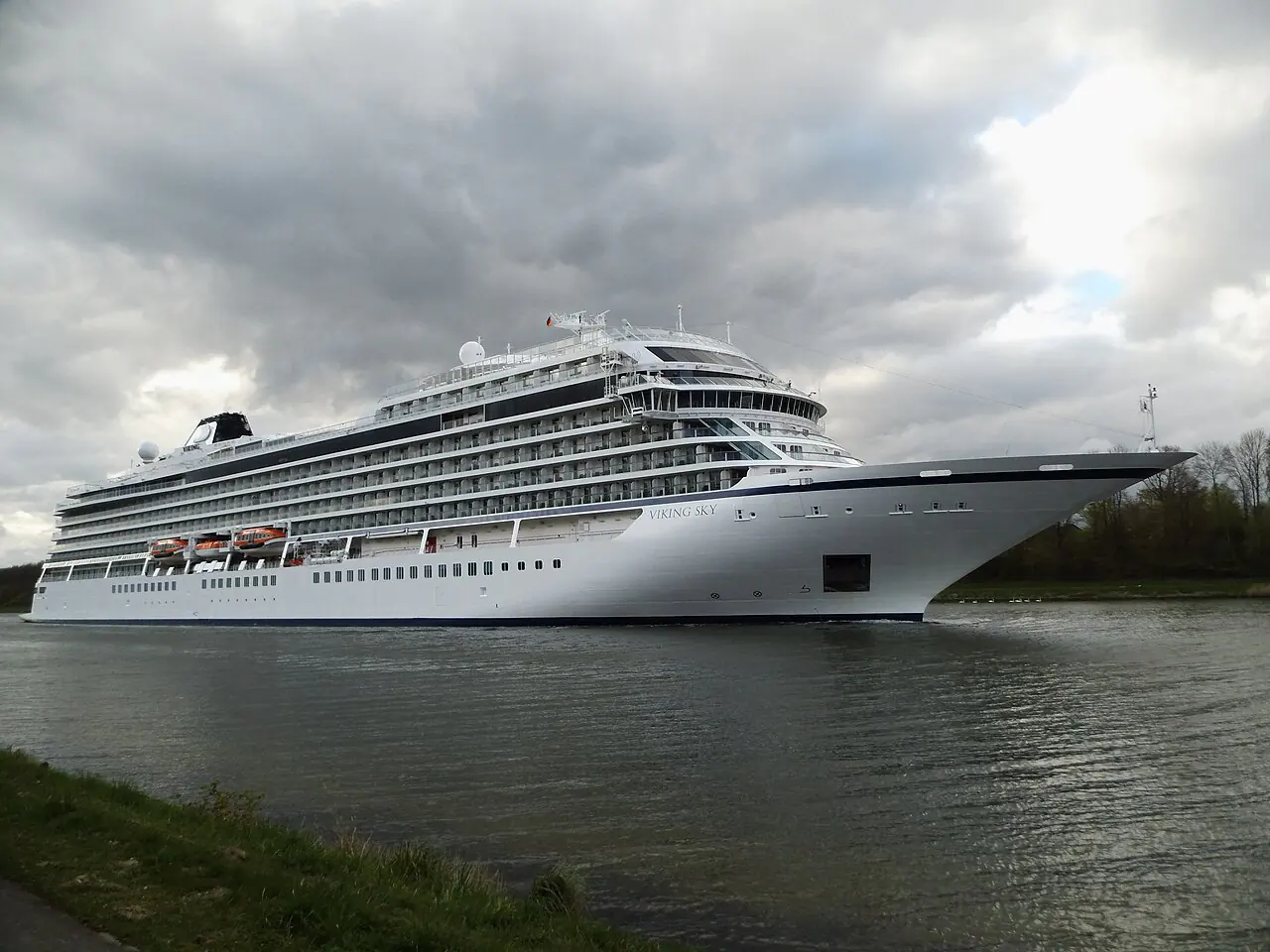
The Viking Sky incident of March 23, 2019, stands as one of the most significant “near-miss” events in the history of modern cruise ship operations. What began as a standard transit through the challenging waters of the Norwegian coast escalated into a life-threatening crisis when a total blackout stripped the vessel of its primary means of control: propulsion and steering.
The vessel drifted dangerously close to the jagged, rocky coastline of Hustadvika, a situation that could have easily developed into one of the most devastating maritime disasters of the 21st century. While the ship ultimately avoided grounding, the incident exposed critical vulnerabilities in the design of auxiliary systems, the adequacy of emergency training, and the management of operational risks under international safety regulations.
| Fact | Details |
|---|---|
| Date of Incident | 23 March 2019 |
| Vessel Name | Viking Sky |
| IMO Number | 9650420 |
| Vessel Type | Cruise Ship |
| Flag State | Norway |
| Port of Registry | Bergen, Norway |
| Location | Hustadvika, Norway |
| Casualties (Fatalities) | 0 |
| Persons on Board | ~1,374 |
| Outcome | Near-grounding; Emergency Anchoring; Massive Helicopter Evacuation |
| Investigating Authority | Norwegian Safety Investigation Authority (NSIA) |
2. The Vessel and Crew Context
The Viking Sky is a high-specification cruise ship built by the renowned Italian shipyard Fincantieri. Entering service in 2017, it was designed to provide a luxury experience for passengers traversing the Norwegian fjords and other scenic coastal regions.
Technical Specifications and Power Plant
The ship’s technical architecture is centered around a highly efficient diesel-electric propulsion system, which allows for precise control of the vessel’s movement.
- Length Overall (LOA): 228.2 meters
- Beam: 28.8 meters
- Gross Tonnage (GT): 47,842
- Net Tonnage (NT): 18,858
- Ice Class: 1C (designed for navigation in light ice conditions)
- Propulsion System: Diesel-electric, utilizing two electric propulsion motors on separate shafts.
- Main Power Generation: The electrical load is met by four large MAN diesel generators:
- 2 × MAN 9L32/44CR (5,040 kW each)
- 2 × MAN 12V32/44CR (6,720 kW each)
- Total Installed Capacity: Approximately 23,540 kW.
Operational Status and Redundancy
Crucially, at the time of the incident, the vessel’s safety margins were reduced. One of the four diesel generators was non-operational due to a defective turbocharger. While the ship was still capable of maintaining propulsion under normal conditions, this loss of redundancy meant the vessel was operating in a state that did not fully comply with the intent of the Safe Return to Port (SRtP) regulations. The SRtP mandate requires that a vessel must be able to maintain essential services—including propulsion, steering, and power—even following a single-failure event. By sailing with a disabled generator into a period of forecasted severe weather, the vessel was effectively operating without the required safety buffer.
Crew and Passengers
The vessel was carrying approximately 1,374 persons, including roughly 930 passengers and 444 crew members. The crew consisted of highly trained professionals, but as the investigation would later prove, their training had not prepared them for the specific, high-stress combination of a total blackout and the loss of redundancy.
3. Chronological Timeline of Events
The escalation from a routine voyage to an emergency evacuation was driven by a rapid sequence of environmental and technical failures.
Phase I: The Onset of Severe Weather (21–23 March 2019)
- 21 March 2019: Viking Sky departs Tromsø, Norway. The vessel is already operating with one generator unavailable.
- 22-23 March 2019: The vessel enters the Hustadvika region, encountering severe storm conditions. The sea state causes intense and sustained pitching and rolling, subjecting the vessel to extreme dynamic inclinations.
Phase II: The Blackout (Approx. 15:00 local time)
- Lube Oil Failure: The extreme motion of the ship causes the lubricating oil in the sump tanks of the operating diesel generators to shift violently. This “sloshing” effect is a direct consequence of the free surface effect in the tanks.
- Suction Loss: As the oil shifts, the level around the suction inlets drops. The generators ingest air instead of oil, causing an immediate and catastrophic drop in lubricating oil pressure.
- Automatic Shutdown: To prevent total engine seizure, the protective systems on all three operating diesel generators trigger an automatic shutdown.
- Total Blackout: The loss of all diesel generators results in a total loss of electrical power, propulsion, and steering.
Phase III: The Crisis and Recovery (The 39-Minute Window)
- The Drift: Without propulsion or steering, the Viking Sky becomes a “dead ship,” drifting toward the rocky coastline of Hustadvika.
- The Alarm Storm: The bridge and engine room are immediately flooded with a massive surge of alarms. The crew is forced to navigate through an “alarm storm” of over 1,000 notifications, many of which are non-critical, which severely hampers their ability to diagnose and react to the primary failure.
- Recovery Efforts: The engineering team attempts to restart the generators. However, the recovery is significantly delayed by the complexity of the marine switchboards and power management systems (PMS) and the crew’s lack of experience with a “total blackout” recovery in a ship without a standby generator.
- Emergency Anchoring: To prevent the ship from running aground during the recovery, the bridge team orders the deployment of the emergency anchors. The anchors successfully catch, slowing the drift and preventing contact with the seabed.
Phase IV: The Evacuation
- Decision to Evacuate: Given the continued risk and the precariousness of the vessel’s position, the command is given to evacuate all passengers and crew.
- Search and Rescue (SAR) Operation: A massive, multi-agency helicopter evacuation is launched. Despite the high winds and extreme sea states, the evacuation is completed without loss of life.
4. Technical & Hydrodynamic Failure Analysis
The Viking Sky incident was a convergence of mechanical design flaws and extreme hydrodynamic forcing.
Lubricating Oil Sump Design and SOLAS Non-Compliance
The primary technical failure was the inability of the diesel generators to maintain lubrication during the ship’s extreme motion. The engine-room auxiliary systems rely on a constant, pressurized supply of oil from the sump tanks.
The NSIA investigation revealed that the design of these lube oil sump tanks was fundamentally flawed. The tanks were not designed to ensure that the oil would remain over the suction inlets during the extreme pitching and rolling experienced in a storm. Specifically:
- Violation of SOLAS II-1: The design did not comply with SOLAS II-1, Part C, Regulation 26.6, which requires that essential machinery must be able to operate safely under the dynamic inclinations expected in normal service.
- Suction Exposure: During heavy rolls, the oil shifted to the side of the tank, leaving the suction pipe exposed to air. This caused the generators to trip on low oil pressure.
Power Management Complexity
The recovery from the blackout was significantly hampered by the complexity of the marine switchboards and power management systems (PMS). The process of restarting the generators and re-synchronizing them with the ship’s electrical grid required a highly specific and complex sequence of actions. The delay in this process—totaling 39 minutes—was a critical factor in the duration of the drift.
Hydrodynamic Forcing and the Free Surface Effect
The environmental conditions provided the energy required to drive these failures. The high-amplitude rolling and pitching of the vessel caused a significant free surface effect within the lube oil tanks. As the ship tilted, the liquid oil moved to the “low” side of the tank, leaving the suction pipe in an air pocket. This effectively “emptied” the suction area even if the total volume of oil in the tank was technically sufficient for steady operation.
5. Human Factors, Bridge/Engine Management, and Organizational Issues
The technical failures were significantly magnified by human and organizational shortcomings.
Alarm Overload and Cognitive Load
One of the most critical findings was the phenomenon of “alarm overload.” During the blackout, the crew was hit by a massive surge of alarms, with up to 1,000 sounding within 10 seconds.
- Lack of Prioritization: The system failed to distinguish between life-safety critical alarms and non-critical operational alarms (such as swimming pool temperature).
- Cognitive Overload: This deluge of information overwhelmed the cognitive capacity of the bridge and engine room teams, making it nearly impossible to effectively triage the situation and execute the required recovery sequence.
Training and Drill Deficiencies
The investigation highlighted a significant gap in the crew’s emergency training. While standard blackout drills were conducted, the crew had never practiced a recovery from a total blackout in a scenario where no standby generator was available. This lack of “worst-case” training meant the crew was not prepared for the specific technical and psychological challenges they faced.
Organizational Failures and SRtP Compliance
The failure was not limited to the crew; it was an organizational failure of Viking Ocean Cruises’ shore-based management.
- SRtP Negligence: The decision to allow the vessel to depart Tromsø with a disabled generator was a direct violation of the spirit, if not the letter, of the Safe Return to Port (SRtP) regulations.
- Risk Management Failure: The management failed to ensure that the vessel’s reduced redundancy was accounted for in the risk assessment for the forecasted storm.
6. Emergency Response, Evacuation, and Search & Rescue
The successful outcome of the incident—zero fatalities—is a testament to the effectiveness of the emergency response once the situation stabilized.
Emergency Anchoring
The decision to deploy the emergency anchors was a critical factor in preventing a grounding. By utilizing anchoring physics, the bridge team was able to arrest the vessel’s drift, providing the necessary time for the engineers to work on power restoration and for the evacuation to be organized.
Helicopter Evacuation
The evacuation was a massive logistical challenge, conducted under extremely hazardous conditions.
- SAR Coordination: The coordination between the vessel, the Norwegian Coast Guard, and civilian SAR helicopter operators was highly effective.
- Lifesaving Operations: Despite the high winds, the use of lifesaving appliances and organized muster procedures ensured that the 1,374 persons on board were successfully transferred to safety.
7. Official Investigation Findings and Root Causes
The NSIA concluded that the Viking Sky incident was a preventable disaster. The root causes were categorized into three main pillars:
- Technical Design Failure: The lube oil sump tank design was non-compliant with SOLAS and failed to account for the vessel’s dynamic motion.
- Operational/Training Failure: The crew’s inability to manage a high-stress, complex blackout recovery was due to a lack of specific, high-fidelity training for “worst-case” scenarios.
- Organizational/Management Failure: Shore-based management failed to enforce the Safe Return to Port (SRtP) requirements, allowing a vessel with compromised redundancy to sail into a storm.
8. Regulatory and Industry Reforms Triggered
The Viking Sky incident has become a catalyst for several key maritime safety reforms.
IMO and SOLAS Improvements
The NSIA issued 14 safety recommendations, many of which target the International Maritime Organization (IMO) to:
- Standardize Alarm Management: Develop an engineroom alarm management performance standard to prevent alarm overload and ensure critical alarms are prioritized.
- Refine Lube Oil Tank Standards: Update SOLAS and Class requirements to ensure that lube oil tanks are designed to maintain suction under all foreseeable dynamic inclinations.
Safe Return to Port (SRtP) Enforcement
The incident has led to increased scrutiny of how SRtP regulations are implemented and audited. There is now a greater emphasis on ensuring that “single-failure” redundancy is not just a theoretical design feature but a strictly enforced operational reality.
9. Key Takeaways for Modern Mariners
- Redundancy is Non-Negotiable: A vessel is only as safe as its least redundant system. Operating with known equipment failures in adverse weather is a violation of fundamental safety principles.
- Training Must Be Realistic: Drills must move beyond the routine and encompass the most extreme, “worst-case” combinations of failures.
- Manage the Alarm Environment: Alarm management is a critical component of bridge and engine room resource management. An unmanageable alarm system is a major safety hazard.
- Design for the Real World: Engineers must ensure that auxiliary systems are resilient to the actual hydrodynamic forces and motions the vessel will encounter in service.
10. Sources and Official Reports
- Norwegian Safety Investigation Authority (NSIA): Report on loss of propulsion and near grounding of Viking Sky, Hustadvika, Norway 23 March 2019
- Nautilus International: Viking Sky near-grounding report: multiple recommendations after disaster was narrowly averted
- VesselTracker: Viking Sky - Passenger ship technical details
- Wikipedia: MV Viking Sky - Historical and technical overview